Pillar: Documents and contract
Can you look up a cadastral reference by ID or name?
On this page
Not in the Catastro's public search. Only the owner, someone with the owner's written consent and the cases in article 53 of the Cadastre Law (TRLCI) get access: heirs, holders of rights over the property, adjoining owners, notaries and a few others. The owner's name, tax ID and address and the cadastral value are protected data (art. 51). Owners can see all their own properties on the Catastro's e-office, under "Mis inmuebles", signing in with Cl@ve, an electronic certificate or a Spanish electronic ID card.
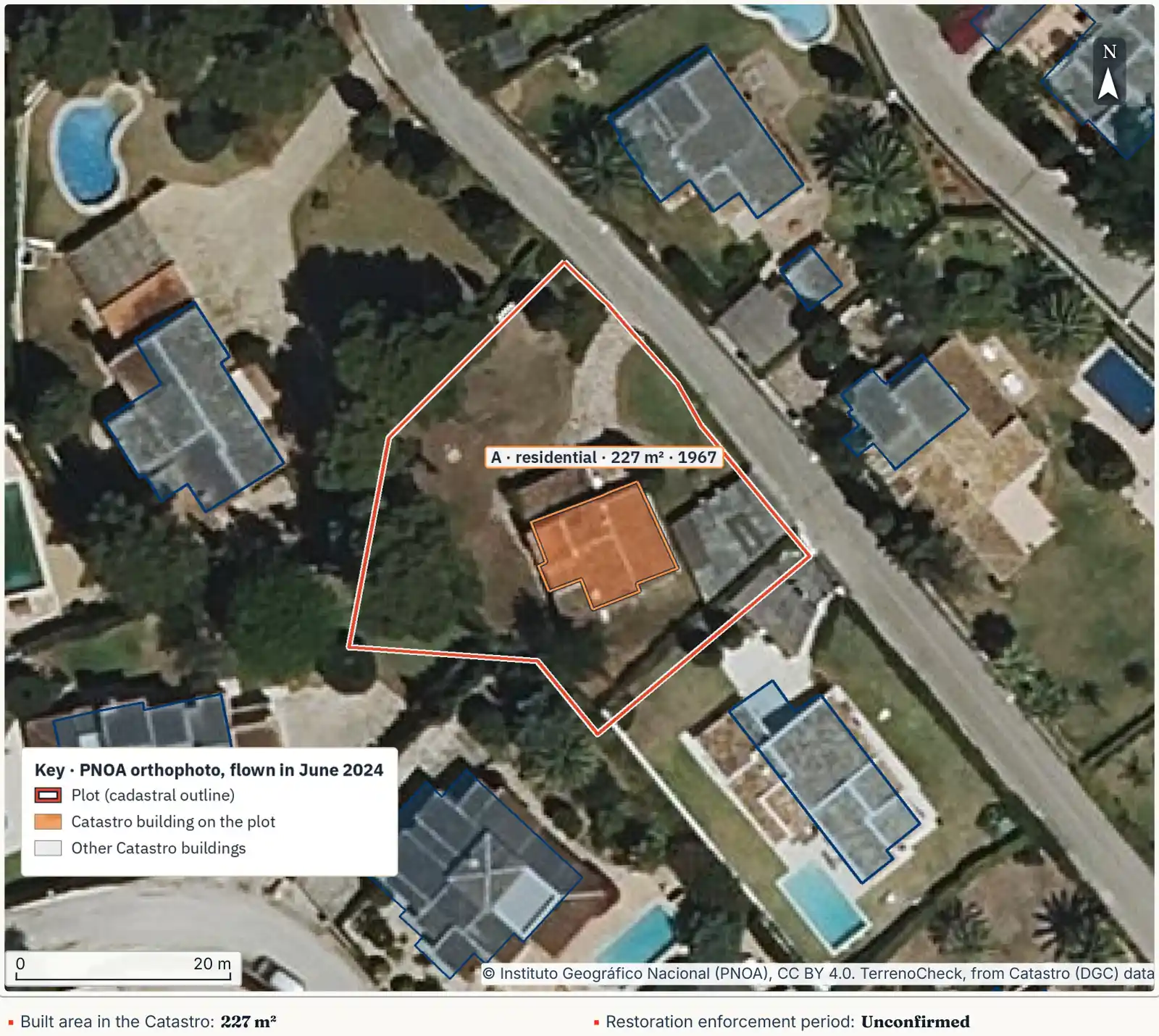

The Catastro (Spain's property survey and tax register) does offer a search by ID number, but it only returns the properties of the person who signs in. If you are a buyer, a neighbour or a creditor searching without signing in or an authorisation, it shows you the plot and its physical data, not the owner's name or the cadastral value. With the owner's written consent, or in one of the cases in art. 53, you can get more: see "Who can see protected data" below.
This guide covers all of Spain except the Basque Country and Navarre, whose cadastres are run by the provincial councils and the Government of Navarre on their own websites.
Protected and unprotected data
Article 51 of the Cadastre Law (the consolidated text known as TRLCI) gives a closed list of protected data. Everything else is open: the e-office shows it without any sign-in.
| Item | Can anyone see it? | Rule |
|---|---|---|
| Location and cadastral reference | Yes | Catastro FAQs |
| Area, use, type of crop | Yes | Catastro FAQs |
| Building quality and mapping | Yes | Catastro FAQs |
| Owner's name, surname or company name | No: protected | TRLCI, art. 51 |
| Owner's tax ID (NIF or NIE) and address | No: protected | TRLCI, art. 51 |
| Cadastral value, of the land and of the building | No: protected | TRLCI, art. 51 |
Protected data as listed in TRLCI art. 51; the open data as listed in the Catastro's FAQ page. Sources: TRLCI, art. 51 (BOE); Catastro, FAQs. Accessed 12 November 2026.
So the public search runs the other way round from what many people expect: from an address or a map to a reference, not from a person to their property. To find a flat from its street address, see the guide on finding the cadastral reference by address; for a rural plot, the one on polygon and parcel numbers.
Who can see protected data
Under art. 52.1 everyone may see the data of the properties they own. For another person's protected data, art. 53.1 requires that person's express, specific written consent, unless a law waives consent or the request falls under one of the cases of legitimate and direct interest it lists.
Art. 53.1 lists five such cases: research projects by universities or research centres that the Ministry of Finance rates as relevant; notaries and land registrars identifying properties; cadastral owners identifying the adjoining plots, except their cadastral value; holders of rights in rem, tenants and sharecroppers, for that property; and heirs and successors, for the deceased's property.
Art. 53.2 adds bodies that need no consent: public authorities and the Tax Agency, within the limits of their powers and proportionality, parliamentary inquiry committees, the Ombudsman, the Court of Audit, judges, courts and public prosecutors. A private buyer is not on that list.
How owners see all their property
- Sign in to the Catastro e-office (sedecatastro.gob.es). Who: the owner. Options: an electronic certificate or Spanish e-ID card, Cl@ve PIN or Cl@ve permanente (the state's online identity system), or the "clave concertada", which the Sede describes as your DNI, its card support number and the cadastral reference of a property you own. It is a separate sign-in, not Cl@ve PIN. Cost: €0. Time: as long as signing in takes.
- Go to Mi Catastro, Inmuebles, "Búsqueda por NIF/NIE". Where: the "Mis inmuebles" menu. You see the properties under your tax number, with co-owners and cadastral values. Cost: €0. Time: immediate.
- Download the certificate. A list certificate ("certificado literal") of all your properties, or a certificate with plan ("descriptivo y gráfico") for each. Obtained directly online, it carries no fee (TRLCI, art. 62.2). Time: immediate.
- Without an electronic ID, write to a local Catastro office ("Gerencia") whose area covers one of your properties; the e-office lets you book an appointment. Cost: the certification fee. Time: the certificates page gives no deadline.
The Sede describes the clave concertada with a DNI, the ID card of Spanish nationals. If you hold only an NIE (the foreigner's tax number), the other routes on that page are an electronic certificate or Cl@ve if you have one, a letter to a local office, or a person you authorise. Catastro information is also available at Cadastral Information Points (PIC), offices authorised by the Directorate General in public bodies, listed by province on the e-office.
What a certificate costs off-line
The fee applies when the Directorate General or a local office issues the certificate at your request (art. 62.1). The Catastro's published rates, in force in November 2026, are €17.97 per certificate with plan for one urban unit or rural plot, and €4.52 per document plus €4.52 per property for a list certificate. If it includes data more than five years old, €45.28 is added per document. If a certificate with plan includes, at your request, data on other properties such as the neighbouring plots, €4.52 is added for each one. Certificates stating that no property exists ("negativas") are free.
A non-resident owner without Spanish e-ID
Tom lives in Bristol and owns a flat, a parking space and a storeroom in Málaga, all urban. He has no Cl@ve or certificate, so he writes to the Málaga office. Without data on other properties or older than five years, a list certificate of the three costs 4.52 + 3 × 4.52 = €18.08; three certificates with plan, 3 × 17.97 = €53.91. If he later obtains an electronic certificate and downloads the same documents himself on the e-office, he pays €0.
If you are not the owner
A buyer does not need the cadastral owner's name to check the plot. An address, the map or coordinates give the reference, area, use and sketch. Who can actually sell is shown by the Land Registry (Registro de la Propiedad); the guide to the cadastral reference explains what each one proves.
If you do need protected data, the lawful route is to ask the owner. The Catastro publishes an authorisation form the owner signs so that another person can request and see the protected data of their properties; it does not give access to case files. With it, the authorised person applies on the e-office or at a local office. When buying through an agent or lawyer, ask the seller to sign it early.
Someone who already owns a plot can identify the owners of the adjoining plots, but not their cadastral value (art. 53.1.c). That helps, for example, when you need to talk to the neighbour about a boundary.
Heirs: a relative's property
Heirs and successors may see the protected data of the deceased's properties recorded in the Catastro (art. 53.1.e). The e-office assistant lets an heir, or their representative, request a list certificate of the deceased's properties, a certificate with plan for each, or a certificate stating that no property is recorded.
The Catastro does not tell you which properties were registered in the Land Registry. For that there is the nota de localización (property index search) from the Spanish Association of Registrars.
How much the e-office is used
From January to October 2026 the e-office logged 129.7 million sessions. Lookups including protected data, those made by registered users and by owners about their own property, numbered 37.8 million, against 507.5 million without protected data: about 7 in every 100 lookups.
If a property is missing or under the wrong name
Owners must declare additions, removals and changes to their property (TRLCI, art. 13.2). The deadline is two months from the day after the deed or other event being declared. There is no need to declare if a notary or land registrar reported the transaction, which requires the cadastral reference to have been given in the deed (art. 14.1.a), or if the previous owner asked to be removed within the deadline. If after a purchase the property still shows the seller, the e-office "Trámites" section offers the change declaration (form 900D), the request to remove a cadastral owner and letters on discrepancies with the cadastral description.
Where the Land Registry entry carries the cadastral reference and the owners differ, the Catastro takes the Registry's owner, unless the document that brought the change into the Catastro is later than the registered title (art. 9.4).
What the lookup does not prove
The cadastral owner is not necessarily the legal owner. The cadastral owner is whoever holds ownership, an administrative concession, a surface right or a usufruct (art. 9.1). Cadastral data are presumed accurate unless proven otherwise, without prejudice to the Land Registry, whose legal entries prevail (art. 3.3). Seeing a property under "Mis inmuebles" does not show that you, or a seller, can sell it.
Before asking for someone else's data
- You have the address, the map or the polygon and parcel numbers: that is enough for the reference.
- You know whether you fit a case in art. 53.1 (heir, right over the property, adjoining owner).
- If not, you have the owner's written authorisation on the Catastro's form.
- For ownership that counts in a purchase, you have ordered a nota simple (Land Registry extract).
If you already have the plot's reference, you can order the report with it and compare what is built with what the Catastro records before you order the nota simple.
Common questions
Can I find out who owns a house from its cadastral reference?
Not through the Catastro's public lookup: the owner's name and tax ID are protected data (TRLCI, art. 51). You can request them with the owner's written consent or if you fit art. 53.1, for example as an heir, as the holder of a right over the house or as the owner of an adjoining plot (in that case without the cadastral value). The registered owner appears in the nota simple from the Land Registry, which you order by showing a legitimate interest.
Can I see my late father's property in Spain?
Yes, as an heir or successor (TRLCI, art. 53.1.e): the e-office assistant lets you request a list certificate of his properties, a certificate with plan for each, or a certificate stating that no property is recorded. Properties registered in the Land Registry are traced with a nota de localización.
Is it free to look at my own property?
Yes, if you look it up or download it yourself on the e-office: anything obtained directly online is not subject to the fee (art. 62.2). At a local office, a certificate with plan costs €17.97 per document, the rate in force in November 2026.
What if I have no Spanish e-ID or Cl@ve?
You can use the clave concertada if you hold a DNI (DNI, support number and the cadastral reference of one of your properties), write to a local Catastro office where you own property, or authorise another person on the Catastro's authorisation form.
Why does a property I have just bought not appear?
If the deed gave the cadastral reference, the notary or registrar reports the purchase and you do not have to declare it; the report may simply not have been processed yet. If the deed did not give the reference, that report does not cover you: file the change declaration (form 900D) within two months from the day after the deed. For wrong data about the property itself, use a letter on discrepancies.
Keep reading
Check this on your own plot
Pin the plot on the map and confirm the cadastral reference: the report gathers the public data and official maps for it, each with its source and date. It does not replace the land registry extract, the notary or a tax adviser. €29 VAT included.