Pillar: Hazards and constraints
Must I clear my plot in Spain, and what fines apply?
On this page
In Catalonia, Ley 5/2003 requires measures for developments, settlements, buildings and installations on forest land or within five hundred metres of it. These include an external strip at least twenty-five metres wide and maintenance inside and along access routes. Penalties depend on the offence and reach €100,000. Check the municipal plan; other regions have different rules.
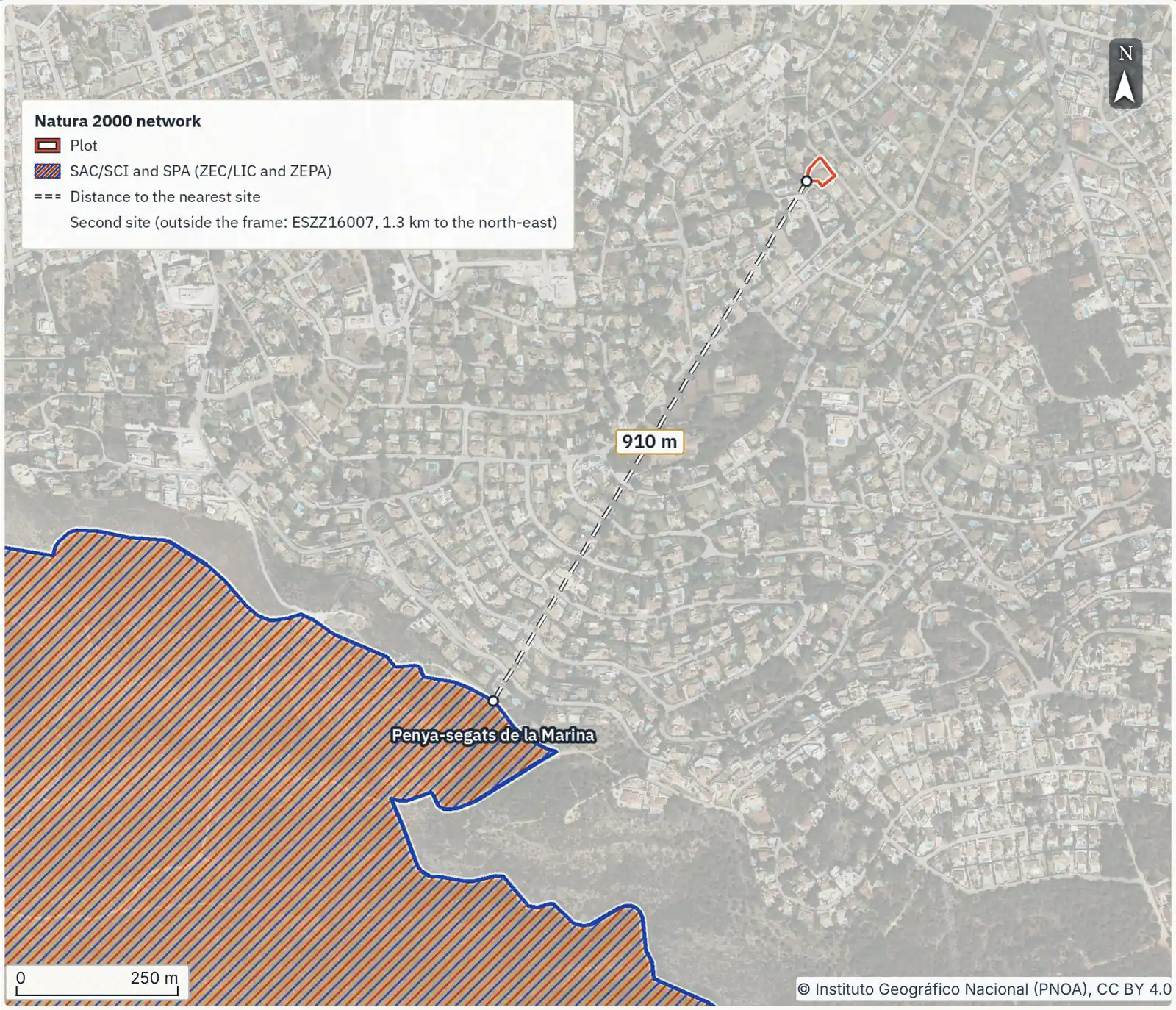

Ask the town hall for the applicable plan and conditions before ordering clearance. Spain's national conservation duties do not set one fire-prevention width for every property. This guide examines Catalonia's regime; a purchase elsewhere needs the corresponding regional rules and local ordinance.
Start with the plan for your property
National Land Law article 15 includes duties to conserve land, installations and buildings in the legally required conditions of safety and health, among others. The detailed clearance specification needs the local rules and the delimitation of the affected area. If you also plan to fell trees or change the use of forest land, see the guide to felling and change of use on forest land.
In Catalonia, Ley 5/2003 article 2 requires the municipality to identify affected elements through a delimitation plan, “plànol de delimitació”. Request the plan for the property's address and cadastral reference and ask whether there is a detailed protection-strip project. A circle you draw on a mapping application is not a substitute.
If you are buying on an “urbanización”, ask who maintains the external strip and roads. A community payment receipt does not establish which works have been done. Request the plan and available maintenance records, particularly if you will manage the property from abroad.
What the Catalan regime requires
Article 3 requires an external strip at least twenty-five metres wide, free of dry vegetation and with tree cover thinned according to the regulatory conditions. Internal plots and green areas must be kept in the same conditions. Private internal and access roads, including their ditches, must be free of dry vegetation.
The law also addresses self-protection planning and hydrants. A clearance contract therefore covers only part of a development's preventive obligations. Ask its management body to identify the responsible person and supporting record for each element.
Article 5 permits greater width or altered characteristics at the competent authority's request where justified by a forestry technical report. Twenty-five metres is not a maximum, and the duty is not permission to cut every tree. Confirm the specified treatment and any other required authorisations before work begins.
| Element | Statutory requirement | What to obtain first |
|---|---|---|
| External strip | At least 25 m, no dry vegetation, thinned tree cover | Delimitation and technical treatment specification |
| Internal plots and green areas | Equivalent maintenance conditions | Schedule of included areas |
| Private roads and ditches | Clearance of dry vegetation | Ownership and maintenance responsibility |
| Affected development or element | Applicable self-protection and hydrant measures | Plan and review documentation |
This is the scope of Catalan Ley 5/2003. Technical characteristics are developed in regulations; obtain the applicable municipal plan and project before commissioning work. Source: Ley 5/2003, articles 1–5. Accessed 13 November 2026.
A local document: Puig-reig
The publicly available explanatory document for Puig-reig's delimitation plan is dated July 2024. Section 3.2 describes twenty-five-metre strips and thirty metres for buildings constructed from 2014. For settlements with an earlier detailed project, it incorporates that project's strip.
The document says that the working mapping in SITMUN has restricted access. We use the public report as a documentary example without claiming access to that viewer or reproducing its map. For a particular purchase, ask the municipality for the approved plan, version and applicable project. The report alone does not establish today's obligation for your property.
Who must arrange the work
Article 4 assigns the obligations to the owners' community or collaborating urban-management entity. If neither has been constituted, the owners of the development's plots are jointly and severally responsible. For isolated buildings and installations, the respective owners must comply.
Where the specified strip, internal-plot and road clearance has not been done, the law provides for municipal intervention. The municipality may establish a charge under local-finance rules. The availability of municipal action does not mean that the service is free.
If a development lacks a management body, ask your solicitor how the duties and costs will be organised before buying. An unadopted development may also have separate infrastructure and maintenance issues. Do not assume that resolving one service bill settles fire-prevention responsibility.
Where the strip crosses someone else's land
Article 6 creates an access easement for necessary clearance on protection-strip land outside the development's ownership. Access must last only as long as necessary and use the least harmful or inconvenient point, subject to the provision's terms.
It also provides compensation payable by the obligated parties for the affected part of the servient land and damage caused by passage. Do not enter a neighbouring property merely because an approximate measurement puts the strip there. Establish the delimitation, access arrangements and any municipal intervention first.
The ordinary right-of-way guide concerns access to a property. This particular prevention easement has its own purpose; it is not a general right to use a neighbour's land for other activities.
Penalty amounts in Catalonia
Article 11 provides up to €600 for minor offences, €601–€10,000 for serious offences and €10,001–€100,000 for very serious offences. These are the bands in this Catalan law consulted in November 2026. They are not clearance prices or automatic charges per square metre.
Article 9 distinguishes a strip narrower than twenty-five metres as serious from the absence of a strip in the conditions it describes as very serious. Failure to maintain undeveloped plots in the specified condition during maximum fire-risk periods is also classified as very serious. The facts and proceedings need examination before predicting the classification.
A decision can impose corrective measures and compensation as well as a financial penalty. Article 10 addresses responsibility, including owners' joint and several liability where the relevant management bodies are absent or insolvent. Establish the obligated party and alleged conduct before estimating the financial exposure.
Article 14 separately allows coercive fines for failure to comply with obligations arising from a notice issued under this law: up to three consecutive fines, each no more than €2,000. These are a means of securing compliance, rather than an automatic surcharge on every penalty. Have your adviser identify which kind of decision each notice contains.
Commission a specification you can verify
Give the contractor the plan and technical requirements. Ask for the area, vegetation treatment, removal of residues, access and permissions included in the price. A quote saying only “plot clearance” may not establish whether it covers the perimeter, internal land or both.
Agree photographs and a work schedule to document completion. If a municipal notice exists, provide it and ask for confirmation that the proposed scope addresses its requirements. A contractor should not decide informally that a deadline or environmental restriction no longer applies.
Check the price and operating dates
The transitional provision of Ley 5/2003 gives the obligated parties six months from approval of the article 2 delimitation plan to carry out the law’s duties. During that period, article 2 of Decreto 64/1995 applies. Ask the municipality for the approval date and how that regime applies to this property. The period does not start again on purchase or with each year’s maintenance.
Municipal charges must be checked against the local ordinance, while private work needs a quotation for the actual vegetation and access. This guide gives no official national price per hectare. Nor does it offer one annual clearance date for every municipality: confirm the current calendar, operating restrictions and residue requirements before machinery is used.
For owners living abroad, identify someone who can check the finished work against the specification. Ask for photographs that show the included perimeter and access, rather than just a tidy view from the terrace. Keep the plan, quote and completion evidence together for future maintenance.
A tidy garden with an unchecked perimeter
A buyer in Sweden visits a plot with a well-kept garden. The community cannot supply records for the external strip, and private roadside ditches contain dry vegetation. Before accepting that prevention is complete, he requests the plan and maintenance responsibility for each area. Ordering another garden clearance would not answer those outstanding questions.
What to do, in order
- Request the plan from the town hall. Identify the property and affected element. Ask about access time and any charge; Ley 5/2003 sets no single delivery period for this enquiry.
- Identify the responsible party. Community, management entity or owner under article 4. Request management and maintenance records before committing expenditure and agree when they will be supplied.
- Confirm treatment and operating dates. Ask the municipality and professional for the plan approval date and application of the six-month transitional period from approval, with article 2 Decreto 64/1995 applying during that period. Also check operating restrictions and the actual notice deadline; purchase does not restart the six months.
- Contract by defined scope. Obtain a private quotation specifying areas, treatment and residues. Agree price and duration; clearance has no uniform national turnaround.
- Keep the evidence. Retain photographs, invoices and any reply to the municipality. Where work was required by notice, respond within its checked deadline.
Maintenance cannot guarantee safety in a wildfire A maintained strip does not eliminate fire risk or replace emergency instructions. Catalonia's minimum width is not a rule for all of Spain. For the separate pre-purchase risk assessment, see forest land and wildfire.
- Applicable plan and project identified.
- External strip, internal land and access covered as specified.
- Responsible parties and cost allocation recorded.
- Operating restrictions and residues checked.
- Evidence of completion and notices filed.
Order the plot report to prepare an enquiry about the forest setting and the property-specific checks to complete with the municipality.
Common questions
Does the twenty-five-metre rule apply throughout Spain?
No. It is the minimum under the Catalan law discussed here, with provision for justified increases. Other regions have their own rules.
Will the town hall clear it free if I do nothing?
Do not assume that. The Catalan law provides for municipal intervention and a possible charge under local-finance rules.
Is €100,000 always the maximum fine?
It is the upper end of the very serious offence band. Separately, article 14 allows up to three consecutive coercive fines, each up to €2,000, for failure to fulfil obligations arising from a notice under this law. They are not an automatic addition to every penalty.
Can I cut every tree in the strip?
The duty requires specified treatment rather than indiscriminate felling. Check the project, conditions and permissions before acting.
Keep reading
Buying forest land or a house near woods in Spain: what should you check?
Buying on a Spanish urbanisation the town hall has not adopted: who pays for roads, water and street lights, and which debts come with the house
Does this Spanish property have legal access or need a right of way?
Check this on your own plot
Pin the plot on the map and confirm the cadastral reference: the report gathers the public data and official maps for it, each with its source and date. It does not replace the land registry extract, the notary or a tax adviser. €29 VAT included.