Pillar: Planning and buildings
What is the exceptional-use authorisation on rustic land in Castile and León?
On this page
In Castile and León, exceptional uses of rustic land "subject to authorisation" need this permit before the building licence (Law 5/1999, art. 25.1.b), unless set out in an approved Plan Regional or Proyecto Regional (regional land-use plan or project; RUCyL, art. 306.1). The town hall grants it in municipalities with 20,000 inhabitants or an adapted town plan (PGOU); otherwise the regional planning committee (art. 306.2). A 20-day public consultation comes first.

This guide covers Castile and León only; the picture for all of Spain is in what you can do on rustic land.
What you can do without authorisation
The owner of "suelo rústico" (rustic land: the legal class for land the plan does not class as urban or for development, Law 5/1999, art. 15; in Castile and León it includes traditional and irregular settlements, art. 16.1) may use it for farming, livestock, forestry, hunting and similar uses (Law 5/1999, art. 23.1). The Planning Regulation (RUCyL, Decree 22/2004) allows them "sin restricciones urbanísticas" (without planning restrictions) if nothing is built (art. 56). Building, installing something or changing the use of a building is already an exceptional use.
The list of exceptional uses
The law lists what may be authorised "atendiendo a su interés público" (in view of its public interest, art. 23.2); the Regulation adds detail (art. 57):
- a) buildings for farming, livestock, forestry, fish farming and hunting;
- b) quarries, mining of rocks and industrial minerals, mineral waters; b bis) energy mining, split off by Law 5/2019;
- c) public works and infrastructure;
- d) buildings typical of traditional settlements, including their renovation for residential, community or tourist use;
- e) a detached single-family house needed for one of the other uses to work;
- f) renovation, alteration and extension of buildings not declared "fuera de ordenación" (non-conforming);
- g) other uses of public interest: tied to a public service, to farm production, or that need a countryside location.
Law 1/2023 added agri-food industries (art. 23.2.h), which the consolidated Regulation does not yet place in its tables: ask the town hall which regime applies.
Permitted, authorisable or prohibited
| Regime | What it needs | Who decides | Example on common rustic land |
|---|---|---|---|
| Permitted | Licence and sectoral permits | Town hall | A farm building for a working holding (art. 59.a) |
| Subject to authorisation | Authorisation before the licence or "declaración responsable" (self-declaration), save art. 306.1 | Town hall (20,000 inhabitants or adapted PGOU) or the provincial committee | A house tied to another use, a renovation, a public-interest use (art. 59.b) |
| Prohibited | Not possible | No authority can allow it | Uses not listed in arts. 56 and 57 (art. 59.c) |
Minimum regime under RUCyL arts. 58 to 65. The town plan may be stricter. Categories under a special regime of sectoral law (roads, rivers, nature, heritage) follow that law (arts. 63.1, 64.1 and 65.1). Sources: Law 5/1999 on town planning of Castile and León, art. 25 (BOE, consolidated text); Decree 22/2004, Planning Regulation of Castile and León, arts. 58 and 306 (BOE, consolidated text). Accessed 12 November 2026.
Which regime applies in each category
The plan may use up to ten categories of rustic land (art. 16.1), each with a minimum regime in the Regulation.
In natural and cultural protection, uses a/b/c/d/f cannot be authorised where significant environmental, landscape or heritage damage is manifest (arts. 64.2.a.1 and 64 bis.1.a.1); article 58.1.c restricts mining in parks.
How to find your plot's category
The category comes from the municipal plan: a "Plan General de Ordenación Urbana" (PGOU, general town plan) or "Normas Urbanísticas Municipales" (NUM, the simpler plan used by smaller municipalities). The regional government publishes them on IDECyL, its spatial data portal, layer "Planeamiento urbanístico CyL: categorías de suelo". The lookup is free and has no legal force: the town hall's planning certificate is what counts.
Pedraza has 335 inhabitants (INE, 2025) and an NUM, so at point 1 a house tied to a farm would go to the provincial committee; a farm building would only need a municipal licence.
Houses on rustic land
A new house is only allowed if it is "necesaria para el funcionamiento" (needed for the running) of another exceptional use (art. 23.2.e). A holiday home with no other use is not on the list.
An existing house can be renovated or extended for its former use or another use on the list, if it is not declared non-conforming (art. 57.f); in traditional settlements residential use is expressly provided for (art. 57.d). If the building is more than 20 years old, has no pending procedure to restore planning legality and is not declared non-conforming, the art. 308.1 conditions do not apply to its renovation, rebuilding and alteration, or to extending it by up to 50% of its floor area (art. 308.2). Authorisation is still needed where the use is authorisable in that category, save the art. 306.1 case.
Minimum plot, footprint and distances to boundaries are set by the plan (Law 5/1999, art. 25.3.a). The law adds one general distance: new buildings, extensions and solid fences over 1.5 m stand three metres back from the edge of tracks and drove roads, or four metres from the centre line where the edge is not defined (art. 24.3). For houses with legal problems, see non-conforming buildings.
Who decides and how the application runs
First check whether the use is provided for and defined in a Plan Regional or Proyecto Regional approved by the Junta (Ley 10/1998, arts. 20.2 and 24.6): if so, no authorisation is needed and you apply only for the licence (RUCyL, art. 306.1).
Otherwise, you apply for the authorisation with the building licence, at the town hall, with plans of the plot and a written report justifying art. 308 (RUCyL, art. 307.2). The town hall opens 20 days of public consultation, with notices in the BOCyL (the regional gazette) and a provincial newspaper; if no notice appears a month after you apply, you may publish one yourself (art. 307.3).
Where the committee decides and the town hall does not forward the file within a month of the consultation, you can go to the committee with copies of your application, the notices and the certificate of objections (art. 307.5).
Deemed approval by silence
The deemed-approval periods for the authorisation (three or two months, see the chart) stop while you correct the application, during the consultation and while reports are issued (arts. 307.4.c, 307.5.d and 296.2).
That silence does not cover the works. The licence is decided within three months (art. 296.1), but it is never deemed granted for a new building or a plot division (Law 5/1999, arts. 99.3.b and 97.1.a and f). And nothing contrary to the planning rules can ever be acquired by silence (TRLSRU, art. 11.3; Law 5/1999, art. 99.3.c).
The conditions of article 308
To authorise, the deciding body must find the public interest proven and check three things (RUCyL, art. 308.1):
- that the plan's conditions are met so the building stands isolated and the land keeps its rural character;
- that the development provides the utilities it needs; without a connection to the municipal networks, a house, an industry or a tourist use needs its own treatment plant or septic tank;
- that the applicant undertakes to register in the Land Registry, before the licence, the tie to the use, its limits and the plot's indivisibility, unless it measures twice the minimum plot or, failing that, twice the minimum farming unit.
These three conditions do not apply to art. 308.2 works on buildings over 20 years old.
Minimum farming unit and plot divisions
Dividing rustic land to develop or build on it is banned, including through undivided shares with exclusive use of a part (Law 5/1999, art. 24.2), and any division needs a licence (art. 97.1.f).
The "unidad mínima de cultivo" (minimum farming unit) is a separate, agricultural measure. The four-month deadline in the Junta’s separate minimum-farming-unit procedure runs from receipt of the request sent by the Land Registry, not the owner’s initial enquiry; silence means approval. Exceptions and how it works are in the minimum farming unit.
Drove roads and public-interest forests
"Vías pecuarias" (drove roads, ancient public livestock routes) are rustic land with natural protection, unless an alternative route is authorised (Law 5/1999, art. 16.1.g.2.º). See drove roads and public paths.
What this guide does not settle. The chart is the Regulation's minimum: your plan may prohibit more.
What to do, in order
- Find the plot on IDECyL: note its category and any drove road or public-interest forest.
- Ask the town hall for the planning certificate, naming the use. Each town hall sets its own time; ask before paying the deposit ("arras").
- Check whether the use is provided for and defined in an approved Plan Regional or Proyecto Regional: if so, the licence alone is enough (art. 306.1); a PGOU or NUM does not count.
- Ask who authorises: the town hall or the provincial committee, depending on population and plan (art. 306.2). The rules set no time limit for this enquiry.
- File the licence and authorisation application at the town hall registry, with plans and report (art. 307.2). Public consultation: 20 days.
- Wait for the decision: three months from the application if the town hall decides; two months from the committee receiving the complete file or article 307.5.b documentation. The clock stops for corrections, the consultation and reports (art. 296.2).
- Register the tie to the use in the Land Registry before the licence (art. 308.1.c), except for art. 308.2 works on buildings over 20 years old. No time limit is set.
- You know the category from the planning certificate as well as the viewer.
- The use you want is permitted or authorisable in that category.
- The plot is not inside a drove road or a public-interest forest.
- Any house has a licence or proven age and is not declared non-conforming.
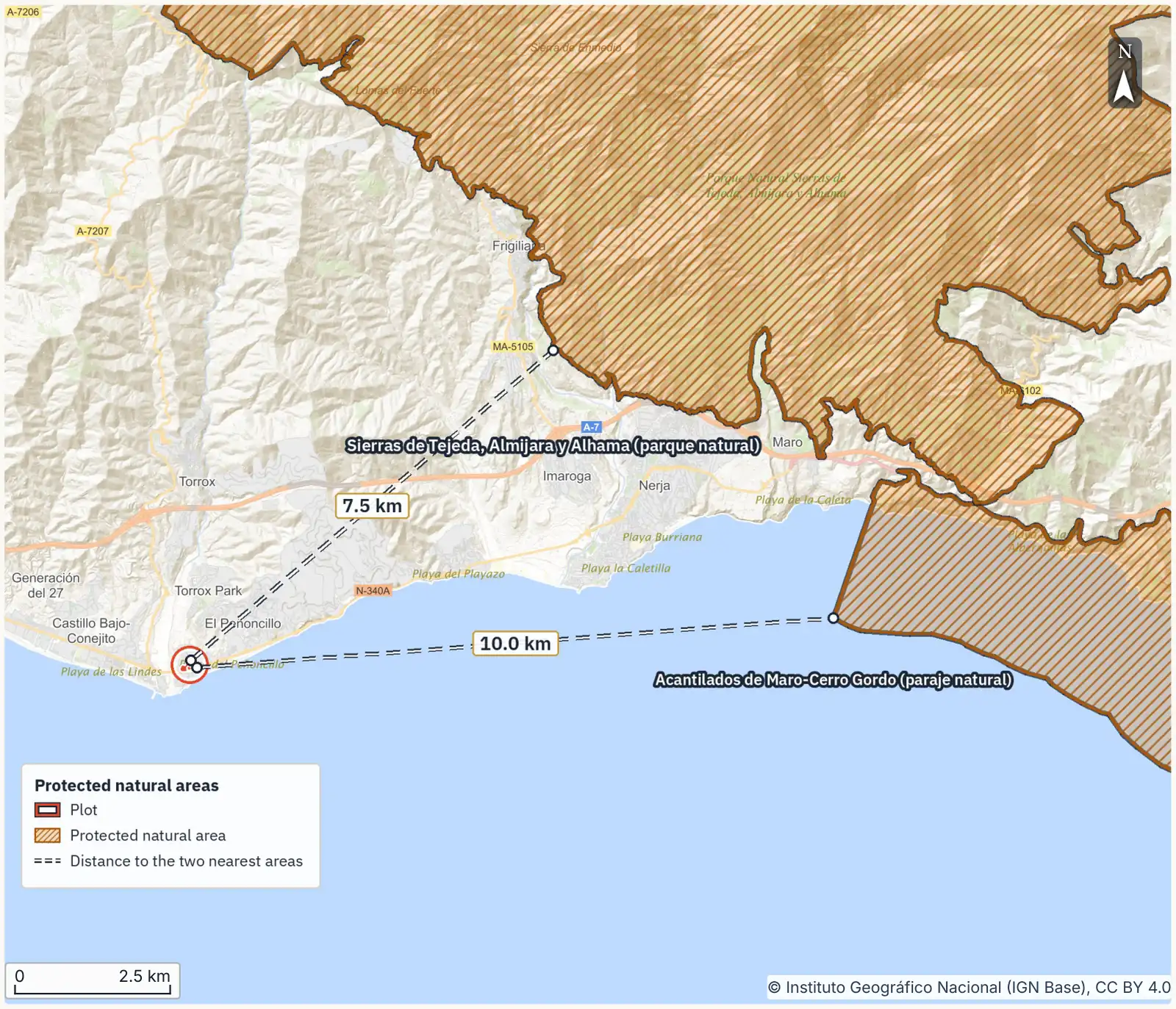
Before you speak to the town hall, you can order the plot report by its cadastral reference and arrive knowing the land class, the drove roads and the Natura 2000 areas around it.
Common questions
What is an exceptional use of rustic land in Castile and León?
A building or activity on the list in art. 23.2 of Law 5/1999 (art. 57 of the Regulation) that goes beyond farming, livestock or forestry. Depending on the land category, it is permitted, subject to authorisation or prohibited.
Who grants the exceptional-use authorisation?
The town hall, if the municipality has 20,000 inhabitants or more or a PGOU adapted to Law 5/1999. In all other municipalities, the provincial "Comisión Territorial de Medio Ambiente y Urbanismo" (RUCyL, art. 306.2). If the use is provided for and defined in an approved Plan Regional or Proyecto Regional, no authorisation is needed (art. 306.1).
How long does the exceptional-use authorisation take?
There are 20 days of public consultation. If the town hall decides, it is deemed granted three months after the application; if the committee decides, two months after it receives the complete file or article 307.5.b documentation. The clock stops for corrections, during the consultation and while reports are issued (art. 296.2). Silence gives no right to works that breach the plan (TRLSRU, art. 11.3).
Can I build a house on common rustic land in Castile and León?
Only if it is needed for another exceptional use to work, and with prior authorisation, unless it is provided for in an approved Plan or Proyecto Regional (RUCyL, arts. 57.e, 59.b and 306.1). On protected rustic land and urban-fringe rustic land it is prohibited.
Do I need authorisation to renovate an old country house?
Renovation is an exceptional use (art. 57.f) subject to authorisation in every category in the chart, unless the municipal plan says otherwise or the work is provided for in a Plan or Proyecto Regional (art. 306.1). If the building is over 20 years old, with no pending legality procedure or non-conforming declaration, the exception covers rehabilitation, reconstruction and alteration, and extensions up to 50% of its area; the art. 308.1 conditions do not apply.
Keep reading
Check this on your own plot
Pin the plot on the map and confirm the cadastral reference: the report gathers the public data and official maps for it, each with its source and date. It does not replace the land registry extract, the notary or a tax adviser. €29 VAT included.