Pillar: Planning and buildings
What does "fuera de ordenación" mean and can I buy such a house?
On this page
It means the building does not fit the town plan now in force. You can buy it, but the deed must state that status (TRLSRU, article 27.2.a), and only the works allowed by the plan and the regional law are possible; under the strictest regime, as a rule, repairs without any increase in volume, with exceptions (see the table). Ask the town hall for a written certificate saying so.
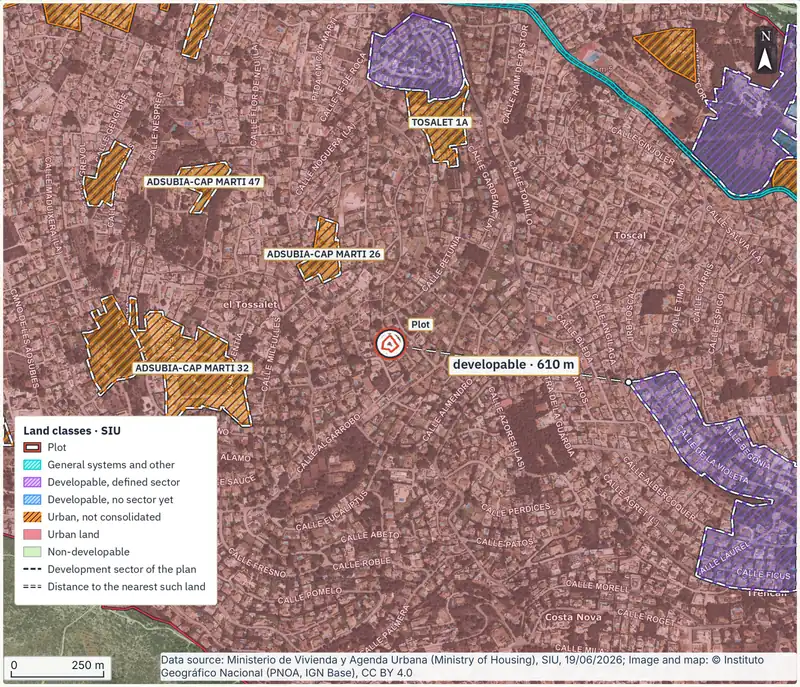

"Fuera de ordenación" (literally "outside the plan") describes how a building relates to the town plan, not its quality or age. A house licensed in 1985 can fall into it when a later plan runs a street line through its front wall; an unlicensed house can end up in a similar position once the time to demolish it has run out. Either can be sold; what changes is the works allowed afterwards.
Two routes to the same label
The first is a building put up lawfully that a later plan no longer matches: a new plan changed the zoning, the building line or the permitted volume after it was built. In Catalonia it covers buildings and uses that the plan makes subject to expropriation, free compulsory transfer, demolition or closure (TRLUC, article 108.1). A house older than the railway law that lies inside a railway's no-build line allows only upkeep and maintenance: see building near a railway line.
The second is irregular work whose time limit has expired: it was built without a licence or in breach of one, and the council can no longer order legality to be restored. The work does not become lawful. In Andalusia this is "asimilado a fuera de ordenación", and the decision recognising it does not legalise the building (LISTA, articles 173.1 and 174.1). How many years must pass in each region is covered in the guide to planning time limits.
Terms such as "relative" or "tolerated" fuera de ordenación do not appear in the laws cited here. Each region has its own terms: "disconforme" (non-compliant) in Castile and León, "fuera de norma" (outside the rules) in Murcia, "inadecuada" (unsuitable) in the Balearics, "volumen disconforme" (non-compliant volume) in Catalonia. The works allowed follow from that term: ask the town hall for it.
Total or partial: which works each region allows
Under the strict regime, the laws read that spell it out allow repairs and, as a rule, no increase in volume; the Galician and Catalan exceptions are in their rows. For a building that is merely non-compliant several allow more, even an extension within the plan; each law and each plan sets its own margin.
| Region | Fuera de ordenación (strict regime) | Non-compliant but not fuera de ordenación | Law and article |
|---|---|---|---|
| Andalusia | If the plan is silent: repair, upkeep and habitability works. Renovation and strengthening without more footprint or volume, and compatible changes of use, only if no expropriation or demolition is planned within five years | The plan separates wholly and partly incompatible buildings and sets the works for each | LISTA, art. 84.3 |
| Madrid | The works the town plan sets for this status, so read the plan's own provisions; fine of 10 to 15 % for strengthening, adding volume or modernising | Partly incompatible: also the improvement or renovation works the plan sets | Ley 9/2001, arts. 64.b and 221 |
| Castile and León | Only works to carry out the plan and repairs for safety and health; partial strengthening if more than eight years remain before expropriation or demolition, or no date is set | "Disconforme" use: strengthening, extra volume and change of use as the plan allows | Ley 5/1999, art. 64 |
| Galicia | Affected by roads, green areas or public facilities: upkeep, renovation, repair and strengthening without more footprint or volume, unless sector rules require it; existing use may continue | On rural land: upkeep, maintenance, renovation and refurbishment, never an extension | Ley 2/2016, art. 90 |
| Catalonia | No strengthening or extra volume; repairs for public health, safety or upkeep and accessibility works are allowed. If only a new road line for free transfer partly affects it, outside any detailed-plan sector or development area: non-compliant-volume rules (art. 108.4 ter) | Non-compliant volume: strengthening and refurbishment, unless the plan limits them or it lies in a protected natural area; extra volume or floor space under the new plan if it does not worsen the non-compliance | TRLUC, art. 108 |
| Murcia | No extra volume, modernisation or rise in expropriation value; repairs to keep a lawful activity going are allowed | "Fuera de norma": extension, improvement and renovation that do not worsen the non-compliance | Ley 13/2015, art. 112 |
| Balearic Islands | Subject to expropriation, transfer or demolition: no strengthening, volume or modernisation; repairs for health, safety and hygiene, exceptionally | "Inadecuada": at least hygiene, safety, renovation, strengthening and refurbishment | Ley 12/2017, art. 129 |
Lawfully built buildings that a later plan leaves non-compliant. The rule in the law; the town plan may define it further within what the law allows. Consolidated texts read on 12.11.2026. Other regions: see their planning law or the guide to old houses linked below. Sources: LISTA; Ley 9/2001, Madrid; Ley 5/1999, Castile and León; Ley 2/2016, Galicia; TRLUC; Ley 13/2015, Murcia; Ley 12/2017, Balearic Islands. Accessed 12 November 2026.
Old houses on rural land, ruins and rebuilding have their own rules in several regions; see the guide to restoring or rebuilding a rural ruin.
The house built without a licence
If the works were irregular and the time limit has passed, each region's law sets the regime. In Castile and León, buildings resulting from a serious or very serious infringement that has lapsed fall under the fuera de ordenación regime (Ley 5/1999, article 121.4). In Catalonia, buildings put up unlawfully on non-developable land are always fuera de ordenación (TRLUC, article 108.7).
In the Balearic Islands, an unlicensed building that can no longer be demolished may only have repairs for health, safety or hygiene. If it was built after 1 March 1987, it cannot take out electricity, water, gas or sewerage contracts either (Ley 12/2017, article 129.2.b). That regime lasts until the building is legalised.
Andalusia: having AFO status recognised
In Andalusia, the town hall recognises AFO status and has six months to decide; silence means the application is refused (LISTA, article 173.2). Until then the building cannot connect to basic services or have any works done, except those the council orders for safety and health (article 173.3). Once recognised, compatible changes of use and upkeep and renovation works may be licensed, including strengthening without more footprint or volume (article 174.7). What to ask the seller of an AFO house is set out in the guide to illegal houses on rural land.
What a forbidden job costs
Works that cannot be authorised in a fuera de ordenación building are an infringement; three of the laws read fine them as a percentage of their value.
New floor slabs for a holiday home
A British owner of a villa in the Valencia region that the plan classes as fuera de ordenación has the builder replace a floor slab, strengthening work the plan does not allow, for €30,000. The fine would be 25 % to 50 % of that sum: between €7,500 and €15,000, and never under €600 (TRLOTUP, article 282.3). Paying the fine does not make the work lawful.
What the deed must say
In any sale of land with buildings that are fuera de ordenación, the deed (escritura) must state the planning status. If it does not, the buyer may rescind the contract within four years and claim damages under civil law (TRLSRU, articles 27.2.a and 27.3). As buyer you take over the seller's planning duties (article 27.1).
How it shows in the Land Registry
Old works whose demolition deadline has passed can be registered on proof of completion on a stated date (TRLSRU, article 28.4.a). The registrar tells the town hall, which must record by marginal note (nota marginal) the planning status and the limits it imposes (article 28.4.c). Throughout Spain, licences granted for fuera de ordenación buildings are noted in the margin of the last ownership entry, stating any duty to demolish without compensation the council has agreed (RD 1093/1997, article 76). In Andalusia AFO status is also entered by marginal note (LISTA, article 174.6). Ask for a nota simple (land registry extract) and read the margins.
Limits of this guide
What this guide does not settle. The regime that applies is set by the town plan within the regional law, and a plan may be stricter or more detailed than the law. Before paying anything, have a lawyer read the town hall certificate and the plan's sheet for your building.
How to check, step by step
- Find the plot on the plan. Where: the town or regional planning map viewer. Who: you, using the cadastral reference. Cost: a public viewer, no fee. Time: the viewer answers at once; check before viewing the house.
- Ask for the planning certificate or cédula. Where: the town hall's Urbanismo department, in person or through its online office (sede electrónica). Who: you or your lawyer, with the cadastral reference and a plan; if you are abroad, a lawyer with a power of attorney can apply for you. Ask in writing whether the building is fuera de ordenación, to what degree, and which works it allows. Cost: the fee in the town's tax bylaw. Time: in Catalonia, one month from the application; elsewhere, whatever the regional rules set. How to read it: guide to the cédula urbanística.
- Ask for a nota simple. Where: the Land Registry or its online office. Who: anyone. Look for marginal notes on planning status, AFO or licences with a duty to demolish. Time: no legal deadline; get it before the deposit.
- Ask the seller for the building licence, the first occupation licence and, if there is one, the AFO decision or the town hall's fuera de ordenación declaration. Where: at the notary's or the seller's lawyer's office, before the deposit; free. Time: no legal deadline.
- Sign the deposit contract (arras) with a condition. For example: "If the town hall certificate does not confirm that the house allows [describe the works], the buyer may withdraw and recover the deposit." Who: your lawyer, when drafting the contract. Time: no legal deadline; the parties agree it. See the guide to the arras contract.
- Check the deed. Where: at the notary's, with the draft a few days before signing. Time: no legal deadline. Make sure it states the building's planning status, as TRLSRU article 27.2.a requires; if you do not read Spanish well, ask for a translation of that clause.
- You know whether the building is fuera de ordenación and what your region's law calls it.
- You have in writing which works it allows, including the ones you want to do.
- You know whether the plan provides for expropriation, transfer or demolition, and by when.
- The nota simple shows no marginal notes you were not told about.
- The deed will state the planning status.
If you are choosing between several houses, you can order a report on each plot by its cadastral reference and take only the open questions to the town hall.
Common questions
Can I buy a house that is fuera de ordenación?
Yes. The law does not bar the sale, but the deed must state the planning status; if it does not, the buyer may rescind within four years and claim damages (TRLSRU, articles 27.2.a and 27.3). First confirm which works are allowed on the building.
Can I renovate a fuera de ordenación house?
It depends on the region and the plan. Under the strict regime, the laws in the table that detail it allow repairs and, as a rule, no extra volume; there are exceptions in Galicia (sector rules, article 90.1) and Catalonia (road lines, article 108.4 ter). Renovation and strengthening only in the cases each law sets (see the table).
What is the difference between fuera de ordenación and asimilado a fuera de ordenación?
In Andalusia, fuera de ordenación is a lawful building that the plan has left non-compliant (LISTA, article 84.3); AFO is a finished irregular building against which the time to act has run out, recognised by the town hall but not legalised (articles 173.1 and 174.1).
Will I get a mortgage?
The Spanish rules on mortgage valuation neither forbid one nor set a discount. The valuer must check that the property matches the plan in force and, if it does not, the report carries a warning (Orden ECO/805/2003, articles 7.2.e and 11.b). The rest is the bank's own policy: ask it in writing before signing the arras, especially if you are a non-resident borrowing in Spain.
Am I compensated if a new plan leaves my house fuera de ordenación?
As a rule, no: fuera de ordenación status caused by a change of plan gives no right to compensation, although being unable to use the building lawfully during its useful life may (TRLSRU, article 48.a). If the plan provides for expropriating it, its value is reduced in proportion to the useful life already elapsed (article 35.3).
Keep reading
Check this on your own plot
Pin the plot on the map and confirm the cadastral reference: the report gathers the public data and official maps for it, each with its source and date. It does not replace the land registry extract, the notary or a tax adviser. €29 VAT included.