Pillar: Planning and buildings
How many years before an unlicensed building can no longer be ordered down?
On this page
Time the authorities have to act against finished unlicensed works (legalisation or demolition): 4 years in the Canaries; 6 in Andalusia, Catalonia, Galicia and Madrid (15 on Madrid's protected non-developable land); 8 in the Balearics; 4, 8 or 10 in Castile and León, depending on the seriousness of the breach, from the outward signs; 15 in the Valencia region outside non-developable land. A case opened in time, or an order issued, survives the deadline.
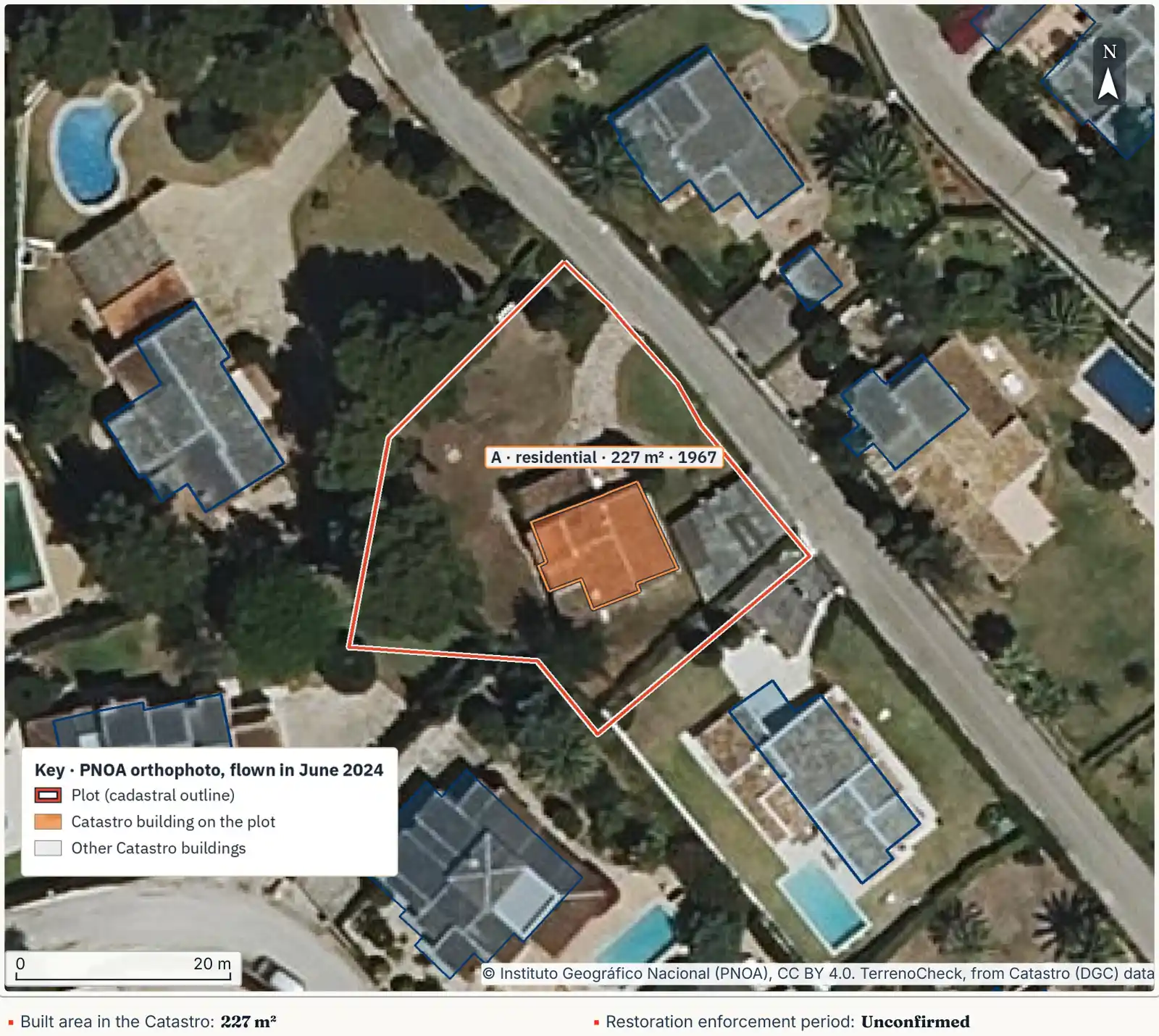

Each Spanish region sets its own limit in its planning law; it changes with the type of land and runs from when the works were finished, not from when you sign. This guide compares eight regions, read in the BOE (Spain's official gazette) consolidated texts on 12 November 2026.
Wider risks and papers to ask for are in the guide to illegal houses on rustic land.
Two clocks that do not stop together
Unlicensed works can lead to two procedures. One fines whoever was responsible; the other requires the works to be legalised or demolished, with its own limit.
The gap is wider in the Valencia region: four years to fine a serious or very serious breach (TRLOTUP, article 270.1) against fifteen to require legalisation (article 255.1).
Time limits by region
| Region | What the authorities must do within the limit | Fine the breach | No restoration limit, among others | Law and article |
|---|---|---|---|---|
| Madrid | Require the owner to apply for legalisation within 2 months: 6 years from full completion; 15 on protected non-developable land | The same limits; none on the land in the next column | Roads, green areas, open spaces, public domain | Law 9/2001, articles 195.1, 200.1 and 236.1 |
| Castile and León | Open disciplinary and restoration proceedings within the time limit for the breach, counted from the outward physical signs | 10 years very serious, 8 serious, 4 minor, from the outward physical signs | Public domain and public open spaces, existing or planned | Law 5/1999, articles 114.2 and 121 |
| Andalusia | Adopt the interim or final measures: 6 years from full completion or, if later, the outward signs | 4 years serious and very serious, 1 minor | Public domain and its easements, the coastal zone of influence, green areas and open spaces, listed assets, rustic land at certain risk | LISTA, articles 153 and 169.1 |
| Catalonia | Bring restoration action: 6 years from the breach or the end of the works; an order already issued lapses after 6 | 6 years very serious, 4 serious, 2 minor; neither the breach nor the penalty lapses on the land in the next column (article 227.4) | Public open spaces, the road system, land that is or must be non-developable (article 32.a) | TRLU, articles 207 and 227.4 |
| Galicia | Open the restoration file: 6 years from full completion | 15 years for very serious breaches under article 158.2.a; 6 for serious and other very serious; 2 minor | Green areas, open spaces, roads, the article 92.1 zone, public facilities | LSG, articles 153.1, 155.1 and 159.1 |
| Canary Islands | Open proceedings: 4 years from full completion; an order issued can be enforced for 10 years from when it takes effect | 4 years very serious, 2 serious, 1 minor | Environmentally protected rustic land already so classed when work began, public domain and its easements, listed assets, roads and green areas | Law 4/2017, articles 361 and 407.1 |
| Balearic Islands | Start proceedings and serve, or lawfully attempt to serve, notice of the start: 8 years from full completion | 8 years serious and very serious, 1 minor | Land that was protected rustic when built, listed assets, parks, gardens, open spaces, public facilities | Law 12/2017, articles 196 and 205.1 |
| Valencia region | Require the owner to apply for authorisation within 2 months: 15 years from full completion or the end of the use, if that was the law when the works were finished | 4 years serious and very serious, 1 minor | All non-developable land, green areas, roads, open spaces, public domain, listed heritage | TRLOTUP, articles 255 and 270.1 |
BOE consolidated texts read on 12.11.2026. Not in the table: the other regions, Ceuta and Melilla (Murcia: LOTURM, article 294). Sources: Madrid Land Law 9/2001; Castile and León Planning Law 5/1999; Andalusian LISTA; Catalan TRLU; Galician Land Law 2/2016; Canary Law 4/2017; Balearic Planning Law 12/2017; Valencian TRLOTUP. Accessed 12 November 2026.
In Castile and León, unlicensed works that comply with the local plan are a minor breach, and works that break the rules on use, height or volume are serious (Law 5/1999, article 115.1). In the Valencia region the limit is the one in force when the works were finished (TRLOTUP, article 255.6); earlier laws are covered in the guide to Valencian non-developable land.
When the clock starts
The usual starting point is full completion: in the Canaries, when the building is ready for use with no further physical work except decoration (Law 4/2017, article 361.3).
Four variations:
- Outward signs. In Castile and León the count starts when outward physical signs reveal the breach (Law 5/1999, article 121.3.a).
- Uses. In the Balearics, an unlicensed use or change of use is continuous, and the count starts when it stops (Law 12/2017, article 196.4). In the Canaries, uses in finished lawful buildings or buildings outside the plan run from the first outward, verifiable sign (article 361.1.d).
- Annulled permits and continuing activity. If the works had a licence that was later annulled, the count runs from the annulment (Castile and León, article 121.3.c; Catalonia, article 207.1; Balearics, article 196.5). In Castile and León, a breach by continuing activity counts from when the activity ends (article 121.3.b).
- Extensions. Each piece of work has its own date. In Galicia, a later extension does not change the count for the original building, but it opens its own file (LSG, article 153.1).
What stops the clock
Under the general rule in Law 40/2015 (to which, for example, LISTA article 169.1 refers), the limit for the fine is interrupted when disciplinary proceedings start and the person concerned is told, and it runs again if the file sits idle for more than a month for reasons not attributable to that person (Law 40/2015, article 30.2). In the Valencia region, learning that a restoration file has been opened also interrupts it (TRLOTUP, article 270.4).
If the authorities acted in time
For demolition, what counts is the step each law requires before the limit passes (second column of the table). If it was taken in time, the limit passing does not close the case. An order already issued has limits of its own: in the Canaries it can be enforced for ten years from when it takes effect (Law 4/2017, article 361.2.c); in Catalonia it lapses after six (TRLU, article 207.2).
What the Land Registry shows
The opening of a planning enforcement or restoration file can be entered in the Land Registry (TRLSRU, article 65.1.c). For a declared new building, a subdivision or a block of flats the authority must request the entry, and if it does not, it compensates a buyer in good faith who suffers loss (article 65.2). A file that was never entered will not appear on the nota simple.
Once the limit has passed
Time-barred does not mean legal. Once the limit has passed, the works do not become lawful. In the Canaries, and in Castile and León after a serious or very serious breach, they fall into the "fuera de ordenación" status, meaning outside the current plan (Law 5/1999, article 121.4; Law 4/2017, article 361.4), and in the Valencia region they cannot be renovated, extended or consolidated while the breach persists (TRLOTUP, article 256). When you buy, you take over the seller's planning duties (TRLSRU, article 27.1).
Proving when the works were finished
To register works by age, national law accepts a town hall or technician's certificate, a notarial deed or the "Catastro" (property survey) certificate, each giving a specific completion date (TRLSRU, article 28.4.a). In the Balearics, whoever relies on the completion date must prove it, by any lawful evidence (Law 12/2017, article 196.3).
The Catastro certificate costs €17.97 at the counter and is free if you download it yourself online (Catastro fee table; TRLCI, article 62.2). If you live abroad, a Spanish lawyer or "gestor" (administrative agent) can obtain it for you. How to date each extension is explained in the guide to the declaration of an old building.
A villa with a newer pool house
You are buying a villa in an urban area of an Andalusian town. The villa has its licence, but the seller added a pool house without one, finished and visible from the street in March 2022. If that was a serious breach and no file was opened, the fine lapsed in March 2026. The town hall can still adopt restoration measures until March 2028 (LISTA, articles 169.1 and 153.1). The risk concerns the pool house, not the licensed villa.
What to do before you sign the deposit contract
- Date each piece of work. Where: the Catastro's online office (catastro.gob.es) and a qualified technician. Who: you, with the technician's certificate. Cost: the Catastro certificate, free online or €17.97 at the counter; the technician's certificate, by quote. Time: no legal deadline; agree it with the technician.
- Order a nota simple. Where: the Land Registry for the property or its online office. Who: anyone with an interest; your lawyer can do it. What to look for: an entry noting an enforcement or restoration file, and any marginal notes. Time: no legal deadline for a nota simple.
- Ask the town hall in writing. Where: the planning or planning enforcement department. Who: you or your lawyer. What to ask: the land class, whether there is a file, and which limit applies to each piece of work. Cost: the fee in the town's tax bylaw. Time: no legal deadline for this enquiry; ask for an answer before the arras date.
- Write the condition into the "arras" (deposit contract). Who: your lawyer. Make the refund of the deposit depend on the town hall confirming that restoration can no longer be ordered, by a set date. Where: the arras contract, before you pay the deposit. Time: no legal deadline; the parties agree it. More in the guide to the arras contract.
- You have the completion date of each piece of work, with evidence, and the land is not among the types with no limit.
- The nota simple shows no entry for a planning enforcement file.
- The town hall has said in writing whether a file exists and whether restoration is still possible.
- If the fine has lapsed, you have not assumed that demolition has too.
If you are unsure which law and which land type apply, you can order the property report by its cadastral reference and take it to the town hall with a precise question.
Common questions
Does the clock start when I buy the house?
No. It starts when the works are finished or, depending on the law, when outward signs appear or a use stops. A sale neither restarts nor stops it.
If the fine has expired, has demolition expired too?
Not necessarily. They are separate limits. In Andalusia a serious breach is time-barred after four years, while restoration can be ordered for six from completion or the outward signs (LISTA, articles 169.1 and 153.1); in the Valencia region, four and fifteen.
What interrupts the time limit for the offence?
Under the general rule, the start of disciplinary proceedings with the person concerned informed; if the file sits idle for more than a month for reasons not attributable to that person, the clock runs again (Law 40/2015, article 30.2). Some laws add cases: in the Valencia region, the opening of a restoration file as well (TRLOTUP, article 270.4).
If the limit has passed, is a case opened earlier dropped?
No. If the authorities acted within the limit, the case goes on; an order already issued has its own limits, such as ten years to enforce it in the Canaries (Law 4/2017, article 361.2.c).
Keep reading
Check this on your own plot
Pin the plot on the map and confirm the cadastral reference: the report gathers the public data and official maps for it, each with its source and date. It does not replace the land registry extract, the notary or a tax adviser. €29 VAT included.