Pillar: Planning and buildings
Can you build a house on non-developable land in the Valencian Community?
On this page
In the Valencian Community you can build one detached house on non-developable land only if the local plan's zoning allows it, the plot reaches the plan's minimum (never less than one hectare), the house covers at most 2 % of it and the town hall grants a licence. An unlicensed house that already stands has three possible routes, depending on when it was finished and whether it meets the rules.
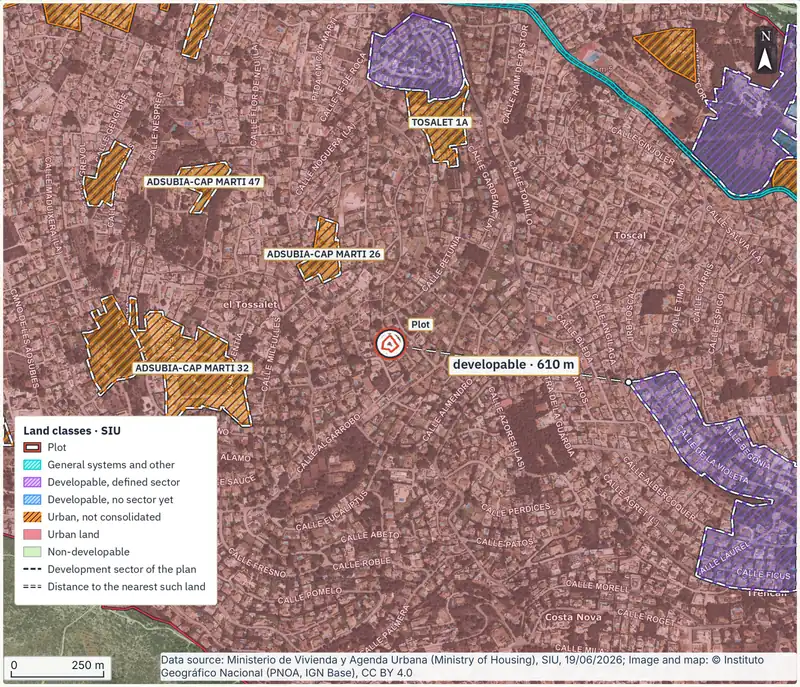
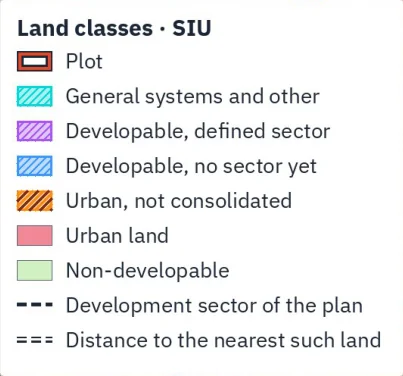

Much of what agents around Valencia, Alicante and Castellón advertise as "rustic" land is "suelo no urbanizable", non-developable land under the TRLOTUP (Legislative Decree 1/2021, amended to August 2026). Rules common to all of Spain are in what you can do on rustic land and rustic and urban land.
What the law requires for a detached house
Article 211.1.b allows the house "exceptionally", on five conditions. The plot must form one unbroken piece whose shape and area meet the plan's minimum, never under one hectare (10,000 m²); the building may cover at most 2 %, with the rest left natural or farmed; it stays out of natural drainage channels and respects trees and terrain; the owner pays for water, waste and sewage treatment; and it must not start a settlement.
Height, services and the farmhouse exception
Unless the plan allows more, two storeys at most (art. 210.2), plus the wildfire-prevention rules of annex XI and treatment of its waste water (art. 210.4). A farmhouse tied to a working holding escapes the hectare and the 2 % only in zones the plan has marked out and with a favourable report from the regional agriculture department (art. 211.1.b).
Minimum plot by use
Who decides and which documents to ask for
The town hall ("ayuntamiento") grants the licence after collecting the reports that apply (art. 215.1); a house needs no DIC, unlike industrial and service uses.
| Document or step | Who | Period and effect | Article |
|---|---|---|---|
| "Cédula de garantía urbanística" (planning certificate) | Town hall | Issued within one month; valid for one year at most, so check the date on it | 246.1 |
| Written report on zoning, classification and development timetable | Town hall | One month, for anyone who asks | 246.4 |
| Sector reports | Regional department, at the town hall's request | Their conditions go into the licence | 215.1 and 215.2 |
| Licence for a new major build | Town hall | Two months; on this land, no reply means refusal | 240.1.b and 214.5 |
| Registration of the plot area tied to the house | Land Registry | A condition of the licence | 214.4 |
Periods and effects under the consolidated text of 10.8.2026. Source: TRLOTUP, arts. 214, 215, 240 and 246. Accessed 12 November 2026.
The last row matters to a buyer: the area that justifies the house is tied to it and becomes indivisible (art. 214.4). The "nota simple", a short Land Registry extract, shows whether such a tie exists: how to order one.
PATRICOVA: what each flood level allows
The regional layers are in the Generalitat's map viewer, run by the Institut Cartogràfic Valencià (ICV). The PATRICOVA (Decree 201/2015), the regional flood-risk plan, sets six hazard levels, each combining annual flood probability with water depth, plus a geomorphological one (art. 8.1).
| Level | General rule on non-developable land | Exception |
|---|---|---|
| 1 | Any building banned (17.2) | What planning approved before the PATRICOVA already provided for (17.2) |
| 2, 3, 4 and 5 | Houses banned (18.2) | Art. 18.6 |
| 6 | House allowed with flood-adaptation measures (18.3) | Not needed |
| Geomorphological | Houses banned (18.2) | Detailed study showing little impact (18.4), or art. 18.6 |
PATRICOVA rules of 2015. Law 2/2025, additional provision two, orders a revision: check the regional ministry's website for its approval. Source: PATRICOVA, rules. Accessed 12 November 2026.
Article 18.6 lets these limits be lifted "with justification" in municipalities of high flood hazard, entered in a register by decision of the regional minister (additional provision one), never in the preferential flow zone and subject to the conditions of annex I. No exception can be read off the map colour: it has to be argued in the application.
A real example: the map at Polinyà de Xúquer
The map gives the level, not the class of land: if the town hall confirms it is non-developable, the "2, 3, 4 and 5" row of the table applies.
The DANA map and the PATFOR
After the October 2024 DANA storm and floods, Law 2/2025 added the "cartografía dana 2024" layer, which affected municipalities weigh alongside the PATRICOVA and the national flood map (SNCZI) until the revision. Rural land flooded on the DANA map but not floodable on the other two can be authorised only with a favourable report from the regional flood-risk body (transitional provision two, paragraph 4). More in flood zones.
The PATFOR (Decree 58/2013), the regional forest plan, maps forest land; its map is for information and public, and can become binding where an approved forest-resource plan exists (art. 20). If the plot is or borders forest land, read wildfire and forest land.
If the house is already built
When it was finished and whether it meets the rules decide the route.
Houses older than Law 19/1975. If finished when that law came into force, still in their original use and building type, and not formally declared ruinous, they are treated as licensed (DT 26).
Works that meet the rules. The mayor's office or the regional enforcement agency ("Agencia Valenciana de Protección del Territorio") gives the owner two months to apply for a licence or bring the works into line; if no application is made, or it is refused because the works breach the rules, restoration follows (art. 255.1 and 255.3).
Minimización de impacto territorial. This route, "minimising territorial impact", is for houses that do not meet article 211, and only if completely finished before 20 August 2014 (art. 228.3). Houses in a cluster (three per hectare, or fewer where they sit close together) go into a plan for that cluster (art. 228.2); an isolated house needs a declaration from the full council ("pleno"), which halts enforcement and sets the conditions (art. 230.1). With the declaration in hand, the owner applies for the minimisation licence ("licencia de minimización de impacto territorial y de ocupación"), with an outline design, a landscape-integration study and an analysis of environmental impacts and risks with corrective measures. From the day that licence is obtained there are at most four years to apply for the occupancy licence, with the certificate that the minimisation works are finished and the other technical documents required (art. 230.2): the deadline is for applying, not for obtaining it. The hectare and the 2 % do not apply, but no extension is allowed (arts. 230.1 and 231.3). If the plan or declaration fails, the route closes (art. 228.3).
When no route applies. The fifteen-year limit does not apply (art. 255.5), but the one in force when the works were finished does (art. 255.6): dates in illegal house on rustic land. Even once a limit has run out, the illegal part cannot be refurbished, extended or reinforced (art. 256).
What this guide does not settle. Restoration measures "reach third-party buyers" and the enforcement file is sent to the Land Registry to be recorded (art. 250.2 and 250.3): if you buy, the problem comes with the house. Ruins: rebuilding a ruin on rustic land; sheds: casa de aperos. This guide is no substitute for a Spanish planning lawyer.
What you pay: purchase tax and the cost of legalising
Purchase tax on a resale property (ITP, transfer tax) at the Valencian rates and the other buying costs are in how much it costs to buy a property.
The certificate and licences can carry a municipal fee (TRLRHL, the local finance law, art. 20.4.h), set in the town hall's "ordenanza fiscal" (tax bylaw). Works also pay ICIO, a municipal construction tax capped at 4 % of the bare construction cost (art. 102): on €40,000 of works, no more than €1,600.
Step by step
- Ask the town hall for the cédula or the written report on zoning and classification (art. 246): one month; fee per the ordenanza fiscal.
- Check the viewer for PATRICOVA, PATFOR and the dana 2024 layer.
- Order a nota simple: area, charges, ties and enforcement entries.
- If there is a house, ask for the building licence, completion certificate and occupancy licence; if any is missing, ask a planning lawyer which route applies and its stage.
- Make the deposit contract (arras) conditional on the missing licence or decision.
- The zoning allows a detached house and the plot, uncut by tracks, reaches the plan's minimum.
- You know the PATRICOVA level; at 1 to 5 or geomorphological, you have the exception relied on in writing.
- You know whether it is forest land in the PATFOR.
- If there is a house: a licence and an occupancy licence, or the exact stage (council declaration, minimisation licence, works, occupancy). The declaration alone replaces neither licence.
- The deposit is refunded if the pending licence or decision has not arrived by the agreed date.
- The nota simple shows no enforcement file.
With a plot in mind, you can order the report by its cadastral reference and take the classification and map layers it identifies to the town hall.
Common questions
Do you need a declaration of community interest for a detached house?
No. The single detached house of article 211.1.b is authorised with a council licence and no prior declaration (art. 215.1). Industrial uses, tertiary or service uses and collaborative housing in existing buildings do need one (arts. 216.1 and 211.1.e, f and g).
Can I split a large plot to build on one part?
Only in very limited cases. Dividing land into two or more lots in order to build is a prohibited subdivision (art. 249.3.a), and that purpose is presumed if a resulting plot is below the minimum (art. 249.4.b). Selling undivided shares for individual use also counts as subdivision (art. 249.3.b).
Can I extend a house legalised through minimización?
No. No licence that adds floor area is granted for these buildings, not even for removable structures. The plan or the minimisation licence may allow interior works and small ancillary elements that add no floor area, with a prior binding report from the Generalitat (art. 231.3).
What if the town hall does not answer my licence application?
On non-developable land silence means refusal: once the legal period passes without a reply, the licence is treated as refused (art. 214.5). Works cannot start without a licence (art. 214.6).
What does "rustic developable land" mean in an advert?
It mixes two classes of land. Developable land (suelo urbanizable) is earmarked by the plan for development and has only a "mere aptitude" to be developed once a development programme is approved (art. 28.4). Rustic land is non-developable land (art. 28.2): ask the town hall for the exact classification.
Does anything change in the municipalities hit by the DANA?
Yes, in the affected municipalities. Law 2/2025 brings the DANA map into the processing of plans, declarations and licences on rural land (transitional provision two) and bans rebuilding illegal buildings once the enforcement period has passed (art. 6.6).
Keep reading
Check this on your own plot
Pin the plot on the map and confirm the cadastral reference: the report gathers the public data and official maps for it, each with its source and date. It does not replace the land registry extract, the notary or a tax adviser. €29 VAT included.