Pillar: Planning and buildings
Can an old house built without a licence go on the Land Registry, and is it then legal?
On this page
Yes, once the period for ordering its demolition has expired, through a notarial deed called ‘declaración de obra nueva por antigüedad’: here ‘obra nueva’ means the building being declared, which may be decades old (Spanish Land Act, consolidated text, art. 28.4). Registration does not legalise the house. Each autonomous community sets that period in its own planning law, and on some land there is none.

A country house can be on the Land Registry ("Registro de la Propiedad") because the town hall has lost the power to order its demolition, and still be a building the plan does not allow. The route is in the Land and Urban Renewal Act (TRLSRU, Royal Legislative Decree 7/2015), applied by registrars under Royal Decree 1093/1997.
This page covers the deed and its registration. Whether to buy a house with no paperwork is the subject of the guide to illegal houses on rustic land.
For obtaining missing planning consent, see how to request legalisation.
For preparing the date evidence, see the building age certificate.
Two routes onto the Registry
The ordinary route needs the licence. The route by age does without it: the deed must prove when the building was finished, and the registrar still applies the other checks below.
| Ordinary route (art. 28.1) | Route by age (art. 28.4) | |
|---|---|---|
| When it applies | The building has the administrative consent, approval or authorisation it requires | Demolition can no longer be ordered because the limitation periods have expired |
| What is produced | The administrative act, a technician's certificate that the building matches the project and, once finished, the documents for handover to users, authorised use and energy efficiency | One of the four documents in art. 28.4.a, giving a specific completion date and a description matching the deed |
| What the Registry checks | That those documents are there (art. 28.2) | The four filters in the diagram below |
| What stays on the Registry | The building, with the licence transcribed in the deed (RD 1093/1997, art. 48.1) | The building, a statement that the town hall has been notified and, if there was no town hall certificate, the marginal note on planning status that the town hall must order |
The qualified technician may be the author of the project, the site director, the municipal technician or any other whose professional college certifies sufficient powers (RD 1093/1997, art. 50). Sources: TRLSRU, art. 28; RD 1093/1997, arts. 45 to 55. Accessed 12 November 2026.
On either route the ground the building occupies must be identified by geographic coordinates (Mortgage Act, "Ley Hipotecaria", art. 202); see the guide to georeferenced coordinates.
What the registrar checks
The technician's certificate can be attached to the deed with the signature authenticated by a notary, or the technician can attend the signing (RD 1093/1997, art. 49). Once the deed is lodged, the registrar applies four filters.
The Registry does not test the house against the local plan. The Directorate-General for Legal Certainty and Public Faith (DGSJFP), which decides appeals against registrars, put it this way in a case from Cullera (Valencia): it is not for the registrar to police planning law; that power belongs to the planning authority (Resolution of 1 April 2025).
The Cullera case
A house on non-developable land was extended from 32 to 111.62 square metres in 2007. The town hall ordered the extension demolished in 2011 but never sent the order to the Registry. The owner signed the deed on 6 June 2019; the registrar suspended it in 2019, in 2020 and again after a supplementary deed in 2024. The DGSJFP overturned the last suspension because both the demolition order and the offence were time-barred, and held that the period is the one in the law in force when the work was finished.
The registrar must record the notice to the town hall in the entry and in any extract issued (art. 28.4.b). So if the "nota simple" (the Registry extract your lawyer orders) mentions that notice, ask whether the house went in by age. Cullera also shows that a clean Registry does not prove there is no town hall file, and that a contested registration can take years: almost six passed between deed and ruling.
The period depends on the region
Art. 28.4 names no period. Each regional law sets its own, says when it starts to run and lists land where the authority can act at any time. Three examples:
| Region | Period and when it starts | No time limit | Law |
|---|---|---|---|
| Andalusia | Six years from full completion or, if later, from the appearance of outward signs that make the works known. For a use, from the outward signs that it has actually been established. The same period applies on rustic land specially protected by sector legislation, without prejudice to the periods in that legislation | Public domain and protection easements; rustic land preserved for definite risks of landslip, ground movement, flooding or similar, while they last; rustic land in the coastal influence zone; properties individually listed in the General Catalogue of Andalusian Historical Heritage; green zones and open spaces; urban parcelling of rustic land, subject to the proviso in letter f | LISTA, art. 153.1 and 153.2 |
| Madrid region | Six years from total completion of the works; fifteen on protected non-developable land | Roads, green zones, open spaces and public domain delimited under its sector legislation | Law 9/2001, arts. 195.1 and 200.1 |
| Valencian Community | Fifteen years from total completion of the works or from the date the use ceases | Non-developable land; green zones, roads, open spaces or public facilities; public domain; the General Inventory of Valencian Cultural Heritage | TRLOTUP, art. 255.1 and 255.5 |
In the Valencian Community the period is the one in the law in force on the date the work was finished (art. 255.6). The Madrid wording quoted has applied since 28.12.2024: for works finished earlier, check the previous wording. Sources: LISTA (Andalusia), art. 153; Law 9/2001 (Madrid), arts. 195 and 200; TRLOTUP (Valencian Community), art. 255. Accessed 12 November 2026.
The Andalusian and Valencian rules are covered in the guides to farm sheds and Valencian non-developable land.
Every extension has its own date. A 1990 house with a porch enclosed in 2021 needs the period to have expired for the porch as well. If the certificate's description does not match the building, the registrar suspends the entry, or what gets registered is not what you are buying.
How the date is proven
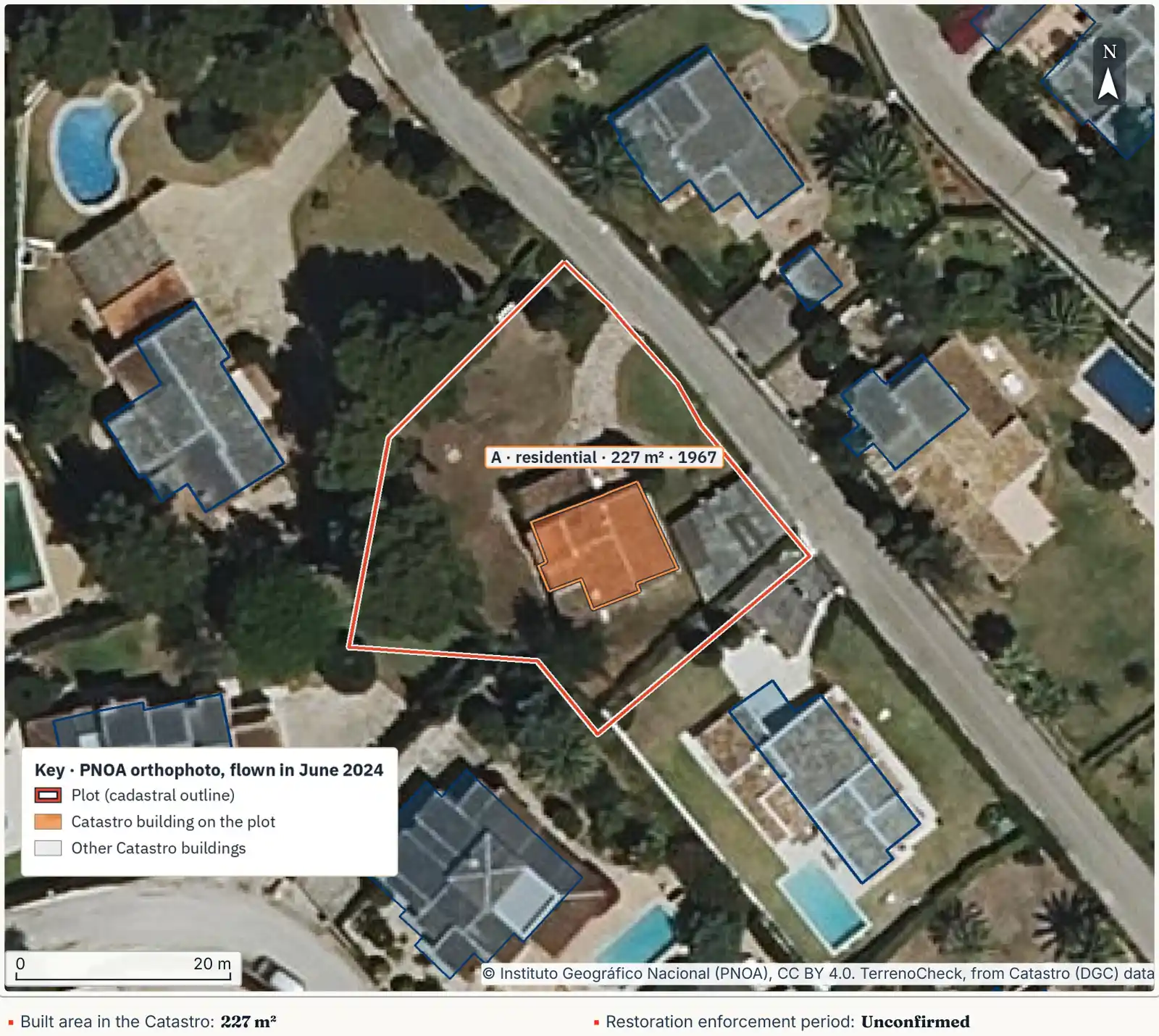
The open-data query on the Catastro's online office ("Sede Electrónica del Catastro") shows a single year of construction ("Año construcción") per property and a table of built elements with use and area, with no date for each. It also states that it is not a cadastral certificate. What the law accepts is the descriptive and graphic cadastral certificate, which is attached to the deed (Cadastre Act, art. 3.2). Cadastral data are presumed correct unless proven otherwise (art. 3.3).
Aerial photography: the IGN flights
Where the Catastro misses an extension or gives a doubtful year, the fallback is a technician's certificate, which can rely on aerial photography. In Cullera the architect produced a 2008 orthophoto. Spain's National Geographic Institute (IGN) publishes the historical flights and the yearly PNOA orthophotos in one service:
A house visible in the 1997–2003 flight and missing from the 1981–1986 one was built between the two.
What registration leaves unchanged
A building registered by age keeps the planning status it had. Where the town hall did not issue the certificate itself, art. 28.4.c obliges it to adopt a decision so that the Registry shows the building's specific planning status, the scope of that status and the restrictions it places on the owner.
What those restrictions are depends on the region. Under Valencian law, the passing of the period does not legalise the works and, while the breach continues, no works of alteration, extension or consolidation may be carried out on what was built unlawfully (TRLOTUP, art. 256).
If the town hall fails to adopt that decision and a good-faith buyer suffers financial loss, the authority must compensate (art. 28.4.c). That is a right to claim, not a guarantee: read the marginal note before paying. Order the nota simple and, if no marginal note appears, ask the town hall for a planning report.
What the deed costs
The deed is taxed under stamp duty on notarial documents ("actos jurídicos documentados", AJD). The taxable base is the real cost of the building work declared (tax regulations, art. 70.1), not the market value of the house. Each region approves the rate; where it has not, 0.50 % applies (consolidated tax act, art. 31.2). In Andalusia the general rate is 1.2 % (Law 5/2021, art. 49). The person who requests the deed, or in whose interest it is issued, pays (art. 29): in practice, the owner declaring the building. The taxes on the later sale are separate and are covered in the guide to purchase costs.
A seller regularises before the sale
A seller in Andalusia declares a house whose building cost is valued at €120,000. The AJD is €1,440 (120,000 × 1.2 %). At the national fallback rate of 0.50 % it would be €600. The technician, the notary and the Registry charge on top: ask for quotes, and if the seller wants you to cover them, agree it in writing before the deposit.
The fee table of the Directorate-General for the Cadastre (checked on 12 November 2026) puts the descriptive and graphic certificate for one property at €17.97 per document, plus €45.28 per document if it includes data from more than five years before the request (Cadastre Act, art. 66.2). No fee is due when it is obtained directly online (art. 62.2).
What to do, in order
- Date the house and each extension. A qualified technician compares the building with the Catastro and the IGN orthophotos and issues the certificate.
- Ask the town hall in writing. At the planning department ("urbanismo"), ask for the land class, whether an enforcement file is open or decided, and which period applies.
- Sign the deed at a notary's office, with the certificate and the coordinates of the occupied ground. A foreign owner needs an NIE.
- File the AJD return with the region's tax agency. The national regulations give thirty working days from the deed (art. 102.1); confirm the deadline in your region.
- Lodge the deed at the Land Registry. As a rule, the registrar has fifteen days from the filing entry. If the deed was withdrawn, had curable defects or an earlier deed was pending, they run from its return, the cure or that earlier registration; for exceptional reasons, at the registrar's request, the Directorate-General can add up to fifteen more days (Ley Hipotecaria, art. 18).
- Order a fresh nota simple some months later to see whether the marginal note is there. The law sets the town hall no deadline.
- The nota simple describes the house you visited: floors, built area and outbuildings.
- You hold the deed declaring the building and the certificate attached to it, with its date.
- You know which period applies in that region and on that class of land, and that the land is not exempt from any time limit.
- The town hall has answered in writing whether an enforcement file exists, even if the Registry shows none.
- You have read the marginal note on planning status, or asked the town hall to issue it.
- Your arras deposit contract lets you recover the money if the town hall's answer is bad.
If you are buying from abroad, order the report on the plot by its cadastral reference and send its data to your lawyer and the technician.
Common questions
Is a house registered by age legal?
Not because it is registered. The entry shows that the Registry accepted the deed because demolition could no longer be ordered (TRLSRU, article 28.4). The planning status and its restrictions are set by the town hall and must appear as a marginal note where the building was registered without a town hall certificate.
How many years must pass before an old building can be declared?
It depends on the region and the class of land. Six years in Andalusia from full completion or, if later, from the outward signs (LISTA, article 153.1), and fifteen in the Valencian Community from total completion (TRLOTUP, article 255.1). Both laws exclude land with no time limit, such as Valencian non-developable land or public domain.
Is the Catastro enough to prove the age?
The descriptive and graphic cadastral certificate is, if it gives a specific completion date and describes the building as the deed does (article 28.4.a). The open-data query on the Catastro's online office is not a certificate. If the Catastro does not show an extension, other proof is needed, such as a technician's certificate.
What tax is paid on the deed?
AJD on the cost of the building declared (tax regulations, article 70.1), at the region's rate: 1.2 per cent in Andalusia, and 0.50 per cent where a region has approved none. The later sale of the house is taxed separately.
Can I renovate or extend a house registered by age?
Only as far as its planning status allows, and that does not depend on the Registry. In the Valencian Community, while the breach continues, alteration, extension and consolidation works are barred (TRLOTUP, article 256). Ask the town hall about the specific works before you buy.
What if the town hall never enters the marginal note?
The house stays registered, and the law gives the town hall no deadline for the note. If that omission causes financial loss to a good-faith buyer, the competent authority must compensate (TRLSRU, article 28.4.c). Get the town hall's answer in writing before the arras.
Keep reading
Check this on your own plot
Pin the plot on the map and confirm the cadastral reference: the report gathers the public data and official maps for it, each with its source and date. It does not replace the land registry extract, the notary or a tax adviser. €29 VAT included.