Pillar: Land, rights and services
What is land consolidation in Spain and how does it change my plot?
On this page
Land consolidation ("concentración parcelaria") is a compulsory reshuffle of all rustic plots in a zone, run by the regional government under its own law (Castile and León, Galicia) or under the 1973 Agrarian Reform and Development Law. Old parcels are swapped for replacement plots of equal value, entered in the Land Registry and passed to the Catastro. If you buy mid-process, you step into the file under each law's rules and cut-off dates.

Consolidation changes what you are buying: scattered parcels disappear and replacement plots ("fincas de reemplazo") appear, with new boundaries and a new area. Before signing, find out the zone's stage and which document proves it. Reading the "polígono" and "parcela" numbers in a listing is covered in the guide to finding rustic land by polygon and parcel.
Who runs it and under which law
Each region's agriculture department ("consejería") runs it. Castile and León regulates it in its Agrarian Law 1/2014 (arts. 34 to 61) and the Regulation in Decree 1/2018. Galicia calls it "reestructuración parcelaria" and regulates it in Law 4/2015, which repealed Law 10/1985. The 1973 Agrarian Reform and Development Law (LRDA) remains on the BOE, Spain's official gazette, as a consolidated text (updated 24/12/2002) and is the national reference; ask the department which law governs your zone.
The stages, one by one
Each owner should receive, in as few plots as possible, land of the same class and of equal value to what the bases gave their parcels (LRDA, art. 173.a). In Castile and León it starts with a public-utility decision by the regional cabinet, published in the BOCyL (Law 1/2014, art. 46.1). The bases ("bases") record each parcel's owner, area, land class and charges; the decision allocates the replacement plots, and ownership and other property rights pass to them unchanged (art. 50.2). In Galicia the stages are bases, decision and reorganisation deed (Law 4/2015, art. 18.1).
Deadlines to object
Once the bases are final, the area and the owner they record can no longer be argued within the consolidation procedure: check them during their public consultation. A right the bases failed to give to its rightful holder, such as an inheritance nobody reported, survives, but it can only be enforced through the ordinary courts (in Castile and León, also through conciliation) against whoever the bases named as owner, on that person's replacement plots; if those have passed to a third party protected by the Land Registry, only compensation remains (LRDA, art. 232; Decree 1/2018, art. 50). Old Land Registry entries can be carried over to the new plot by agreement before the authority or, failing that, by a judge (LRDA, art. 233). For that route you need a lawyer's advice.
| Step | LRDA 1973 | Castile and León | Galicia |
|---|---|---|---|
| Bases and project | 30 days from the last posting of the notice, extendable twice (art. 209) | One month from the day after publication in the BOCyL (Decree, arts. 20.4, 23.2 and 25.2) | Appeal against the bases: one month from receiving your individual property statement; only land class, area or ownership (art. 27) |
| Appeal against the decision | 15 days from notification, or 30 if published by notice or edict (art. 213.1) | One month for an express decision (Decree, art. 10; Law 39/2015, art. 122.1) | One month from notification; only value, land class and location of the new plots (art. 36) |
| Claiming area on the new plot | 30 days from handover; gaps over 2 %, with an expert report (art. 221) | One month from publication of possession; over 2 %, with an expert report (Decree, art. 32) | Two months from handover, with an expert survey and the tolerance in art. 37.2 |
Consolidated texts read on 12.11.2026. Other regions: check their law with the agriculture department. Sources: LRDA (BOE); Law 1/2014 (BOE); Decree 1/2018 (BOCyL); Galicia Law 4/2015 (BOE). Accessed 12 November 2026.
Buying a plot mid-process
In Castile and León, sales completed and evidenced between publication of the final bases and publication of the final taking of possession in the BOCyL join the process, with the buyer taking the seller's place (Decree 1/2018, art. 48.1).
In Galicia every buyer steps in from the public-utility decree (Law 4/2015, art. 11.2). Once the bases are approved, each zone has a cut-off date for changing owner; after it and until the decision, a change is accepted only if one person passes all their parcels whole to another. After the decision, whole replacement plots are processed until a further cut-off, with a public deed ("escritura") and the relevant tax settled; final court judgments always are (art. 41.3). Under the LRDA, giving effect to a sale reported after publication of the bases has begun is at the authority's discretion (art. 229.1).
From the public-utility decision, any works or improvement needs prior consent (Law 1/2014, art. 46.5.c; in Galicia also planting, art. 68.2), and without it is ignored in the valuation (art. 46.6). In Castile and León it is a serious offence: a fine of €1,001 to €10,000 and a duty to put things back (arts. 201.2.b and 202). If you buy from abroad, tell whoever looks after the land before they clear, fence or plant. While the procedure lasts, the "retracto de colindantes" (an adjoining owner's right to take the buyer's place after a sale, on the same terms) is extinguished, unless a claim was filed earlier (LRDA, art. 227.1; Law 4/2015, art. 70.1); that right is explained in the guide to the minimum farming unit and pre-emption.
Before and after: what changes on the ground
Mortgages and other charges move to the replacement plot their holders name or, failing that, one the authority picks (Decree 1/2018, art. 25.5). Rights of way between plots ("servidumbres prediales") are ended, kept, changed or created to suit the new layout (LRDA, art. 230.2). A tenant may end the lease without compensation before provisional possession if the new plot does not suit them (Decree 1/2018, art. 49).
In Galicia the owner must keep replacement plots farmed for at least ten years from when the decision becomes final, personally or through someone else, or place them in the regional Land Bank ("Banco de Tierras") (Law 4/2015, art. 12.1.b). That final decision also classes the rustic land as protected farming or forestry land without changing the town plan (art. 38); what that allows is a question for the town hall.
Land Registry and Catastro afterwards
The reallocation deed is lodged with a notary and the regional ministry arranges and pays for registration; each owner's registered partial copy is their title (Law 1/2014, art. 51.3; Decree 1/2018, art. 35). The regional law leaves registration to national law (art. 51.4). Under the LRDA, replacement plots are registered without reference to the old parcels and the entry has no effect against third parties until ninety calendar days have passed (art. 235). Under the same Act, registering a later sale requires the "cédula parcelaria catastral" (cadastral plot record) and the plot plan from the consolidation title or a certified copy.
The Catastro, Spain's property survey and tax register, gets a first notice one month after possession is published and the final one with the deed (Decree 1/2018, art. 30). In between, the cadastral map may not match the field; the guide to boundaries, Catastro and Land Registry explains how to fix that.
Can a replacement plot be split?
In Castile and León, once consolidation is over, a split leaving plots below the minimum farming unit is not valid, save the cases the law allows (Decree 1/2018, art. 7.2). In Galicia replacement plots stay undivided (art. 12.1.d) and may be split only in the cases in art. 72, among them a sale to a neighbouring owner where both plots keep the minimum viable size, with a favourable report.
A real zone: Fermoselle (Zamora)
The BOCyL no. 124 of 1 July 2025 announced that the local commission had approved the provisional bases for the Fermoselle zone, declared of public utility by Agreement 51/2023 of 22 June, and opened one month of public consultation. The notice warns that once the bases are final their details cannot be reopened, and asks tenants and mortgage lenders to check their right on the owner's individual property statement ("Boletín Individual de la Propiedad"): that is the seller's document you need to read.
Where to check whether a zone is affected
- Castile and León: the land consolidation search tool shows, by zone, the current stage, the area and the plots allocated.
- Galicia: the "Oficina Virtual do Medio Rural" searches processes by municipality and its viewer finds plots by cadastral reference; for official certainty the Xunta points to the files at its provincial agrarian infrastructure offices.
- Other regions: the regional agriculture department.
Two replacement plots and a road bill
You buy two replacement plots in a Castile and León zone whose deed is registered, in a consolidation started on public initiative (an assumption of this example; a privately initiated one follows different funding rules, art. 60). A nota simple (Land Registry extract) for each: 2 × €9.02 = €18.04 before tax (fee in force in November 2026). If the zone's new tracks cost €400,000 and are partly funded through special levies, the special levy on all beneficiaries together cannot exceed €300,000, or 75 % (Law 1/2014, art. 59.2.b).
What this guide does not settle
Limits of this guide. Other regions, such as Asturias or Cantabria, may have their own rules not analysed here, and an older zone may follow a different law. Confirm the stage and the law with the department and a Spanish lawyer before paying.
What to do, in order
- Look the zone up in the Junta or Xunta search tool. Online, instant answer.
- Order a nota simple for each plot from the Registradores online office: €9.02 per plot before tax; no time limit is set by the rules and it downloads as a PDF. Look for the consolidation warning.
- Ask the seller for the individual property statement, the decision and the copy of the deed with its plan; if missing, the file is at the regional agriculture office. No time limit is set for consulting it.
- Compare on the viewing that plan with the cadastral map and the field. After possession, area claims have a deadline: one month in Castile and León for gaps over 2 % (Decree 1/2018, art. 32); two months in Galicia (Law 4/2015, art. 37.2).
- If the zone is still in progress, make the deposit contract ("arras") conditional on the file recording the change of owner: before the final taking of possession in Castile and León (art. 48.1) or the zone's cut-off date in Galicia (art. 41.3).
- Do no works or planting without prior consent while the process lasts; no time limit is set for deciding on it.
- You know the zone's stage and its law.
- The nota simple shows a replacement plot or warns of the consolidation.
- The title plan matches the cadastral map and the boundary stones.
- You know the charges moved onto the plot and, in Galicia, the ten-year farming commitment.
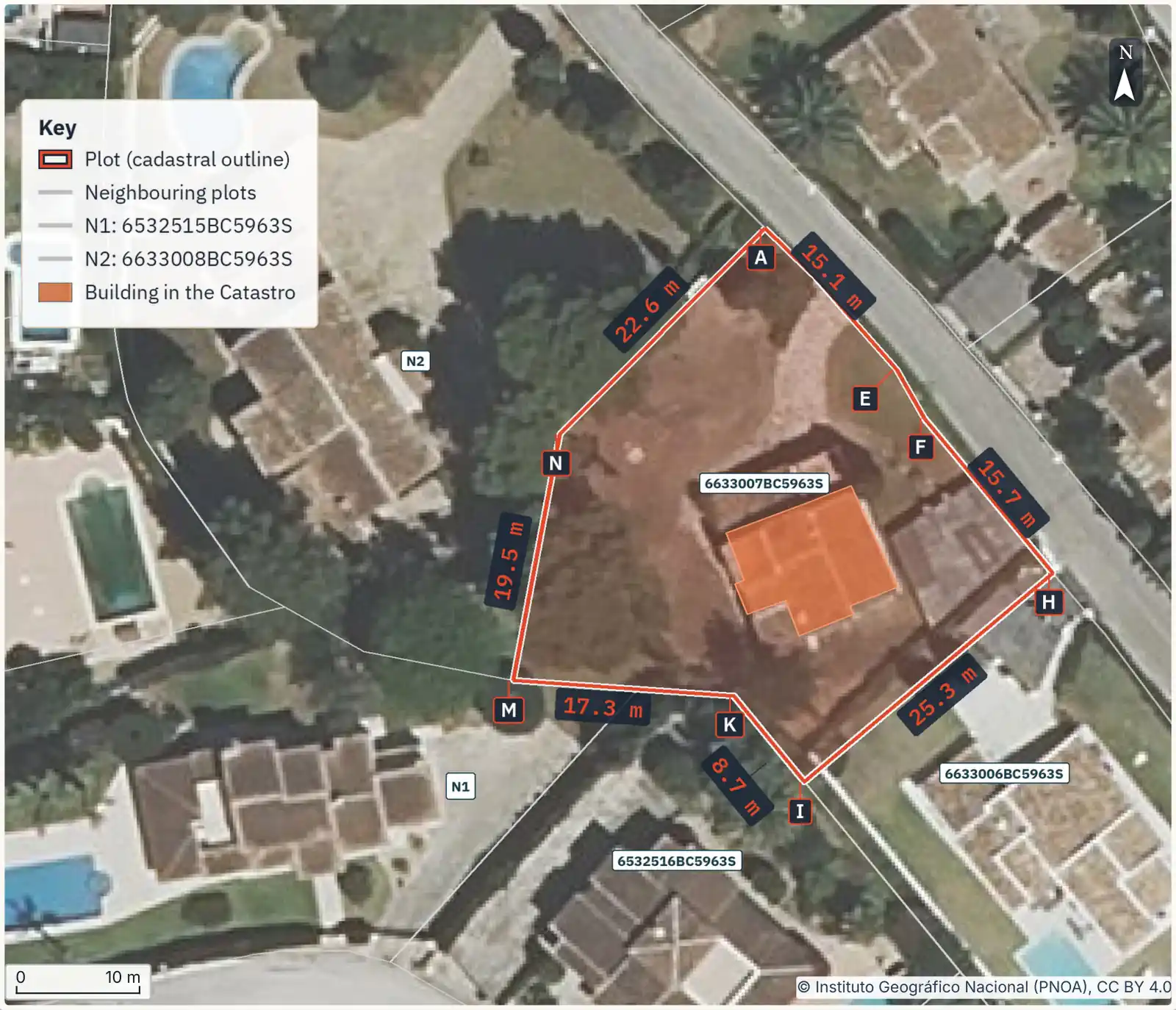
Before asking for the consolidation file, you can order the report for the plot by its cadastral reference and take the cadastral outline and area with you to compare against the title.
Common questions
Can I refuse to have my plot included?
No. Once agreed, consolidation binds every owner and rights holder inside the boundary (Law 1/2014, art. 38.2; LRDA, art. 171.3; Law 4/2015, art. 11.1). You can object and appeal within each stage's deadlines.
What happens to a mortgage on the old parcel?
It moves to the replacement plot. In Castile and León the charge holders name the plot or part it will fall on; if they do not, the authority does it (Decree 1/2018, art. 25.5).
I bought before the decision. Who gets the new plot?
In Castile and León, if the sale was completed and evidenced between publication of the final bases and the final taking of possession, you do, by stepping into the seller's place (Decree 1/2018, art. 48.1). In Galicia the buyer steps in from the decree, but the change of owner is recorded only within the cut-off dates and conditions of art. 41.3 of Law 4/2015.
Does the cadastral reference change?
It can: the Catastro receives the new layout after possession and with the deed (Decree 1/2018, art. 30). Check the current reference on the Catastro's online office before signing.
Keep reading
Check this on your own plot
Pin the plot on the map and confirm the cadastral reference: the report gathers the public data and official maps for it, each with its source and date. It does not replace the land registry extract, the notary or a tax adviser. €29 VAT included.