Pillar: Documents and contract
What is the difference between nota simple, certificate and simple copy from the Land Registry?
On this page
A nota simple is an information extract from the Spanish Land Registry that does not certify the entries; it costs €9.02 per property on the Registradores online office. A certificate is signed by the registrar and is the only document that proves charges against third parties (Mortgage Law, article 225). A "copia simple" comes from the notary, not the Registry: a copy of the deed without the effects of an authorised copy.

Agents and sellers use these words loosely, but they come from two different offices. The Land Registry ("Registro de la Propiedad") publishes what is registered either as a nota simple or as a certificate (Mortgage Law, article 222.2); the notary keeps the signed original deed and hands out copies. If someone asks you for a "copia simple from the Registry", they almost always mean a nota simple.
How to read a nota simple line by line is covered in the nota simple guide.
Two offices, four documents
The registrar answers for the registry books and is the only official who may certify what they contain (Mortgage Regulations, article 335). The notary keeps the "protocolo", the bound archive where the signed original deed stays, and only the notary holding it may issue copies (Notarial Regulations, article 222).
So they are not interchangeable: the nota shows the Registry today; the copy, what was signed on one day.
Nota simple: for checking
The regulations define the nota simple as a brief extract of the live entries for the property: its identification, the holders of registered rights and the extent, nature and limits of those rights, plus any bans or restrictions on them. It "has purely informative value and does not certify the content of the entries" (Mortgage Regulations, article 332.5).
It is issued electronically, with the Registry's electronic seal and a verification code (Mortgage Law, article 222.2). The Registradores online office charges €9.02 per property, taxes and withholdings extra, and will translate it into English for a further €30 plus tax. The safest reference is the CRU (the property's unique registry code, formerly IDUFIR) or the registry details; searching by owner name requires an electronic sign-in, or a lawyer or "gestor" (administrative agent) can order it.
It is the working document before you sign the arras (the deposit contract), and the regulations presume a legitimate interest when it is ordered for a valuation or a mortgage loan (article 332.5).
Certificate: for proving
A certificate is the registry statement that carries legal proof. The Mortgage Law puts it plainly: whether a property is free of charges or burdened "may only be proved to the detriment of a third party by a certificate from the Registry" (article 225).
The registrar signs it with a qualified electronic certificate (article 222.2). It is issued to anyone the registrar considers to have a known interest in the state of the property, or under a court order (article 227), as quickly as possible and never in more than four days per property (article 236). Online, you must identify yourself and state why you are asking.
Which certificate to order
The law distinguishes certificates of all entries on given property or persons, of specific entries, and negative certificates stating that no entries of a given kind exist (article 223). The online office sells them as follows:
| Document | What it covers | Price |
|---|---|---|
| Nota simple | Extract of the live entries for the property | €9.02 per property online |
| Title certificate ("certificación de dominio") | The latest registered ownership in force | Under the tariff: €9.015182 per property (item 4.1.a) |
| Title and charges certificate ("de dominio y cargas") | Ownership and every charge or burden in force | Under the tariff: €24.040484 per property, however many charges (item 4.1.b) |
| Literal certificate ("literal") | The entries in full (Mortgage Law, article 232) | Under the tariff; the office publishes no fixed figure |
| Certificate with continuous information | Notice of filings against the property for 30 calendar days (Mortgage Regulations, article 354) | €48.080968 (item 4.1.c) |
Product pages of the Colegio de Registradores online office read on 12.11.2026 and Royal Decree 1427/1989 (Registrars' Tariff), item 4.1, consolidated text. Prices in force in November 2026, before taxes and withholdings. Sources: Registradores online office, title and charges certificate; Registradores online office, nota simple; RD 1427/1989, Registrars' Tariff (BOE). Accessed 12 November 2026.
For certificates the online office gives no fixed price: the registrar invoices under the tariff, the amount can rise if expired entries have to be cancelled when it is issued (Mortgage Regulations, article 353), and €150 is held on your payment card, with an optional warning if the fees exceed €50 or €100. If what you must prove is the charges, ask for the title and charges certificate; the literal one only when someone needs the entries word for word.
A certificate with continuous information may only be ordered by the registered holders of rights over the property, their spouses or their legal representatives, for one registered property (article 354.2 and 354.3). It is a certificate with alerts for 30 days, not a standing online access service.
Simple copy and authorised copy: the deed
The original deed, the "matriz", stays in the notary's archive. Besides the original, its copies issued with the legal formalities are public deeds: the authorised copies, signed and sealed on paper by the notary or signed with the notary's qualified electronic signature (Notarial Regulations, article 221). Each party who signed is entitled to the first copy (Notaries Act, article 17), and so is anyone who acquires a right under the deed or shows a legitimate interest (Notarial Regulations, article 224.1).
The simple copy is something else. The notary issues it "without the effects of an authorised copy" and "only at the request of a party entitled to one", and it never shows the signatures (article 224.2). It lets you read the content. Since Ley 11/2023, a notary may issue electronic authorised copies on the same terms as paper ones, naming the recipient after checking their legitimate interest, through the notaries' online office; simple electronic copies go the same way, for information only (Notaries Act, article 17 bis.3). You can ask for either by appearing online (article 23.2.c). The same electronic route takes your purchase deed to the Registry. What the notary does on signing day is covered in the guide to the notary's role.
What the notary, bank and court ask for
The notary, before authorising a purchase, must check ownership and charges online, as close to signing as possible, and attach the result to the deed (Notarial Regulations, article 175.1 and 175.3). If that is technically impossible, a written request is allowed; the deed must then be signed within ten calendar days, with a warning that the Registry may have changed (article 175.2 and 175.4). The office may still ask you for a nota simple while preparing the deed.
A Spanish bank may ask for a nota simple when assessing a mortgage; the regulations presume a legitimate interest for that purpose (Mortgage Regulations, article 332.5).
A court, in a mortgage enforcement, asks the registrar for a title and charges certificate quoting the mortgage in full, and the registrar adds a marginal note that it has been issued (Civil Procedure Act, article 688). If you see that note on a nota simple, the property is in debt-recovery proceedings; how charges are cleared is in the guide to charges, mortgages and attachments.
How many enforcement certificates are issued
The Registrars' statistics ("Estadística Registral Inmobiliaria") count certificates issued for home mortgage enforcement: 12,545 across Spain in 2024, 8.9 % fewer than in 2023 and at the lowest levels of the series. Catalonia, Andalusia and the Valencia region accounted for 59.7 %.
What each one costs
Notarial copies are charged by the sheet. The notarial tariff sets €3.005061 per sheet or part of a sheet for authorised copies, half that from the twelfth sheet, and €0.601012 per sheet for simple copies (Royal Decree 1426/1989, item 4). If the deed is held in the Historical Archive, a district archive or a notarial archive and is more than five years old, the fees are doubled and €0.601012 is added for each year or part year of its age (item 4.3).
A villa made up of two registered properties
You live in the UK and agree to buy a villa that sits on two registry properties. Before the deposit your lawyer orders two notas simples online: 2 × €9.02 = €18.04 plus tax. If the seller later disputes the charges in court, you will need a title and charges certificate for each property: €24.04 per property under the tariff, with €150 held by the online office. If the seller's deed runs to 20 sheets and is not in a notarial archive at more than five years old, a simple copy costs 20 × €0.601012 = €12.02 and an authorised copy 11 × €3.005061 + 9 × €1.502531 = €46.58, tax extra.
Details you need to order them
For a nota simple or a certificate, the CRU or the registry details are the safest: province, Registry, municipality, section and property number. With the CRU the online office needs nothing else.
If you do not know which Registry holds the property, a nota de localización tells you where a person's properties are registered; then order a nota simple for each. For a copy of a deed you need the notary's office and, ideally, the date and protocol number, and you must show your right to a copy, or your authority if you ask on someone else's behalf (Notarial Regulations, article 229).
Common mistakes. A nota simple shows the Registry on the day it is issued; one that is weeks old misses anything filed since. Check that the property number and CRU match what you are buying, and get a nota for every registry property in the sale. And a simple copy of the seller's deed does not prove the seller still owns the property: only the Registry shows that.
What to do, in order
- A nota simple for each property. Where: the Registradores online office or the Land Registry. Who: you or your lawyer. Cost: online, €9.02 per property plus tax; at the Registry, the tariff sets €3.005061 per property (item 4.1.f), before tax and other items on the invoice. Time: no legal deadline; it arrives by email with a link to the PDF.
- A copy of the seller's deed. Where: the notary's office that keeps it, on paper or through the notaries' online office. Who: the seller, who is entitled to a copy, orders it or authorises you. Cost: €0.601012 per sheet for a simple copy; double, plus a storage fee, if it is archived and more than five years old. Time: whatever the notary's office tells you.
- A certificate, if someone needs proof. Where: the online office, after identifying yourself, or the Land Registry. Who: anyone with a known interest, or a court by order. Cost: under the tariff, with €150 held online. Time: at most four days per property.
- Signing and the authorised copy. Where: the notary of your choice. Who: the notary checks the Registry before signing and sends the electronic authorised copy to the Registry. Cost: notarial tariff, per sheet for the copy. Time: on signing day; ask for proof of filing.
- You have a recent nota simple for every registry property you are buying.
- The owner on the nota is the person signing the arras.
- You have read the marginal notes, including any charges certificate issued for a court.
- You know whether anyone will require a certificate, and which kind.
- You have seen a copy of the seller's deed.
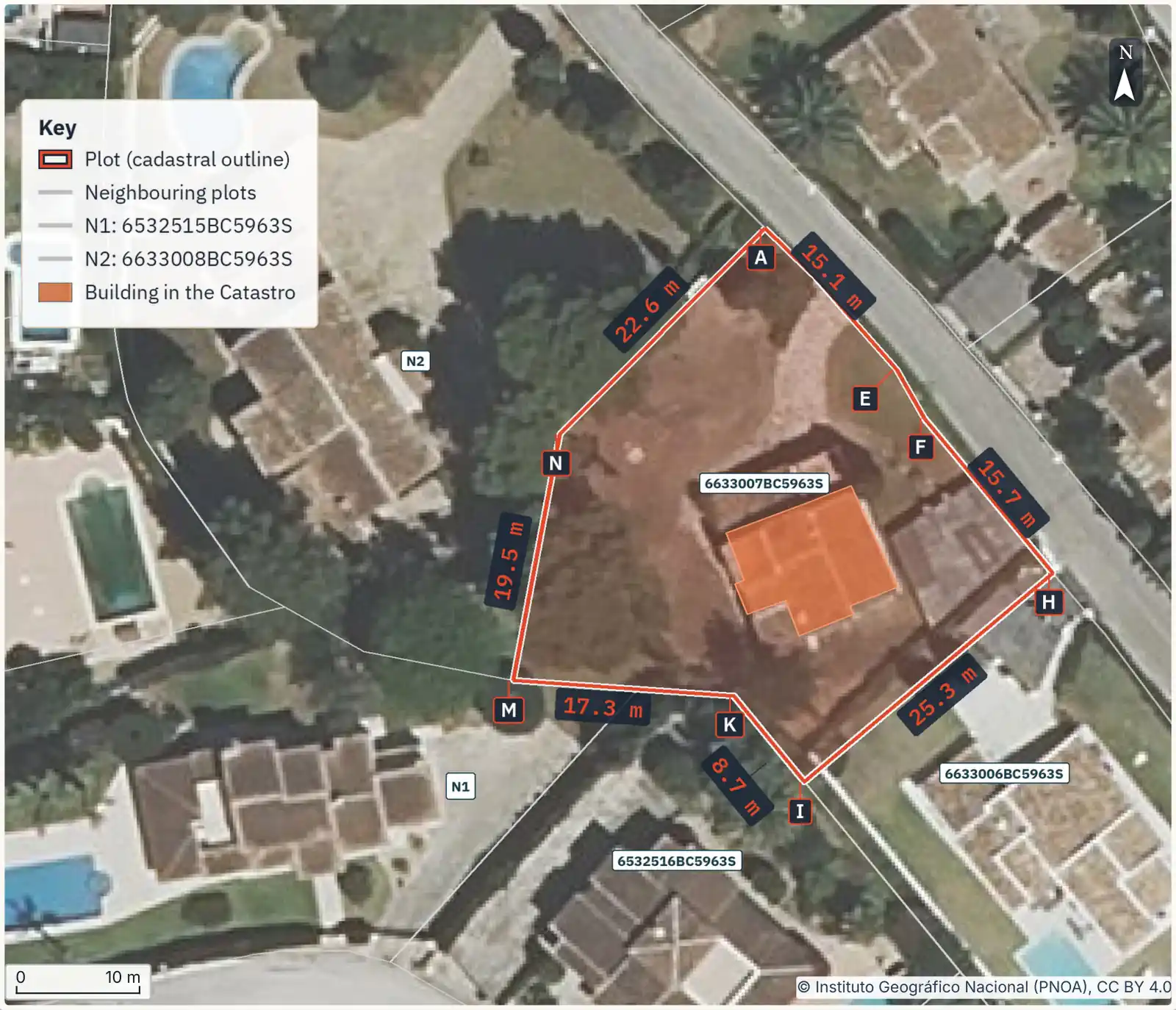
Before ordering the notas simples, you can order the report on the plot by its cadastral reference and take the cadastral outline to your lawyer.
Common questions
Is a copia simple the same as a nota simple?
No. The nota simple comes from the Land Registry and summarises what is registered on the property today. The copia simple comes from the notary and reproduces a deed, without the effects of an authorised copy (Notarial Regulations, article 224.2).
Will a nota simple do for a court?
Not to prove charges, or their absence, against third parties: the law requires a Registry certificate (Mortgage Law, article 225). The nota is for information only and does not certify the entries.
How long does a Land Registry certificate take?
The registrar must issue it as quickly as possible and never in more than four days per property (Mortgage Law, article 236).
What is a "certificado de titularidad"?
The online office calls it a "certificación de dominio": it shows the latest ownership in force, without the charges. If you also need the charges, order the title and charges certificate.
Can I get a copy of another owner's deed?
Only if you are entitled: the parties who signed, anyone who acquires a right under the deed and anyone the notary accepts as having a legitimate interest (Notarial Regulations, article 224.1). Simple copies also go only to someone entitled to a copy.
Keep reading
Check this on your own plot
Pin the plot on the map and confirm the cadastral reference: the report gathers the public data and official maps for it, each with its source and date. It does not replace the land registry extract, the notary or a tax adviser. €29 VAT included.