Pillar: Land, rights and services
What makes a rural septic system lawful in Spain?
On this page
For a rural property in Spain, establish where the wastewater goes and ask the competent water authority which procedure applies. Infiltration can be an indirect discharge, generally requiring prior consent. Sealed storage with full collection is a different arrangement; specific basin exceptions must be checked before choosing equipment.
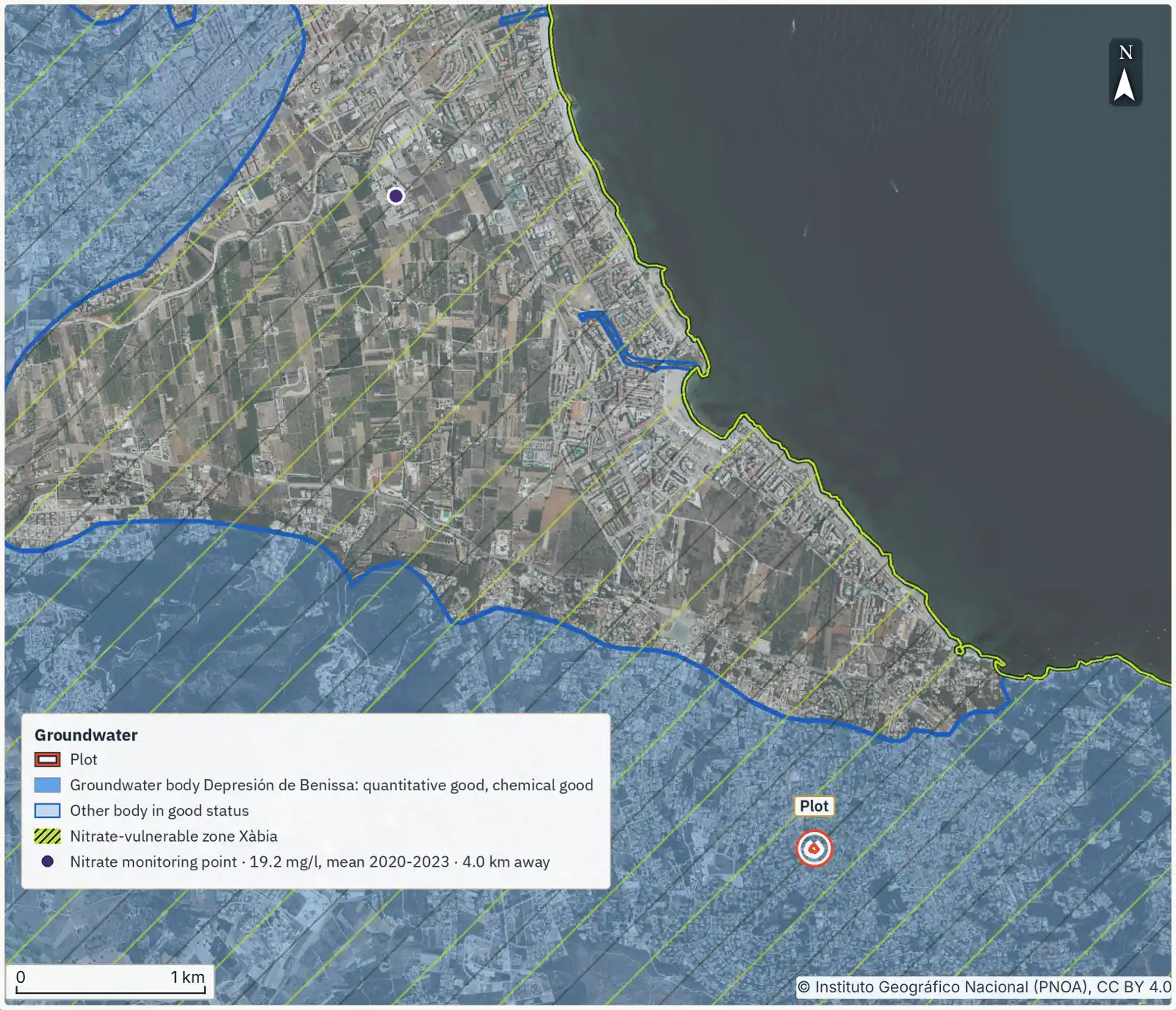
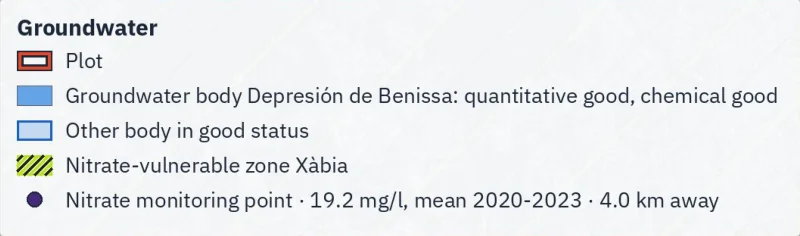

A Spanish property listing may call several different installations a “fosa séptica”. Before treating that as a working service, establish whether it stores everything, treats wastewater before infiltration, or discharges elsewhere. Ask for a drawing of the complete route rather than relying on the equipment name.
Trace the outlet before discussing equipment
Article 245 of the Reglamento del Dominio Público Hidráulico, the public water domain regulation, includes infiltration through soil or subsoil within indirect discharges to groundwater. Keeping the outlet inside your boundary does not remove the water authority from the picture.
The Ley de Aguas, Spain’s water law, generally requires prior administrative consent for discharges capable of contaminating the public water domain. Consent for the discharge and permission for the installation address different questions. Article 100.5 expressly preserves other approvals required for the activity.
Have the seller mark the drains, tank, treatment unit and final outlet on a plan. If nobody can locate the outlet, drainage is an unresolved purchase issue.
Recognise the arrangement you are buying
| Arrangement | What needs establishing | Evidence to request |
|---|---|---|
| Sealed holding tank, fully emptied | No outlet into the ground; all wastewater and sludge removed | Layout, watertightness assessment and contractor records |
| Treatment followed by infiltration | Infiltration point and applicable groundwater rules | Consent or other applicable instrument with its conditions and, if the authority required one, the hydrogeological study |
| Treatment followed by discharge to a watercourse | Receiving point and authorised conditions | Discharge consent and commissioning documents |
| Public sewer connection | Acceptance by the sewer operator | Relevant regional or local permission and connection records |
These are operating arrangements, not approvals of particular products. Sources: RDPH article 245, TRLA articles 101.2 and 102 and the Segura authority’s guidance, revision 1/2017, read on 13 November 2026. Sources: RDPH, article 245; TRLA, article 102; Segura authority, guidance. Accessed 13 November 2026.
What sealed storage means in Segura
In the Segura catchment, the authority’s published guidance says that a sealed container periodically emptied by an authorised contractor does not discharge to the public water domain. That description requires removal of both the sludge and all wastewater. The authority does not issue a discharge authorisation or endorse the suitability of such storage; the relevant local or regional administration must address that question.
A leaking tank does not fit the description. Nor does a sludge collection receipt necessarily show that the entire contents were removed. Ask your drainage professional to establish the physical arrangement and the contractor to explain exactly what its service covers.
If effluent enters the ground: the hydrogeological study
Under article 102 TRLA, where a discharge could lead to infiltration or storage of substances capable of contaminating aquifers or groundwater, it may only be authorised if a prior hydrogeological study shows it to be harmless. Under RDPH article 246 bis.3 the river basin authority can require that study when it considers a discharge to groundwater capable of contaminating it. Annex III, part C, sets the minimum content.
This is not an automatic requirement for every sealed tank: if nothing leaves the tank, there is no discharge to study. Where the design infiltrates, ask the authority before you buy equipment whether it will want the study. The answer can rule out a soakaway or drainage field, and the study is another line in your budget.
A single house: small-scale discharges
RDPH article 253 bis defines “vertidos de escasa entidad” as domestic wastewater discharges that cannot form part of an urban agglomeration, provided they do not exceed 50 population equivalents (“habitantes-equivalentes”). A population equivalent measures pollution load, not occupants: RD-ley 11/1995 defines it as 60 grams of five-day biochemical oxygen demand (BOD5) per day. Ask your designer to calculate the load for the house.
The application uses the official simplified declaration form plus the annex IX documents. For a factory-made unit these include a description showing CE marking under standard UNE-EN 12566, the product data sheet, the maintenance manual, a plan of the discharge point and, for infiltration, detailed drawings of the trench or soakaway. The authority decides without a public consultation or requests for reports from other bodies.
The result is still a discharge authorisation. It is not the Eastern Cantabrian declaración responsable described below. Article 253, by contrast, covers isolated settlements, housing estates and other groupings without legal personality.
The Eastern Cantabrian exception has boundaries
Within the Spanish part of the Eastern Cantabrian river basin district, article 51.1 of annex I to RD 35/2023 provides a particular route. It concerns domestic wastewater from single-family homes unable to connect to public sewers, infiltrated within the home’s plot after settlement and digestion, without affecting third parties.
For that qualifying situation, the provision removes the article 100 TRLA discharge authorisation requirement. The homeowner must instead notify the water administration through the corresponding declaración responsable, a formal declaration of compliance. Other necessary approvals remain required.
Confirm the catchment and every condition before relying on that route. An isolated location alone is insufficient. If you are buying elsewhere, obtain the procedure for that basin rather than asking an installer to submit a form found for another part of Spain.
Read the existing consent as a property document
Request the complete authorisation, its plans and its conditions. Check the holder, discharge location, flow, treatment and effluent limits against the installation you will acquire. An application reference does not establish that approval was granted.
Article 101 TRLA requires the authorisation to specify treatment, operating controls and the canon de control del vertido, the discharge control levy. Article 249 RDPH also addresses authorisations requiring works: full legal effect can depend on approval of a favourable final inspection record. For article 253 situations, the authority may determine that supporting documents can replace that record.
Obtain maintenance and waste collection records as well. Ask whether a change of ownership, additional occupancy or your intended use requires a further step. Have the authority explain the transfer or amendment procedure; the sale deed should not be assumed to update the discharge file automatically.
Decision time and consent duration are separate
Article 249.2 RDPH sets a maximum of one year for notification of a reasoned decision on the authorisation; absence of a decision may be treated as refusal. For an application initiated by the interested party, article 21.3.b of Ley 39/2015 starts the calculation on receipt in the electronic register of the administration or body competent to process it. Applicable statutory suspensions and extensions must also be considered.
The maximum duration of an authorisation is five years. Renewal depends on the environmental and water quality conditions in article 249.4 and does not prevent a review where appropriate. Read the actual period granted: the legal maximum is neither a tank warranty nor an exemption from inspections.
Site constraints
Do not accept a universal separation from wells, boundaries or streams copied from a product leaflet. Ask the designer to identify the requirements for the receiving environment and the competent administration. A nearby channel may create an additional issue: see building near a river or rambla. A private borehole needs its own water-rights check.
Comparing running costs: a worked example
Spain has no national installation price. The example below uses assumed figures to show the arithmetic; they are not market rates. Assumptions: the house produces 0.4 m³ of wastewater a day (146 m³ a year); the sealed tank holds 10 m³ usable; each contractor visit costs €250 including travel and waste handling; the infiltration option needs one sludge removal a year, and its consent sets a levy coefficient of 1.
| Item | A. Treatment with infiltration | B. Sealed holding tank |
|---|---|---|
| One-off: studies and design | €1,500 | €600 |
| One-off: equipment and works | €5,000 | €4,000 |
| Total investment | €6,500 | €4,600 |
| Yearly maintenance | 1 emptying × €250 = €250 | 15 collections (146 ÷ 10 = 14.6) × €250 = €3,750 |
| Discharge control levy | 146 m³ × €0.01751 × 1 = €2.56 | Not applicable: no discharge |
| Total per year | €252.56 | €3,750 |
Hypothetical example with assumed amounts, not market prices. Discharge control levy: TRLA article 113.3, basic price €0.01751 per m³ of urban wastewater, read on 13 November 2026; the actual amount is stated in the consent (RDPH article 291.4). Sources: TRLA, article 113; RDPH, article 291 and annex IV. Accessed 13 November 2026.
On these assumptions, over ten years option A costs €6,500 + 10 × €252.56 = €9,025.60, and option B €4,600 + 10 × €3,750 = €42,100. The levy hardly matters: the regulatory coefficient cannot exceed 5, which here would give €12.78 a year. The number of collections drives the result, and option A only exists if the authority approves infiltration. Ask for real quotes broken into the same lines, and note what they leave out, such as regional or municipal sanitation charges, which are separate from the levy. If you will spend long periods abroad, ask how collections and maintenance visits will be arranged in your absence.
Buying a house with records in someone else’s name
Give your adviser copies rather than summaries translated by the seller. Ask for the operative conditions to be explained in English, keeping the Spanish document and reference as the record. A foreign buyer needs to know which obligations continue after completion, rather than simply whether a document has an official stamp.
For electricity and water alongside drainage, use the separate guide to rural utility connections.
A collection receipt and an infiltration trench
A buyer receives records of sludge removal, but the installation plan shows a trench beyond the tank. Their surveyor checks whether treated liquid enters the ground. The buyer requests the corresponding water authority file before accepting the seller’s description of the system as sealed storage.
A practical sequence before committing
- Ask about a public connection. Contact the town hall and sewer operator for written availability and connection requirements. Ask for the local service’s processing period before agreeing a completion date; it is not a national period.
- Commission the physical check. Have a competent professional inspect and draw the actual route. Agree the delivery time in the appointment; finish it before treating drainage as resolved.
- Confirm the basin procedure. Apply to the competent water administration with the article 246 discharge declaration, the article 253 bis simplified declaration with annex IX documents if the house qualifies, or the specific basin route it confirms. Ask whether it will require a hydrogeological study. The authorisation procedure has a one-year maximum from receipt in the competent electronic register, subject to applicable timing rules.
- Check commissioning and ongoing duties. Review the consent, any required final record or replacement evidence, controls and ownership procedure. The file sets the relevant works and monitoring dates.
Drainage does not establish a lawful home A satisfactory wastewater arrangement does not confirm planning permission or a lawful residential use. Check the house’s planning documents separately. Technical paperwork for the equipment also does not replace the discharge approval required for its location.
- Complete route from the house to the receiving destination.
- Consent or applicable legal instrument with all conditions.
- Hydrogeological study, if the authority required one for infiltration.
- Installation and commissioning evidence required by that route.
- Maintenance, monitoring and contractor records.
- Written advice on holder, capacity and proposed use.
You can order the plot report to prepare questions about the location and water mapping, then review the drainage documents with your professional and the competent authority.
Common questions
Does infiltration always require discharge consent?
Prior consent is the general rule for a potentially contaminating discharge, and the authority can require a hydrogeological study showing it is harmless (TRLA article 102). Check the relevant basin plan for specific exceptions, including the conditional Eastern Cantabrian route described here.
Is town hall permission sufficient?
Local permission does not replace water authority consent where required. The water law expressly preserves other necessary approvals.
Does Segura issue discharge consent for a sealed holding tank?
Its guidance distinguishes sealed storage with authorised collection of all wastewater and sludge. It does not authorise that as a discharge or assess suitability; local or regional requirements still need checking.
Will the authorisation necessarily run for five years?
Five years is the legal maximum. Read the granted period and the renewal and review conditions in RDPH article 249.4.
Keep reading
Can a rural home in Spain get electricity, water and drainage?
Can I use the well water on a property I buy in Spain?
Buying near a river or a dry rambla in Spain: the 100-metre rule, the River Basin Authority permit and what to check before the deposit
Check this on your own plot
Pin the plot on the map and confirm the cadastral reference: the report gathers the public data and official maps for it, each with its source and date. It does not replace the land registry extract, the notary or a tax adviser. €29 VAT included.