What is the cadastral reference value and how do you check it?
On this page
It is the value the Catastro (Spain's property survey and tax register, separate from the Land Registry) gives each property every year from notarised sales. It is the minimum base for transfer tax (ITP) and for inheritance and gift tax: if the price or declared value is higher, you pay on that. Its reports do not cover the Basque Country or Navarre. You can look it up free on the Catastro website with a DNI or NIE, a digital certificate or Cl@ve.
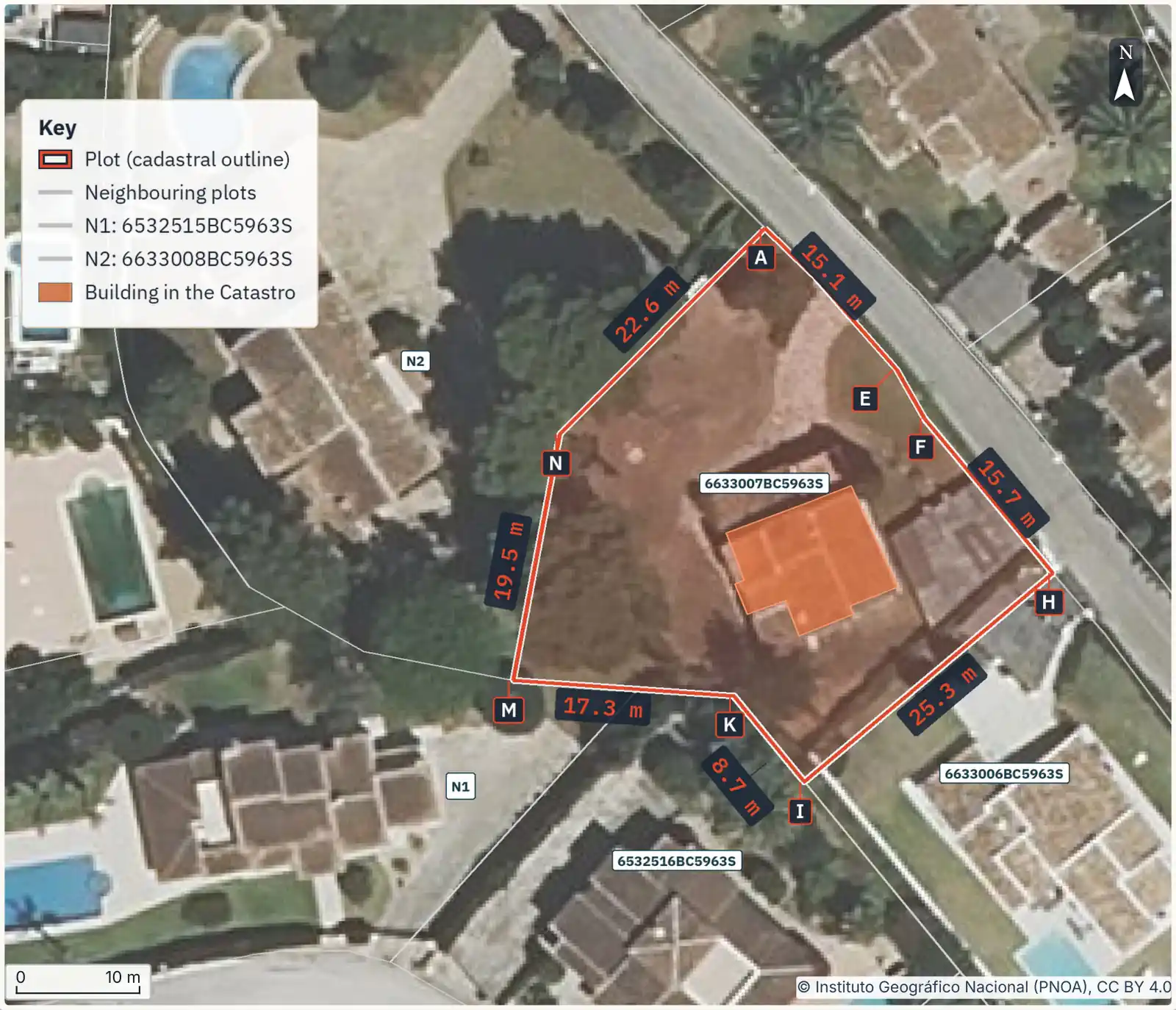

The reference value ("valor de referencia") decides how much transfer tax you pay when you buy a house or a plot from a private seller, even if the price in the deed is lower. Look it up before you sign the deposit contract ("arras"), using the cadastral reference of each plot. The Catastro's market reports leave out the Basque Country and Navarre.
If the sale carries VAT instead of ITP, see VAT or ITP when buying land.
What it is and where it comes from
The Dirección General del Catastro sets it objectively and capped at market value, by analysing the prices that notaries and other public officials report for property sales (Cadastre Law, final provision three). It is part of the property's cadastral description, alongside its area, use and cadastral value (art. 3.1). Law 11/2021, in force since 11 July 2021, made it the base for ITP and for inheritance and gift tax, and the Catastro has published it online since 1 January 2022.
The work starts with an annual property market report. For the 2026 values, the urban report analysed 1,194,648 home sales and 495,928 parking-space sales completed between 1 April 2023 and 31 March 2025. From those prices the Catastro splits the country into uniform zones and gives each an average value module. It then adjusts that figure to each property: for urban property by category, age and state of repair; for rustic land by location, farming and socio-economic factors.
Finally it applies a reduction factor of 0.9, the same for urban and rustic property, so that the reference value stays below market value (Order HFP/1104/2021, arts. 1 and 2).
Reference value and cadastral value
| Cadastral value ("valor catastral") | Reference value ("valor de referencia") | |
|---|---|---|
| What it is for | Base of IBI and other taxes that use it | Base of ITP and AJD and of inheritance and gift tax |
| How it changes | Budget laws and collective revaluations | Every year, in all municipalities at once |
| Is it public? | Protected, not published | Published on the Catastro website |
| Effect on IBI | It is the IBI base | None: it does not change the cadastral value |
| How you dispute it | Cadastral procedures | In the tax procedure: rectifying the self-assessment or appealing the assessment |
The two values shown in a property's cadastral description. Source: Catastro FAQ and BOE consolidated texts. Sources: Catastro, frequently asked questions; RDLeg 1/2004, Cadastre Law. Accessed 12 November 2026.
How the tax is worked out
Article 10.2 of the ITP law covers three cases. If the property has a reference value and neither the price nor the declared value is higher, the base is the reference value. If either is higher, the base is the highest of those figures. If there is no reference value, or the Catastro cannot certify it, the base is the highest of declared value, price and market value, subject to administrative review. The rate applied to that base is set by each region and is in the guide to ITP by region.
The value that counts is the one on the tax date, which for a sale is the day the contract is made (art. 49.1.a). When the base is the reference value or a higher figure, the tax office cannot open a valuation review of the property (art. 46.1).
A rustic plot without buildings bought below its reference value
You are a non-resident buying an olive grove from a Spanish private seller for €30,000, and the Catastro website gives a reference value of €36,000 on the contract date. The base is €36,000. At a hypothetical rate of 7%, the ITP is €2,520; worked out on the price it would be €2,100, so a budget based on the price falls €420 short. If you paid €40,000, the price would be the base and the tax €2,800.
Inheritances and gifts
For an inheritance or a gift there is no price, so the base is the reference value on the tax date, or the declared value if higher (Law 29/1987, art. 9.3). For an inheritance, that date is the day of the death (art. 24.1).
Looking it up on the Catastro website
The reference value is not personal data and can be consulted at any time on the Catastro's online office, the Sede Electrónica (Cadastre Law, final provision three). For 2026 it offers the lookup, the value maps and the market reports published on 9 October 2025; those for 2027 came out on 25 September 2026.
- Find the cadastral reference of each plot on the nota simple (land registry extract), the IBI bill or the seller's deed. Who: you. Cost: nothing. Time: a few minutes.
- Go to the Sede Electrónica, reference value section, and pick the tax year in which you will sign. You log in with your DNI or NIE details and its document support number, a digital certificate or Cl@ve (the state online login system). Who: you or your gestor (tax and paperwork agent). Cost: no fee online (Cadastre Law, art. 62.2). Time: a few minutes.
- Get the certificate of the reference value on the contract date. The registered owner can also get a statement of reasons ("certificado de motivación") with every element of the calculation. Who: the seller, if you need the reasons before you buy. Cost: no fee online. Time: immediate.
- If you have no electronic ID, call the Catastro helpline (91 387 45 50 or 902 37 36 35) or book an appointment at a regional office ("Gerencia"). Who: you. Cost: the call; a certificate issued at the office carries the cadastral certification fee, paid by whoever requests it. Time: no set time; it depends on the appointments available.
Rustic land: with or without buildings
The Cadastre Law's transitional rules give calculation guidelines for two groups: urban property and "rustic property without buildings" (Cadastre Law, transitional provision nine). The yearly resolutions are approved for those two groups, and the Catastro states that there is no reference value for property outside their scope.
For rustic land without buildings, the 2025 report divides the territory into 233 uniform zones and sorts crops into 27 groups (dry arable, irrigated, olive, vineyard, pasture, woodland). In each zone the value map gives an average price per hectare for each group. Your plot's value therefore depends on the crop recorded in the Catastro.
The same report leaves out of the analysis any property with at least one building, whatever its use and size: 16,434 sales at the first filter and 6,143 more at the regional offices' review.
If you are buying a country house ("casa de campo") or a farm with a barn, check on the Sede whether it has a reference value that year. If it does not, the base will be the highest of declared value, price and market value, and the tax office may review it (RDLeg 1/1993, arts. 10.2 and 46). The same applies if the crop recorded in the Catastro is no longer what is grown: correct it through the cadastral procedure, which is separate from the tax.
If the value seems too high
The reference value may only be challenged in two procedures: by appealing the tax office's assessment or by asking to rectify your self-assessment (RDLeg 1/1993, art. 10.3). Neither depends on having paid first. You can file on that value and then ask for a rectification, arguing that it harms your legitimate interests, except during a tax audit or inquiry covering that tax, where you argue your case within that procedure (RD 1065/2007, art. 126.2). The tax office decides after a mandatory and binding report from the Dirección General del Catastro, which confirms or corrects the value in the light of what you provide (art. 10.4).
Time limits for a challenge
| Route | When | Time limit | Law and article |
|---|---|---|---|
| Request to rectify the self-assessment | You have already filed the self-assessment on the reference value. Not possible while a tax audit or inquiry covering that tax is under way: there, you submit your arguments and documents. After a provisional assessment, only on a ground other than the one it settled | Before the final assessment or, failing that, before the right to assess or to claim the refund is time-barred (four years); the tax office decides within six months, or it is deemed refused | RD 1065/2007, arts. 126.2, 126.3 and 128.4; General Tax Law, art. 66 |
| Appeal for reconsideration ("recurso de reposición") | The tax office sends you an assessment | One month from the day after notification | General Tax Law, art. 223.1 |
| Claim to the regional tax tribunal ("reclamación económico-administrativa") | Against the assessment, before the Tribunal Económico-Administrativo Regional | One month from the day after notification | General Tax Law, art. 235.1 |
| Appeal against the Catastro's yearly resolution | Against the year's criteria, not your plot | One month from publication; to the central tax tribunal (TEAC) or, first, to the Catastro, not both at once | Cadastre Law, final provision three |
Time limits from the General Tax Law (consolidated text of 21.12.2024) and its management regulation (consolidated text of 7.10.2026). Sources: Law 58/2003, General Tax Law; RD 1065/2007, tax management and inspection regulation. Accessed 12 November 2026.
What the Constitutional Court said
In STC 13/2026 of 12 February, the Constitutional Court dismissed the challenge to article 10 and noted that the system lets taxpayers prove a different value with no limit on the kind of evidence, expert reports included. The specific procedure of a contradictory expert valuation ("tasación pericial contradictoria") is not available, but you can file an expert report with your request or appeal.
Before you sign
What this guide does not settle. It does not work out the value of a particular plot or tell you whether an appeal will succeed: that depends on the evidence. Rates, reliefs and filing deadlines are set by each region. The Basque Country and Navarre have their own rules; ask their foral tax office.
- You have the reference value of each plot for the year you will sign.
- If signing slips into the next year, you have looked it up again.
- Your ITP budget uses the highest of price, declared value and reference value (market value instead of reference value if the plot has none).
- If the rustic plot has buildings, you know whether it has a reference value that year.
- The crop and area recorded in the Catastro match what you see on the ground.
If you are about to make an offer on a rustic plot, you can order the report by its cadastral reference and see first which crop, area and buildings the Catastro records.
Common questions
Where can I see a property's reference value?
On the Catastro's Sede Electrónica, in the reference value section, choosing the tax year. You log in with your DNI or NIE details, a digital certificate or Cl@ve. The Catastro helpline (91 387 45 50 or 902 37 36 35) and the regional offices, by appointment, also provide it.
Does the reference value raise my IBI?
No. According to the Catastro, it does not affect the current cadastral value and has no effect on IBI or on taxes based on the cadastral value.
What happens if the deed shows less than the reference value?
In a purchase subject to ITP, the tax is worked out on the reference value, because it is the minimum base (RDLeg 1/1993, art. 10.2). If the price or the declared value is higher, you pay on the higher figure. If the property has no reference value that can be certified, the base is the highest of declared value, price and market value.
Can I challenge the reference value before I buy?
Not the value of your plot: only in the tax procedure, by asking to rectify your self-assessment or by appealing an assessment (art. 10.3). The Catastro's yearly resolution can be appealed within a month of publication, but that disputes the year's criteria, not your plot.
Does a rustic plot with a house have a reference value?
The Catastro's yearly resolutions cover urban property and rustic property without buildings, and there is no reference value outside their scope. Check on the Sede. If it has none, the base is the highest of declared value, price and market value, open to review.
When does the reference value change?
Every 1 January. The Catastro approves the next year's resolution before 30 October and publishes a BOE notice in the first 20 days of December (Cadastre Law, final provision three). The value on the tax date is the one that counts.
Keep reading
Check this on your own plot
Pin the plot on the map and confirm the cadastral reference: the report gathers the public data and official maps for it, each with its source and date. It does not replace the land registry extract, the notary or a tax adviser. €29 VAT included.