Do you pay VAT or transfer tax when buying a plot?
On this page
It depends on who sells and what kind of land it is. On the mainland and in the Balearics, if the seller is a private individual not acting as a business, you pay transfer tax ("ITP", in its "TPO" form) at the regional rate. If a business sells in the course of its activity, you pay 21% VAT ("IVA") plus stamp duty ("AJD") when the plot is building land or land developed or being developed (public parks, gardens and roads excepted), and ITP when it is rustic or non-buildable, unless the seller waives the exemption (Law 37/1992, articles 20.Uno.20º and 20.Dos).

Nationality or residence play no part: the transfer tax falls on property located in Spain (RDLeg 1/1993, article 6.1.A). The right to deduct VAT belongs to businesses and professionals (Law 37/1992, article 93.Uno), not to someone buying a plot for their own house.
This page deals with land without buildings. Houses, notary and Land Registry fees and other regions' rates are in the guide to the cost of buying; the tax number a foreign buyer needs is in the NIE guide.
First question: who is selling
VAT applies to supplies of goods made by businesses or professionals in the course of their activity (Law 37/1992, article 4.Uno). A trading company is a business unless the contrary is shown, and so is anyone who develops land or builds in order to sell, even occasionally (article 5.Uno, letters b and d). Farming, forestry and livestock are business activities (article 5.Dos), and selling an asset of the business is part of the activity (article 4.Dos.b).
A person selling a plot from private assets, not developed for sale, does not charge VAT: you pay TPO (RDLeg 1/1993, articles 7.1.A and 8.a). A farmer selling a field that belongs to the farm sells as a business, but if that field is rustic and not developed the sale is exempt from VAT and you pay ITP (Law 37/1992, article 4.Cuatro).
Second question: what land it is
The exemption in article 20.Uno.20º covers rustic land and other land that is not buildable, including structures on it that a farming business cannot do without. Land is buildable when it is a "solar" under planning law, or when an administrative licence has authorised building on it.
The same provision takes out of the exemption, even if not buildable, land that is developed or being developed ("urbanizado o en curso de urbanización"), unless meant only for public parks and gardens or public roads, and land sold together with buildings under construction or finished whose supply is taxable and not exempt. Non-buildable land with structures that are halted, ruinous or demolished stays exempt.
| Who sells and what land | What the buyer pays |
|---|---|
| A person not acting as a business who did not develop the land for sale | TPO at the regional rate |
| Business: a "solar" or land with a building licence | 21% VAT and AJD |
| Business: land developed or being developed, not meant only for public parks and gardens or public roads | 21% VAT and AJD |
| Business: rustic or non-buildable land that is not developed, including land with indispensable farm structures or with halted, ruinous or demolished structures | VAT exempt: TPO |
| Business: exempt land, with a valid waiver of the exemption | 21% VAT, accounted for by the buyer and not paid to the seller, and AJD |
| Business: land with a building under construction or finished, sold together | If the supply of the building carries VAT, the land is not exempt |
Rule for the mainland and the Balearics under the common regime. AJD: the variable charge on the first copy of a registrable deed, at each region's rate. Basis: Law 37/1992, articles 4.Cuatro, 20.Uno.20º, 20.Dos, 84.Uno.2º.e and 90.Uno; RDLeg 1/1993, articles 7, 8 and 31.2. Sources: Law 37/1992 on VAT; RDLeg 1/1993, ITP-AJD. Accessed 12 November 2026.
Land being developed
Article 20.Uno.20º does not say from what moment land is "being developed". If the sector has a development project or works under way, ask the seller to justify the tax in writing; the charges on such land are in the guide to developable land and urbanisation costs.
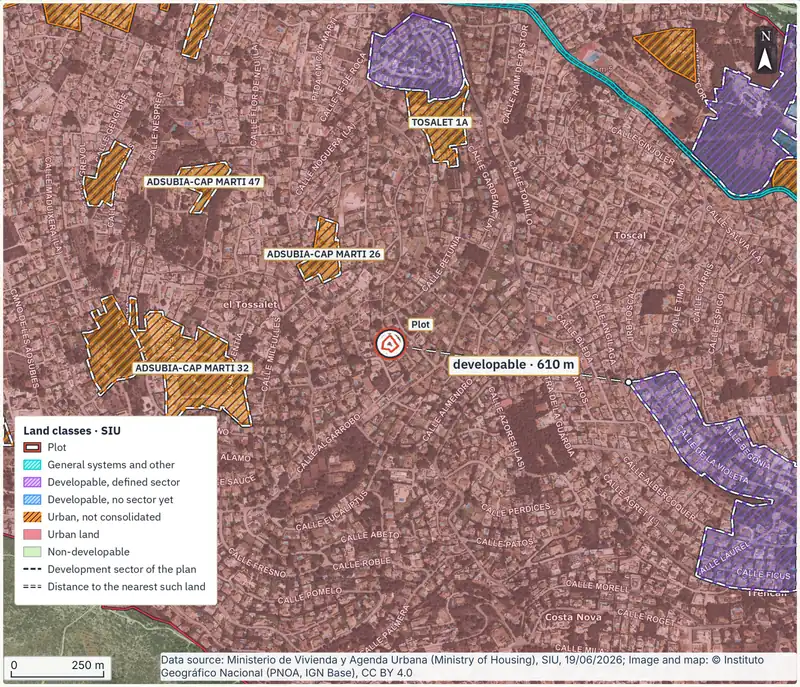
The land class is checked in the town plan (rustic and urban land) and requested in writing from the town hall (planning certificate).
How much tax will you pay?
VAT on a plot is 21%, a national rate; the 10% rate is only for buildings fit to be used as homes (Law 37/1992, articles 90.Uno and 91.Uno.1.7º). TPO and AJD rates are approved by each region (RDLeg 1/1993, articles 11.1.a and 31.2). The rates of each region, with their bands and deadlines, are in the guide to ITP by region.
| Item (November 2026) | Andalusia | Valencia region |
|---|---|---|
| TPO, general rate on real property | 7% | 9% |
| AJD, general rate on the deed | 1.2% | 1.4% |
| AJD where the VAT exemption was waived | 1.2% (general rate) | 2% |
| Deadline for the self-assessment | Two months from the day after the tax accrues | One month from the day of the act or contract |
General rates, without reliefs, from the consolidated texts of 31.12.2025 (Andalusia) and 10.8.2026 (Valencia region; the 9% becomes 11% if the value is above €1 million). The Andalusian text as read contains no specific AJD rate for a waiver. Sources: Andalusia, Law 5/2021, articles 41, 49 and 69; Valencia region, Law 13/1997, articles 13, 14 and 14 ter. Accessed 12 November 2026.
The same €100,000 plot in Andalusia
A private owner sells you a rustic plot for €100,000 and the reference value is not above the price: you pay €7,000 of TPO (7%). A developer sells you a "solar" for €100,000 plus VAT: you pay the developer €21,000 of VAT against an invoice and the region €1,200 of AJD (1.2% of the value declared in the deed), €22,200 in all.
What each tax is charged on
VAT is charged on the consideration (Law 37/1992, article 78.Uno). TPO, on the Catastro reference value ("valor de referencia") at the date the tax accrues, or on the price or declared value if higher; where no reference value can be certified, on the highest of declared value, price and market value (RDLeg 1/1993, article 10.2). AJD, on the declared value, never below the article 10 value (article 30.1).
Waiving the exemption
The seller may waive the exemption on non-buildable land and sell it with VAT, but only if the buyer is a taxable person acting in the course of a business or profession with the right to deduct, in full or in part, the VAT on the purchase. Failing that, it is enough that the foreseeable use of the land is, in full or in part, an activity that gives the right to deduct (Law 37/1992, article 20.Dos). A private person buying land to build a home does not meet the first condition.
The waiver must be notified to the buyer verifiably before or at the time of the supply, is made transaction by transaction, and is backed by a declaration signed by the buyer about their right to deduct (RD 1624/1992, article 8.1). In these sales the taxable person for the VAT is the buyer (Law 37/1992, article 84.Uno.2º.e).
You also pay AJD on the deed, and the Valencia region raises the rate to 2% where the exemption was waived (Law 13/1997, article 14.Dos).
How and when you pay
In an ordinary sale with VAT, the seller charges it on an invoice ("factura"), with the tax shown separately, when the invoice is issued (Law 37/1992, article 88). With a waiver of the exemption the seller does not charge it: the buyer is the taxable person (article 84.Uno.2º.e), declares the VAT to the tax office and does not pay it to the seller. Payments made before the handover trigger VAT when received, on the amount received (article 75.Dos); see the guide to the arras contract.
ITP and AJD are self-assessed by the buyer (RDLeg 1/1993, articles 8.a and 29) at the office for the territory where the land lies (RD 828/1995, article 103). TPO accrues on the day of the contract and AJD on the day the deed is signed (RDLeg 1/1993, article 49.1). In Andalusia you file form 600 ("modelo 600") within two months from the day after accrual (Law 5/2021, article 69.1); in the Valencia region, within one month from the day of the act or contract (Law 13/1997, article 14 ter.1). The national regulation speaks of thirty working days (RD 828/1995, article 102.1): confirm your region's deadline.
What this rule does not cover
Limits of this guide. The rule does not cover the Canary Islands, Ceuta, Melilla, the Basque Country or Navarre, the purchase of a whole business or farm as a going concern (Law 37/1992, article 7.1º), sales in insolvency or on enforcement of a security to a business buyer (article 84.Uno.2º.e), or regional tax reliefs.
What to do, in order
- Order a nota simple (Land Registry extract) and see whether the owner is a company or a person.
- Ask the town hall for a planning report or certificate: land class, whether it is a "solar", any building licence or development under way.
- Ask the seller in writing in what capacity they sell and which tax they will apply.
- Fix in the arras contract the tax and whether the price includes VAT. With VAT, require an invoice for the deposit on the day you pay it.
- At the notary's office, on the day of the deed. If the sale carries VAT because the plot is a "solar", has a building licence or is developed, pay the VAT to the seller against an invoice. If the seller waives the exemption, sign the declaration under article 8.1 of the VAT Regulation before or on that day and do not pay the VAT to the seller: you declare it to the tax office yourself as the taxable person (Law 37/1992, article 84.Uno.2º.e).
- After the deed, self-assess TPO or AJD with the regional tax agency, within your region's deadline. Then present the deed at the Land Registry, which will not accept it without proof of payment, of a declared exemption or, at least, of presentation to the tax administration (RDLeg 1/1993, article 54.1).
- The town hall has given you the land class in writing, and whether there is a licence or development under way.
- The seller has told you in writing which tax applies, and the contract says whether the price includes VAT.
- You have worked out the tax with your region's rate and the Catastro reference value.
Before you write to the town hall and the seller, order the report for the plot by its cadastral reference to know the land class first.
Common questions
Is there VAT on rustic land in Spain?
Not if a private individual who is not acting as a business sells it: you pay ITP (TPO). If a business sells it, the sale is exempt from VAT and you also pay ITP, except as set out in articles 20.Uno.20º and 20.Dos: land developed or being developed (not meant only for public parks and gardens or public roads), land with a building licence, land sold together with a building whose supply carries VAT, or a valid waiver of the exemption.
Can I choose between VAT and ITP?
No. The tax follows from the seller's status and the state of the land. The only option the act provides is the seller's waiver of the exemption, and it requires the buyer to be a business or professional with the right to deduct, in full or in part, or to be going to use the land for transactions that give the right to deduct (article 20.Dos).
Is VAT on a building plot 10% or 21%?
21%, the general rate (Law 37/1992, article 90.Uno). The 10% rate applies to buildings or parts of buildings fit to be used as homes, with up to two parking spaces and annexes sold with them (article 91.Uno.1.7º); a plot is not a building, even if you intend to build your home on it.
If I pay VAT, do I also pay ITP?
You do not pay both VAT and TPO on the same purchase (Law 37/1992, article 4.Cuatro). With VAT you do pay the variable AJD charge on the first copy of the registrable deed, at the regional rate (RDLeg 1/1993, article 31.2): 1.2% in Andalusia and 1.4% in the Valencia region as general rates in November 2026.
Can a private individual sell land with VAT?
Yes, where for VAT purposes they act as a business: if they developed the land in order to sell it, even occasionally (article 5.Uno.d), or if the land is part of their business assets, for example a farm or a let property (articles 4.Dos.b and 5.Uno.c). Even then, rustic or non-buildable land is exempt from VAT and you pay ITP, with the exceptions already listed.
Keep reading
Check this on your own plot
Pin the plot on the map and confirm the cadastral reference: the report gathers the public data and official maps for it, each with its source and date. It does not replace the land registry extract, the notary or a tax adviser. €29 VAT included.