Pillar: Planning and buildings
Can I build on rural nucleus land in Galicia?
On this page
In Galicia, yes, with a town hall licence, if the plot has public road access, you pay for and build the connection to the existing village services, you hand over any land the plan needs for the street and you meet the plan's village rules (Law 2/2016, articles 24 and 55). Minimum plot size and height come from each municipal plan; the 2,000 m² and 7 m in the law apply to rustic land.
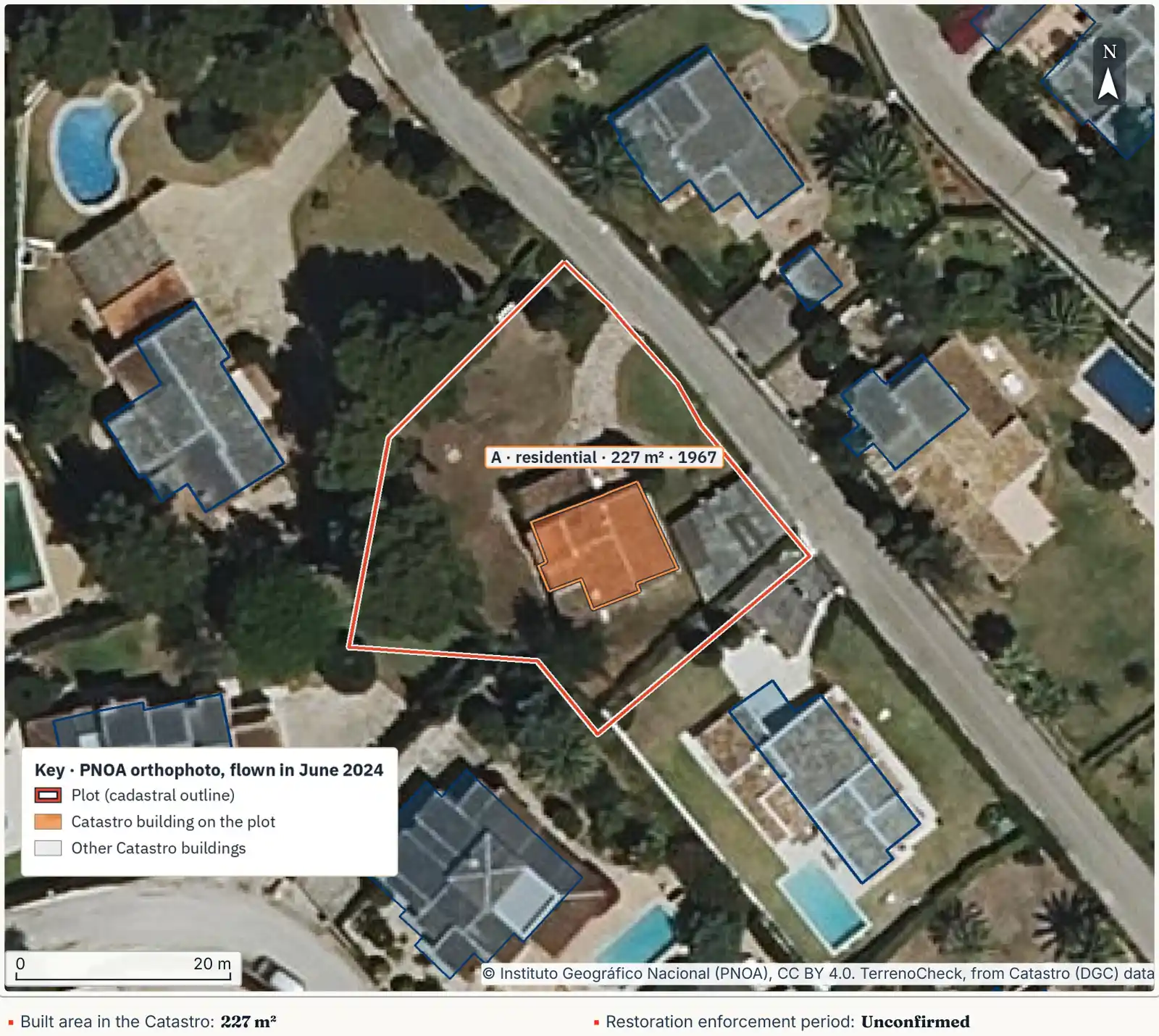

Galician law sorts land into four classes: urban, rural nucleus, land earmarked for development and rustic (article 15). The rural nucleus is the class for hamlets and villages. If the house or field you are looking at sits inside the nucleus boundary, the town hall ('concello') licenses building under the plan's village rules. Fifty metres outside the line, none of what follows applies: check the plan for that plot's own class (urban, development land or rustic) and apply its rules.
General rules for a house on rustic land across Spain are in the guide to rustic and urban land; this page covers what is specific to Galicia.
What Galician law calls a rural nucleus
Law 2/2016 on land in Galicia defines a rural nucleus as the area that supports a settlement identifiable in the census and population registers, provided the planning documents define and draw its boundary (article 23.1). A village having a name and residents is not enough. What counts is the line on the municipal general plan.
The plan picks one of two basic types (article 23.3):
- Traditional rural nucleus ('núcleo rural tradicional'): a hamlet, village or quarter of traditional character, with a degree of consolidation by building ('grado de consolidación') of at least 50% inside the boundary.
- Ordinary rural nucleus ('núcleo rural común'): a settlement recognisable by its plot pattern or old lanes but lacking the features above, with a degree of consolidation of at least a third.
The degree of consolidation is not the share of ground covered by buildings. The regulation under the law defines it as built-on plots as a percentage of buildable plots in the area. Buildable plots are counted by laying the divisions the plan allows over the Catastro plot map or, in the simplified method, by dividing the gross area by the plan's minimum plot size and applying a 1.75 factor (Decree 143/2016, article 35).
The type matters because the traditional one has stricter rules on form and volume (article 24.7) and extra bans (article 26.2).
How many villages there are, and how many are empty
The settlement model of the Galician government's regional base plan, the Plan Básico Autonómico (PBA), lists 38,797 settlements in its December 2025 layer. More than half had fewer than ten residents in 2024.
Many village houses for sale stand in places with few or no neighbours, where there may be no water or sewerage network with spare capacity. Water and waste-water treatment are then your job (article 24.5).
What the law requires to build in a rural nucleus
Article 24 adds these duties to the plan's rules (where the plan foresees a wider redevelopment scheme, an 'actuación integral', there are more: article 24.6):
- Land for the street. If you divide the plot, build, add volume, replace a building or fully restore it, you must hand over, free, the land the town hall needs to open or straighten the street (article 24.2).
- Connection at your cost. For a new building, extra volume, a change of use or a full restoration, you build and pay for the connection to the services in the village (article 24.3).
- Access and networks. You need road access open to the public and a connection to the networks in or near the village. Connection to water and sewerage is only required where public networks, or networks of an authorised water users' community with enough capacity, exist; if it is not required, the developer provides their own systems (article 24.5, as worded by Law 5/2024).
- Traditional nucleus. Materials, colours and finishes in keeping with the village, and a volume similar to the traditional buildings, unless the use makes more essential, with measures to soften the visual impact (article 24.7).
A 300 m³ stone house bought by a non-resident
A buyer living in Bristol acquires, through a Spanish power of attorney, a 300 m³ stone house in a rural nucleus that already stood in 1970. Because it predates Law 19/1975, it can be refurbished and enlarged by up to 150 m³ (50% of 300) with a municipal permit, without meeting the plan's other parameters except height (article 40.2). Knocking it down is only allowed if it has no special architectural, historic or ethnographic value (article 26.1.g), and a new house would then follow the village rules and the whole of article 24, including handing over land for the street.
What is banned in a rural nucleus
Every nucleus bans, among other things, industrial sheds, plot divisions that spoil the village pattern and new livestock units other than small craft or own-use buildings; existing buildings may only come down in the cases of article 26.1.g. A traditional nucleus also bans terraced houses in a series of more than three similar units and new overhead lines (article 26.2), so a row of four identical holiday cottages is out.
Rural nucleus versus rustic land
In the nucleus, a house is the normal use and the plan sets the numbers. On rustic land, a new home appears in the list of permitted uses only as housing linked to a farming or livestock business (article 35.1.n); anything not on the list is banned (article 35.2), and that house needs regional approval before the licence (article 36.3).
| Condition | Rural nucleus | Rustic land | Article |
|---|---|---|---|
| New house | Main use | Only tied to a working farm, with prior regional approval | 25.2; 35.1.n and 36.3 |
| Minimum plot | Set by the plan | 2,000 m², other plots cannot be added | 55; 39.d.2 |
| Height | Set by the plan | Two storeys and 7 m, unless the activity makes more essential | 55; 39.c |
| Plot coverage | Set by the plan | 20% of the plot, with exceptions for some uses | 55; 39.d.3 |
| Distance to boundaries | Set by the plan | 5 m, except plots of the same owner with indivisibility registered | 55; 39.d.5 |
| House standing before 25.5.1975 | Restoration and up to 50% more volume | Same | 40 |
Law 2/2016, BOE consolidated text, latest update published on 31.12.2025. For rural nucleus land, the figures are in the municipal general plan. Source: Galicia Land Act 2/2016 (BOE). Accessed 12 November 2026.
One practical point: on land the plan classes as rustic, article 39 does not let you attach other plots to reach 2,000 m². With Galicia's very small holdings ('minifundio'), that rules out many small rustic fields even when the seller owns several.
If the municipality has no general plan
Where a municipality has no general plan, rustic-land rules apply, with two exceptions: building is only possible on land that meets the article 17.a conditions for consolidated urban land, and existing rural nucleus boundaries stay in force (first transitional provision, paragraph 4).
Under plans older than the law, the nucleus follows its own plan, except traditional buildings, which follow article 40 (first transitional provision, paragraphs 1.c and 2.c). So the first question for the town hall is which plan is in force and when it was approved.
Smallholdings: small, scattered fields
A village house often comes with separate fields: a vegetable plot, a meadow, a patch of woodland. The house may be in the nucleus while the meadow next to it, outside the line, has another class. Check each field's class in the plan; the article 39 rules only apply if the plan classes it as rustic.
Splitting a plot needs a licence (article 142.2.f), and in the nucleus a division that spoils the village pattern is banned (article 26.1.b). Check each field's boundaries with its cadastral reference; the guide to boundaries, the Catastro and the Land Registry shows how. If the parish is going through land consolidation ('concentración parcelaria'), fields can change shape and number; the PBA has its own layer for those areas.
Communal woodland: not for sale
Much of the Galician hillside belongs neither to private owners nor to the town hall but to the residents of a parish or village. Galician Law 13/1989 says this communal woodland cannot be divided, sold, acquired by long use or seized for debt (article 2). It is private, collective property of all residents who keep a household and live in the village (article 3.1). A foreign buyer who settles in the village is not given a share to sell on.
The community can grant temporary use, a lease of up to eleven years (thirty through the Banco de Tierras de Galicia, the regional land bank) and a surface right ('derecho de superficie'): up to thirty years for installations or buildings and ten for crops; for timber, no longer than one growing cycle of the species planted. When it ends, whatever was installed, built or planted passes to the community without compensation (articles 5 and 7.1).
The PBA communal woodland register layer holds 3,331 entries: 1,311 in Ourense, 920 in Lugo, 831 in Pontevedra and 269 in A Coruña. The law sets up a General Register of communal woodland, open to the public (article 26).
How to check it on the Xunta's maps
The Plan Básico Autonómico viewer at mapas.xunta.gal shows settlements and, among the constraints, the communal woodland register. We queried a point in the municipality of Allariz (Ourense) on 12 November 2026.
The viewer does not give a land class with legal effect: the plan in force is in the Galician Register of Territorial and Urban Planning (article 88), and the answer for your plot comes from the town hall.
What this guide does not cover. It does not summarise the Regulation (Decree 143/2016) or each plan's rules, which set the nucleus figures. Sector rules (coast, water, roads, heritage) apply on top (article 40.4).
What to do before you buy, in order
- Find the plot in the PBA viewer (mapas.xunta.gal) and note whether it is next to a village and whether it touches communal woodland. It is free and takes a few minutes.
- Ask the town hall for the plan in force and the village rules: boundary, minimum plot, height, building lines and any redevelopment scheme ("actuación integral"). Law 2/2016 sets no deadline for this information; a Spanish-speaking architect or lawyer can ask on your behalf.
- Ask about networks: whether there is a public network or an authorised water users' community with capacity, or whether you must provide water and waste-water treatment yourself (article 24.5). The law sets no deadline.
- If the house is old, gather proof it stood before 25 May 1975, when Law 19/1975 came into force: Catastro records, old aerial photos or deeds. You need them to rely on article 40. The law sets no deadline; allow several weeks if you must order copies.
- Commission the project and apply for the licence: the town hall must decide within three months of an application with complete documents, and silence never grants rights against the plan (articles 143.1 and 143.2).
- You know whether the plot is inside the rural nucleus line, and which type (traditional or ordinary).
- You have the plan's village rules with minimum plot, height and building lines.
- You know what land you would hand over for the street and how you would connect to services.
- No field is communal woodland.
- If there is an old house, you have proof it stood before 25 May 1975.
If you already have the plot's cadastral reference, you can order the report and go to the town hall with the land class and the buildings already identified.
Common questions
What is the minimum plot for building in a Galician rural nucleus?
Whatever your municipality's general plan says: Law 2/2016 leaves uses, volume and conditions in the nucleus to the plan and gives no figure of its own (articles 25.1 and 55). The 2,000 m² in article 39.d.2 applies to rustic land.
Can I build a new house on rustic land in Galicia?
Only as housing tied to a working farm or livestock business, with regional approval before the licence (articles 35.1.n and 36.3) and the conditions of article 39. If there is a building that stood before 25 May 1975, the route is different: restoring it under article 40.
Which houses count as traditional?
All buildings that existed before Law 19/1975 came into force on 25 May 1975, whatever their style (article 40.3). They can be enlarged by up to 50% of their original volume, within the height limit and keeping the essential features of the building and the place (article 40.2).
Do I have to pay for the water and sewerage connection?
Yes: for a new building, extra volume, a change of use or a full restoration, the owner builds and pays for the connection to the village services (article 24.3). Where no authorised network with capacity exists, you provide water and waste-water treatment yourself (article 24.5).
Can I buy a piece of communal woodland?
No. Communal woodland cannot be sold and belongs to the village community (Law 13/1989, articles 2 and 3.1). Temporary use, a lease of up to eleven years (thirty through the land bank) or a surface right of up to thirty years for installations or buildings are possible (articles 5 and 7).
How long does a building licence take?
The town hall must decide within three months of an application with complete documents (Law 2/2016, article 143.2). Silence never grants anything contrary to the plan (article 143.1).
Keep reading
Check this on your own plot
Pin the plot on the map and confirm the cadastral reference: the report gathers the public data and official maps for it, each with its source and date. It does not replace the land registry extract, the notary or a tax adviser. €29 VAT included.