Will a bank give me a mortgage for rustic land?
On this page
Yes, if a lender is satisfied you can repay: neither Law 5/2019, Order ECO/805/2003 nor Royal Decree-law 24/2021 sets a percentage the bank must lend you. What the law does set is the valuation: the land, with the buildings needed to farm it, is worth the lower of its comparison value and the value of its farm income; a house and other buildings are valued separately and added (Order ECO/805/2003, art. 49). In 2025, 10,366 mortgages on rustic property were registered in Spain (INE).
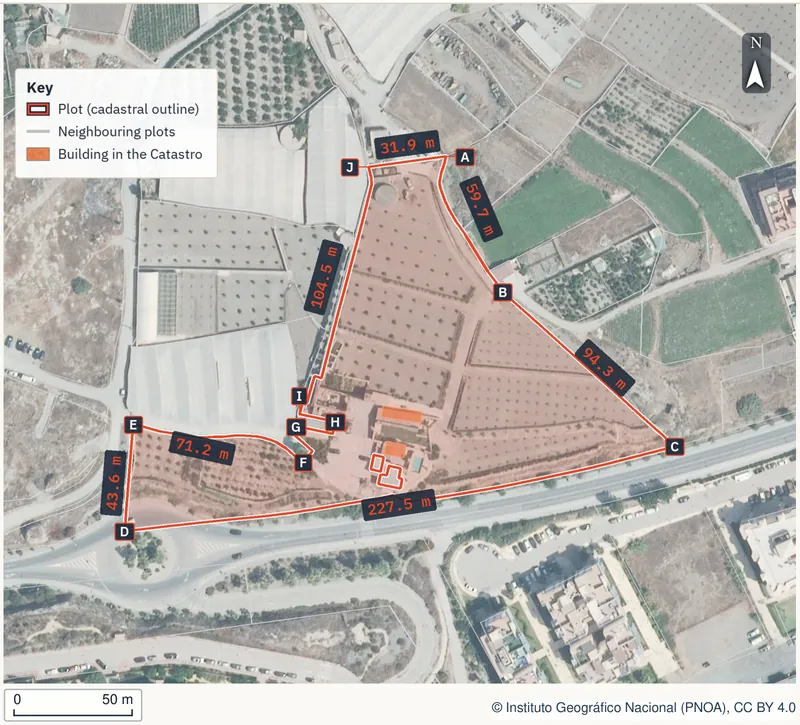

Spanish banks do lend on rustic land and on houses in the countryside, but the valuation ("tasación") weighs on what each bank offers and need not match the price you agree. Its rules (Order ECO/805/2003) usually leave out what the land "might become". Knowing how the figure is reached lets you ask for a realistic loan before you sign the arras contract, the deposit agreement that commits you to buy.
How much the bank lends: what the rules say
Royal Decree-law 24/2021 sets the limits for a mortgage loan to be added to the cover pool of a bank's covered bonds, the securities banks use to fund themselves: at that moment, the loan may not exceed 60 % of the valuation, or 80 % for residential property (art. 23.2). It is a rule about the bank's funding, not a ceiling written into your contract.
Royal Decree 716/2009, article 5, still often quoted (60 %, 80 % for homes, up to 95 % with a guarantee), implemented Law 2/1981, repealed with effect from 8 July 2022, and also referred to loans eligible to fund the bank (art. 3).
What does bind the bank towards you is a thorough check of your ability to repay: job, income, savings and debts. That check may not rest mainly on the property being worth more than the loan, or on its value rising (Law 5/2019, art. 11.1 and 11.3). Law 5/2019 covers a mortgage on a home taken by an individual, and also loans to a consumer to buy land (art. 2.1). Article 2 sets no condition of residence in Spain.
A €90,000 olive grove
You agree to buy for €90,000 and the valuation comes in at €75,000. If the bank lent 60 % of the valuation, the loan would be €45,000: you would fund the other €45,000 of the price, plus tax and buying costs. The bank sets the percentage and applies it to the valuation.
How rustic land is valued
The Order sorts land into two levels. Level II covers non-developable land where building is allowed only for farming, forestry, livestock or a permitted business tied to the land, and land zoned for development that has no development area or no defined conditions yet; Level I is everything else (art. 4). A "finca rústica" is Level II land that is or could be farmed.
| What is valued | Valuation | Article |
|---|---|---|
| The land of a rustic property, with the fixed buildings and installations needed to farm it | The lower of the comparison value, adjusted where relevant, of each class of land and the capitalised value of the farm | 49.a |
| Buildings used for a different business from the land (a shed for another trade, for example) | As property tied to a business; at most, its net replacement value | 49.b |
| A house or other buildings on the property (homes, leisure) | The rules for buildings; for mortgage purposes, a home lived in or empty is valued by comparison, adjusted where relevant | 49.c and 45.2.c |
| Land not valued as a rustic property and used for a business other than farming | By capitalising its income, under the procedure in art. 30 | 50.1 and 51.2 |
| Other Level II land not valued as a rustic property | By comparison, ignoring any possible urban use; if that is impossible, at most its cadastral value | 50.1 and 51.3 |
| Level I land | By comparison, adjusted where relevant; if impossible, residual value | 51.1 |
Order ECO/805/2003, consolidated with Order ECM/599/2025 (in force 12.8.2025), arts. 4, 30, 45, 49, 50 and 51. Source: Order ECO/805/2003 (BOE, consolidated text). Accessed 13 November 2026.
The comparison method needs a representative market and data on at least six comparable sales or offers (art. 21.1). In valuations for the bank's mortgage pool, speculative elements are stripped out (art. 16.2), including expected changes of use or building rights (art. 4). The rezoning an estate agent hints at does not count.
A house on rustic land
The house is valued on its own and added to the land (art. 49.c). One of the minimum checks is whether the property complies with current planning (art. 7.2.e); if it does not, the valuer must add a warning ("advertencia"), unless the report already carries a condition ("condicionante") (art. 11.b). Why an unlicensed house makes a purchase risky: unlicensed houses on rustic land.
If the house is "fuera de ordenación" (out of line with planning): buildings out of planning.
Conditions and warnings in the report
To be used for mortgage purposes, the value must be stated with no condition attached, save the cases in article 14 (art. 9). A condition arises, among other cases, when the minimum checks could not be made, when the required Registry or Catastro papers are missing, when the land is valued as irrigated without proof of the water right, or when there are reasoned doubts about identifying the property on the ground or in the Registry (art. 10.1). With a condition, the valuation firm issues a conditional report or one with no value; if it could not identify the property, it must decline to report (art. 13.1).
A warning is milder: it flags, for instance, differences between the property on the ground and its Registry or Catastro description that do not affect the value, or missing farming or yield papers for a rustic property (art. 11). The report must explain its effect on the value (art. 13.2).
- A Land Registry certificate or "nota simple" (registry extract) showing owner, full description and charges, less than three months old (art. 8.1).
- The descriptive and graphic record from the Catastro's online office, less than three months old (art. 8.1).
- For a rustic property: the relevant Catastro papers, how it is farmed and, where relevant, irrigation rights and yield (art. 8.2.g).
- For a finished house: a registered energy performance certificate (art. 8.1).
- A house planned or under construction: the papers listed in the next section and, once building, the latest site certificate (art. 8.2.b).
Buying to build
If you mortgage only the plot and build later, the Mortgage Law ("Ley Hipotecaria") does not automatically extend the mortgage to new buildings where there were none before (art. 110.1). To value a house still at the planning stage as if finished, the Order asks for the project approved by the architects' professional body (art. 8.2.a); without it the report is conditional (art. 10.1.d.2). Once building has started it also asks for the building licence or, instead, a council permit to start that meets art. 8.2.b plus a registered declaration of the building under construction ("declaración de obra nueva en construcción"); with neither licence nor permit, or a permit without that declaration, the report is conditional (art. 10.1.d.4). What you may build on rustic land: guide to rustic and urban land.
How many rustic mortgages are signed
In 2025, Spain's Land Registries recorded 643,870 mortgages, of which 10,366 were on rustic property, 1.6 %, for about €2.45 billion (INE, the national statistics office, provisional data). Banks granted 7,339 of them and other lenders 3,027; the INE's lender types include credit cooperatives and rural savings banks ("cajas rurales").
From valuation to signing
- Gather the property records. You order the nota simple from the Land Registry, paying its fee, and download the descriptive and graphic record from the Catastro's online office, which is free when you get it directly online (TRLCI, art. 62.2). Both must be under three months old on the valuation date. Time: no legal deadline for the nota simple.
- Commission or bring the valuation. A licensed valuation firm independent of the bank does it (Law 5/2019, art. 13), and you pay. The bank must accept a valuation you bring if it comes from a licensed valuer and has not expired; if the bank checks it, it cannot charge you for that check (RDL 24/2021, art. 20). The report is issued within two months of the visit, up to six for land, and lasts six months.
- Receive the offer. The bank gives you the FEIN, the FiAE (standard warnings sheet) and the draft contract at least ten calendar days before signing, anywhere in Spain (Law 5/2019, art. 14.1). In Catalonia, for a consumer loan secured on the home you are buying or renovating, the pre-contract information must reach you at least fourteen calendar days ahead (Catalan Consumer Code, arts. 261-2.1 and 262-4.1). The FEIN binds the bank for the agreed period, ten days at least. If you do not read Spanish well, arrange a translation in this window.
- See the notary you choose. You attend no later than the day before the deed for the transparency record ("acta"), which carries no notary fee (Law 5/2019, art. 15.3 and 15.8). Someone holding your power of attorney can attend for you (art. 15.3).
- Sign the purchase and the loan. At the notary's office, on the agreed day: at least ten calendar days after you received the FEIN and the other documents (art. 14.1), or fourteen in the Catalan case in step 3, and after the notary record, made no later than the day before (art. 15.3).
- Registration. A voluntary mortgage needs a public deed and entry in the Land Registry (Mortgage Law, art. 145); the bank pays the registration of its security. Where: the Land Registry for the property. Time: fifteen days at most from filing, unless the deed is withdrawn, has curable defects, an earlier deed is pending or an exceptional extension is granted (Mortgage Law, art. 18).
Who pays each loan cost
Law 5/2019 splits the costs this way: the valuation, the borrower; the agency, the notary's fees for the loan deed and registration of the security, the lender; copies, whoever asks for them; taxes (ITP and AJD, the transfer and stamp duties), as tax law provides (art. 14.1.e). Purchase costs: buying costs.
Two bills after signing
The valuation costs €400 and the notary €600 for the loan deed. You pay the €400; the bank pays the €600, the agency and the mortgage registration. Made-up amounts: the law shares out the costs, it does not set them.
If the seller must clear a mortgage at signing: charges, mortgages and attachments.
What this guide does not cover. It cannot tell you how much a given lender will offer or at what rate: that depends on its offer and its assessment of you. Order ECO/805/2003 has been amended several times (consolidated text of 12.6.2025); check the version in force and read the full valuation report, with conditions and warnings.
Before ordering a valuation, order the report on the plot by its cadastral reference and go to the bank knowing its land class and restrictions.
Common questions
What percentage do Spanish banks lend on rustic land?
None of the rules we read fixes a percentage for your loan. The 60 % of the valuation, or 80 % for residential property, is the condition for the bank to put the loan in its covered-bond pool when it adds it (RDL 24/2021, art. 23.2). Get the offer in writing: the FEIN binds the bank for the agreed period, ten days at least (Law 5/2019, art. 14.1.a).
Does the valuation count the chance of the land being rezoned?
In valuations for the bank's mortgage pool, speculative elements are stripped out, including expected changes of use or building rights (Order ECO/805/2003, arts. 4 and 16.2). Level II land not valued as a rustic property is valued ignoring any possible urban use (art. 51.3), unless it is used for a business other than farming: then its income is capitalised (art. 51.2).
Can I bring my own valuation to the bank?
Yes. The bank must accept a valuation from a licensed valuer that has not expired; it may check it but cannot charge you for the check (RDL 24/2021, art. 20). It expires six months after it is issued (Order ECO/805/2003, art. 62.4).
What if the house does not comply with planning?
The valuer must flag it in the report, unless a condition has already been stated (Order ECO/805/2003, art. 11.b), and explain the effect on the value. Whether to lend is the bank's decision.
Who pays for the valuation and the notary on the loan?
You pay for the valuation. The bank pays the notary's fees for the loan deed, the agency and the mortgage registration; copies are paid by whoever asks for them (Law 5/2019, art. 14.1.e).
Keep reading
Check this on your own plot
Pin the plot on the map and confirm the cadastral reference: the report gathers the public data and official maps for it, each with its source and date. It does not replace the land registry extract, the notary or a tax adviser. €29 VAT included.