Pillar: Planning and buildings
Does a buyer inherit liability for the seller’s unlawful works?
On this page
Buying does not itself make you responsible for the seller’s earlier offence: penalties require intent or fault under Ley 40/2015 article 28. But a sale does not remove planning duties affecting the property (TRLSRU, article 27). Obtain the municipal file and distinguish penalties, restoration orders and enforcement before completing.

If the Registry extract mentions planning enforcement, ask for the underlying decision and file. You need to know which works are disputed and what has been ordered. A seller's promise to cover “any fine” may leave a separate demolition or alteration requirement entirely unresolved.
The property duties that survive a transfer
Article 27.1 of the TRLSRU, Spain's consolidated Land Law, states that a transfer does not change the owner's planning duties. The buyer succeeds to the previous owner's rights and duties. The provision also addresses certain obligations assumed before the authority and recorded in the Registry, subject to its conditions concerning changes to property rights.
Have the actual obligations investigated even if you did not build the extension. Start with what the authority can require in relation to the property. A claim against the seller is a separate question and may not give you the house in the condition or use you expected.
Administrative penalties have a different basis. Ley 40/2015 article 28 requires responsibility through intent or fault and distinguishes penalties from restoring the altered situation and compensating damage. Neither “the buyer always inherits the seller's fine” nor “the buyer has no obligations because they did not build it” is an adequate reading.
Separate the documents before discussing liability
A translated message calling everything a “fine” can obscure the action required. Ask your Spanish solicitor to identify the legal nature of the document and the person to whom it is addressed. That should happen before deciding whether the seller's proposed guarantee is useful.
| Document or measure | Its subject | What the buyer needs to establish |
|---|---|---|
| Penalty decision | Responsibility for an offence | Person penalised, facts and status of the decision |
| Restoration order | Measures to bring the property into compliance | Affected works, duties, deadline and appeals |
| Compulsory enforcement | Failure to comply with an order | Addressee, service and action required |
The general distinction follows national Land Law and Ley 40/2015. The compulsory-enforcement example refers to Andalusia rather than a national schedule. Sources: TRLSRU, article 27; Ley 40/2015, article 28; LISTA, article 154. Accessed 13 November 2026.
In Andalusia, LISTA article 154 provides for compulsory enforcement where measures ordered by the authority are not complied with. A restoration decision can lead to substitute execution and, on the provision's terms, coercive fines. These concern enforcement of an order rather than simply identifying who carried out the original building work.
If a notice arrives after completion, send the full document to your solicitor. Record the issuing body, decision referred to and what the recipient must do. The seller's informal description cannot identify the correct remedy or the available time.
Read the Registry entry accurately
Look for references to an “expediente de disciplina urbanística”, a preventive annotation, a planning decision or restrictions affecting the building. Note the entry number and date, then obtain its supporting document. A nota simple is a Registry information extract; a certification may be needed for a fuller examination of the recorded position.
RD 1093/1997 distinguishes an annotation of the opening of enforcement proceedings in article 56 from the marginal note recording that a certificate of ownership and charges was issued in article 58. The latter is not itself proof of a final demolition order.
The instrument supporting an annotation identifies the agreement, authority, notification to the registered owner and the proceedings' subject and opening date (article 57). Use those details to request the correct municipal file. The nota simple guide explains obtaining the initial extract.
An expired entry does not settle the planning question
Do not calculate expiry through an automatic “four plus one” sum. RD 1093/1997 article 60 contains that wording, but article 61 provides a judicial extension route where administrative-court proceedings have been brought. In its 29 July 2025 decision, ground 3, the DGSJFP also refers extension of planning-enforcement annotations to Land Registry Act article 86.
That article generally provides four years from the annotation, unless a shorter statutory period applies. It permits four-year extensions at an interested party’s request or by the ordering authority, provided the extension order is presented before expiry. Each extension runs from its own annotation and further extensions can follow on the same terms. Expiry is recorded at the owner’s request. Distinguish a preventive annotation from a marginal note, which can follow another regime (TRLSRU article 67).
Ask the Registry for the entry type, date, extensions and supporting orders. Have your solicitor establish its actual duration, including any judicial intervention. Registry periods are not the restoration period or the time for enforcing an order.
Ask the registrar for the current status of the entry and your solicitor for the effect of its expiry or cancellation in the particular purchase. Keep the municipal enquiry separate. The administrative file may contain decisions and notices that are not explained by a brief Registry summary.
Building age is another investigation. TRLSRU article 28.4 provides a registration route for certain completed works where demolition-based restoration is no longer available because the relevant periods have elapsed, subject to its requirements. That route cannot be used as proof that any enforcement proceedings have ended. See registration of older buildings.
Frame the municipal enquiry broadly enough
Identify the plot using its cadastral reference, address and Registry details. Describe the building and extension you intend to buy. Request written information about restoration and penalty proceedings, decisions taken and measures still outstanding. Include the file number whenever one is known.
Ask your solicitor how access can be obtained and what consent or representation is required. A reply saying that no penalties are recorded may not answer whether there is a restoration order. Make the request cover both subjects, while keeping their legal consequences distinct.
Check whether another authority is involved through a sectoral restriction. Municipal planning information does not replace a coastal or water-authority decision. The guide to buying an unlawful rural house places those enquiries within the wider purchase checks.
For a buyer outside Spain, appoint someone to collect the replies and forward complete attachments. A summary translated by the agent may omit the annex identifying which structure is affected. Keep the original Spanish decision with any translation your advisers use.
What a seller's guarantee should address
Ask the seller to identify unlicensed works and known proceedings in writing and provide the documents. Any retention, guarantee or condition should state its trigger and how compliance will be proved. A retained amount should follow the investigated risk rather than an improvised estimate.
Article 27.2 of the TRLSRU requires specified disclosures about planning status and outstanding duties in the transfers it describes. Paragraph 3 provides civil consequences for failure to meet those requirements. If the issue emerges after completion, give your solicitor the contract, deed and supplied documents promptly.
The promise covers a penalty but misses the porch
An overseas buyer sees a planning-enforcement reference in the Registry extract. The seller offers to pay any penalty. The buyer obtains the file and finds that removal of an enclosed porch is also in question. Before signing, they ask for that separate obligation and its effect on the house's use to be assessed. A promise about a penalty did not answer it.
Where an order already exists
Do not carry out improvements or change use for the purchase without having the order reviewed. Ask the solicitor which activities remain possible and the technical professional which physical part is affected. Preserve photographs and correspondence showing the property's condition and the notices received.
Good faith and execution of the order
In Andalusia, LISTA article 155.5 expressly states that the existence of good-faith third-party purchasers is not itself a reason why an administrative decision cannot be executed. Nor should a technical difficulty be treated as an automatic suspension. Any suspension or revised measure must be established from the relevant proceedings.
Checks before completion
- Get current Registry information. Ask the competent Registry about its delivery arrangements and tariff. Review before the deposit and update for completion.
- Obtain the supporting decisions. Use the municipality and any sectoral authority. Access arrangements and the requested procedure determine the timescale; ask for service information and any applicable charge.
- Classify the obligations. Your solicitor separates the penalty, restoration and enforcement questions. Agree fees and a review date before committing to buy.
- Assess the physical requirement. A technical professional identifies the affected works and necessary measures. Request a quotation and delivery date without presuming the proposed solution will be authorised.
- Decide with the file available. Agree guarantees or a contractual condition with your solicitor. If a notice has already been served, follow its reviewed deadline rather than replacing it with the sale timetable.
The Registry and town hall answer different questions An extract without an enforcement reference does not certify that every building is lawful. An opening notice does not show that a final decision has already been made. Read each document for its subject and procedural stage.
- Entries identified and supporting documents obtained.
- Municipal and sectoral proceedings reviewed.
- Physical duties separated from personal penalties.
- Deadlines and any suspension checked.
- Seller's guarantees tied to verifiable events.
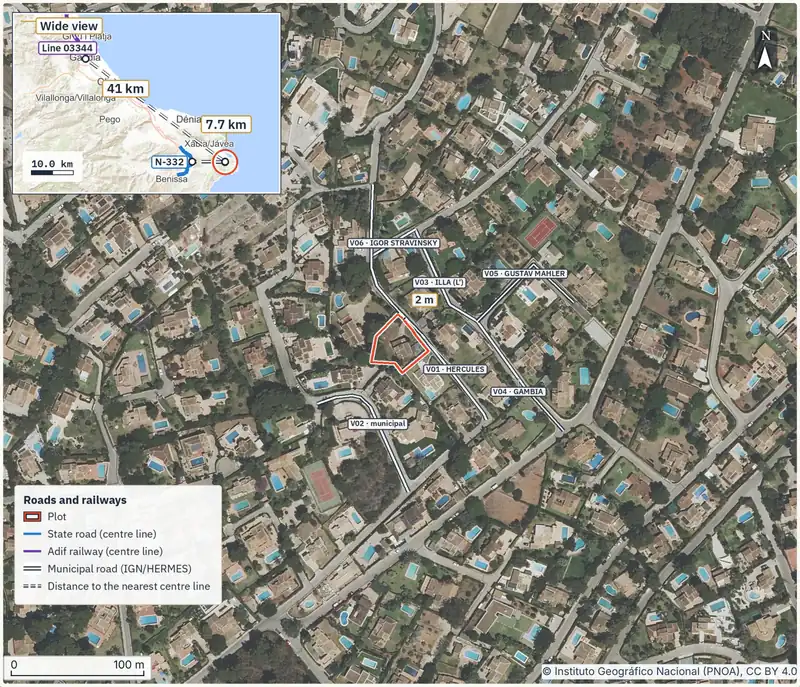
Use the plot report to organise the territorial checks before requesting the municipal and Registry documents for the purchase.
Common questions
Am I automatically fined for buying an unlawful house?
A penalty requires responsibility under Ley 40/2015 article 28. Buying does not itself make you responsible for the seller's earlier offence, but duties and orders affecting the property need separate review.
Can restoration affect me even though I did not build it?
A transfer does not remove the planning duties addressed by TRLSRU article 27. Check the particular decision and applicable legislation for its effect.
Does a marginal note always mean demolition?
No. It may record the issue of a certificate, for example. Identify the entry and its underlying administrative document.
Does expiry of the annotation end proceedings?
Registry expiry alone does not establish that. Check the administrative decision and the separate time limits applying to it.
Keep reading
Check this on your own plot
Pin the plot on the map and confirm the cadastral reference: the report gathers the public data and official maps for it, each with its source and date. It does not replace the land registry extract, the notary or a tax adviser. €29 VAT included.