Pillar: Hazards and constraints
What happens if a power line crosses the plot I want to buy?
On this page
You can buy the plot, but first ask the operator for the voltage, conductor type, installation date and later modifications. These establish the applicable rules and clearances. The easement restricts buildings, trees and access; fencing or building requires compliance and official authorisation (RD 1955/2000, article 162).
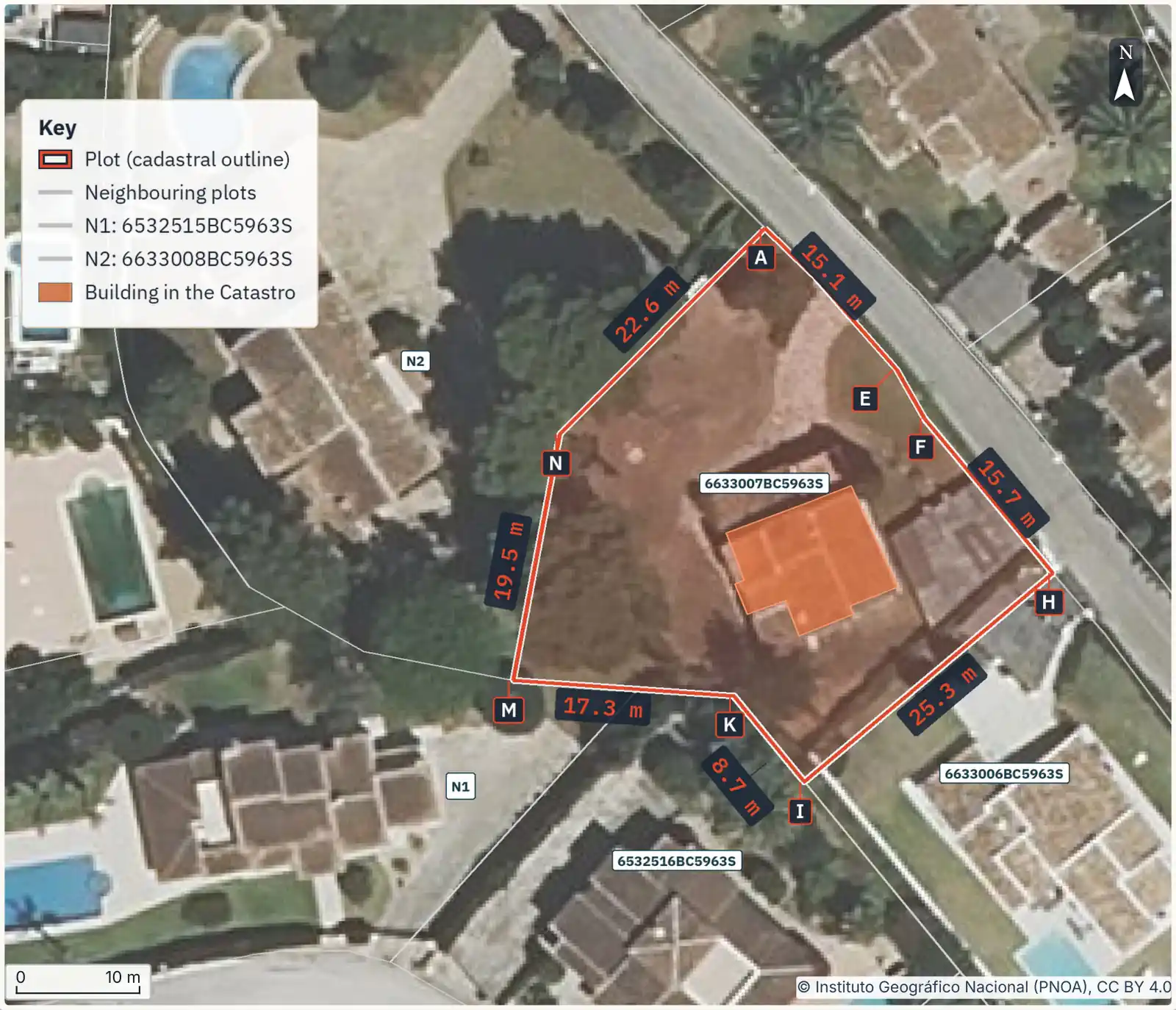

A line shrinks the part of the plot you can build on and gives its owner a right of entry. Before the deposit, find out the voltage, the width of the strip and whether the easement is entered in the Land Registry.
What the power line easement is
Electricity transmission and distribution installations are of public utility for compulsory purchase and for imposing the right of way (Ley 24/2013, art. 54.1). For each line, the company applies for a declaration listing the land affected, which goes out to public consultation (art. 55).
The law treats this "servidumbre de paso de energía eléctrica" as a statutory easement (art. 57.1), and the declaration allows urgent occupation of the land (art. 56.1). The decision is published in the BOE (Spain's official gazette) and the provincial gazette and served on the owners affected (RD 1955/2000, art. 148.2).
What it covers: wires, pylons and access
For an overhead line it covers the airspace, the pylons with their earthing, access to inspect, maintain and repair the line and cut trees if necessary, and temporary use of land for that (RD 1955/2000, art. 158).
For an underground line, the subsoil taken by the cables, with the same access; for compulsory purchase, the strip between the two outer cables (art. 159).
This is not the same as a neighbour's right to cross your land on foot or by car, which comes from the Civil Code and is covered in the guide to rights of way.
Where it cannot be imposed
A high-voltage easement cannot be imposed over buildings, their yards and pens, schools, sports grounds, or gardens and kitchen gardens attached to homes that already existed when the procedure began, if they are under half a hectare (RD 1955/2000, art. 161.1).
Nor over private land if the line can run over public land or along private boundaries with a technically possible detour adding no more than 10 % in length or height to the section affected; the detour is refused if it costs over 10 % more than that section's budget (art. 161.2).
These limits apply while a new line is being planned. Once it is built, other routes remain, each with its conditions: moving the line (art. 153) or, if the easement makes working the land uneconomic, expropriation of the plot (art. 152).
The strip where you cannot build
The high-voltage lines regulation calls the ground projection of the outer wires, swung by a 120 km/h wind at 15 °C, the "zona de servidumbre de vuelo", the strip beneath the wires (ITC-LAT 07, 5.12). A safety distance is added on each side, which grows with the voltage through the electrical distance Del in table 15.
RD 1955/2000 states the rule in general terms (art. 162.3); for underground lines the strip is the trench plus the minimum safety distances.
| Nominal voltage | Del | Buildings (3.3 + Del, min. 5 m) | Trees (1.5 + Del, min. 2 m) | General ground clearance; not for agricultural holdings |
|---|---|---|---|---|
| 20 kV | 0.22 m | 5 m | 2 m | 6 m |
| 66 kV | 0.70 m | 5 m | 2.2 m | 6 m |
| 132 kV | 1.20 m | 5 m | 2.7 m | 6.5 m |
| 220 kV | 1.70 m | 5 m | 3.2 m | 7 m |
| 400 kV | 2.80 m | 6.1 m | 4.3 m | 8.1 m |
For overhead high-voltage lines with bare conductors to which RD 223/2008 applies under article 2: Nominal voltage and highest system voltage from table 1 of ITC-LAT 07; Del from table 15. Distances to buildings and trees are horizontal, from the edge of the strip beneath the wires. Height above ground is at maximum sag; over agricultural holdings, fenced or unfenced, and fenced livestock holdings, at least 7 m (5.5). Rules in force in November 2026. Source: RD 223/2008, ITC-LAT 07 (BOE, consolidated text). Accessed 13 November 2026.
The table heights allow the reductions in section 5.5 for hard-to-reach places and under the wind assumption; on farms, fenced or not, and on fenced livestock holdings the 7 m minimum applies, and the general 6 m is no clearance for farm machinery.
The exception is mutual agreement between the parties: the regulation then sets minimum clearances between the wires and buildings beneath the line, 5.5 m plus Del (at least 6 m) above points people can reach and 3.3 m plus Del (at least 4 m) above points they cannot (5.12.2).
How much land a 66 kV line takes
A 66 kV line crosses the plot for 120 m with a 6 m wide strip beneath the wires (an assumed figure). You add 5 m on each side, because 3.3 + 0.70 = 4.0 m is below the minimum. The no-build strip is 6 + 5 + 5 = 16 m wide, so 16 × 120 = 1,920 m² cannot take a building.
Older lines, medium and low voltage
The 2008 regulation applies to new lines, their extensions and rerouted sections of older lines (RD 223/2008, art. 2.2). For an older line, ask the authority that authorises your works which distance it requires (RD 1955/2000, art. 162.1).
So-called medium voltage is high voltage for the regulation: above 1 kV between phases (art. 2.1), third category up to 30 kV and second up to 66 kV (art. 3). The table applies to them too. Low voltage, up to 1 kV, has its protection zones around façades and roofs in ITC-BT-06 of the low-voltage regulation (RD 842/2002).
Trees, fences and crops
The company keeps the wires clear of trees and the landowner must let it; the protection zone comes with compensation, and you may not plant trees that will grow into the distances (ITC-LAT 07, 5.12.1).
You can fence if the easement is left intact and the competent authority authorises it; it is respected when the fence does not affect what it covers or safety (RD 1955/2000, art. 162.1 and 162.2). The municipal permit is covered in fencing rustic land.
How to spot the line and its easement
Every pylon carries a number or mark readable from the ground (ITC-LAT 07, 2.4.7). With it, the line's owner can give you the voltage and the width of the strip. Lines of 220 kV and above make up the transmission grid (RD 1955/2000, art. 5.1), whose sole operator is Red Eléctrica de España (Ley 24/2013, art. 34.2); the rest usually belong to the local distribution company.
The nota simple (land registry extract) shows registered easements (Mortgage Act, art. 2). If nothing appears, do not rule it out: the extract only shows what is registered. Ask the power company and the authority that approved the line for the legal basis of that particular line, such as the public utility declaration or a purchase agreement with a former owner (RD 1955/2000, art. 151). How to order one is in the nota simple guide.
What this guide does not settle. The distances in the table are those of the 2008 regulation; the actual width of the strip depends on each line's design. Whether the plot can be built on, and how much, is for the town plan and the town hall: see what you can build.
Compensation and who received it
Compensation covers the land taken by the pylons (or the trench), the loss of value from access and safety restrictions, and damage from temporary use of land (RD 1955/2000, art. 156.3), under the Compulsory Purchase Act rules (art. 156.1).
The company may agree terms with owners at any time (art. 151). If the line already exists, it was agreed or set with the owner at the time: ask the seller for the agreement or proof of payment. Buying from abroad, have your lawyer or the person holding your power of attorney request them before the deposit contract.
Moving the line or asking to be bought out
The owner may ask for a new route if there are no technical obstacles, paying for it (RD 1955/2000, art. 153.1). Without the company's agreement, the request goes to the authority that handled the file, with documented consent from the new owners affected. The company submits its budget within fifteen days, the authority decides within fifteen days of receiving the request, and you pay before the works (art. 153.4, 153.6 and 153.7).
If the easement makes working the plot uneconomic, the owner may ask for the plot to be compulsorily purchased, setting out the losses; the authority rules on the request within ten days (art. 152). If a public authority's approved project or plan requires the line to move, that authority pays (art. 154.3).
What to do, in order
- During the site visit, photograph each pylon with its number and pace out its distance to the boundaries. About an hour on site.
- Order the nota simple from the Land Registry and look for electricity easements. Timing and cost are in the nota simple guide.
- Write to the line's owner with the pylon number and the cadastral reference: voltage, width of the strip beneath the wires and agreements. No deadline for a reply is set by law.
- Ask the seller for the agreement or proof of compensation. No deadline is set by law; make it a condition of the deposit contract.
- If you plan to build or fence, apply for authorisation from the competent authority and for the municipal licence. Art. 162 sets no deadline for a decision.
- If you need the line moved, file the art. 153 request: fifteen days for the company's budget and fifteen days for a decision; you pay the budget up front.
- You know the line's voltage and who owns it.
- You have the width of the strip beneath the wires in writing.
- You have drawn the strip on the plan and there is room for what you want to build.
- The nota simple and the seller's papers show what was agreed and what was paid.
Ask the company where the line runs and what clearances apply. With that and the length of each side of the plot, which the report gives by cadastral reference, you can roughly place the restricted strip. Whether you can build outside it depends on the plan and the permits.
Common questions
Will I be paid anything for a line already crossing the plot I am buying?
Compensation is set when the easement is imposed, with whoever owned the land then (RD 1955/2000, arts. 151 and 156). Damage from future temporary occupation is compensated (art. 156.3.c).
Can I build a house under a medium-voltage line?
It is high voltage for the regulation. Not in the strip beneath the wires or within 3.3 m plus Del on each side, at least 5 m, unless both sides agree to the vertical clearances in ITC-LAT 07, 5.12.2. Outside it, with authorisation and a licence.
How far from a high-voltage line can I build?
Measured from the edge of the strip beneath the wires: 5 m for lines of 20 to 220 kV and 6.1 m for 400 kV under the 2008 regulation (see the table). For older lines that have not been altered, check with the authority which distance it applies.
Can the company cut down trees on my land?
Yes, if they threaten the safety distances: the easement includes tree cutting and the owner must allow that work (RD 1955/2000, art. 158.c; ITC-LAT 07, 5.12.1). Nor may you plant trees that will grow into those distances.
Can I ask for the line to be moved?
Yes, if there are no technical obstacles, at your cost and with the consent of the new owners affected (RD 1955/2000, art. 153). The authority decides within fifteen days of receiving the request.
Keep reading
Check this on your own plot
Pin the plot on the map and confirm the cadastral reference: the report gathers the public data and official maps for it, each with its source and date. It does not replace the land registry extract, the notary or a tax adviser. €29 VAT included.