Pillar: Planning and buildings
Can I fence rustic land and what permit do I need?
On this page
It depends on the region and the town hall. In Andalusia a permanent fence on rustic land needs a licence; in the Valencia region, as a rule, a declaration; in Galicia, prior notice at least 15 working days ahead. Near a State road (up to 100 m from a motorway, 50 m from an ordinary road) you also need the roads authority's consent, and near a river you must check with the river basin authority.
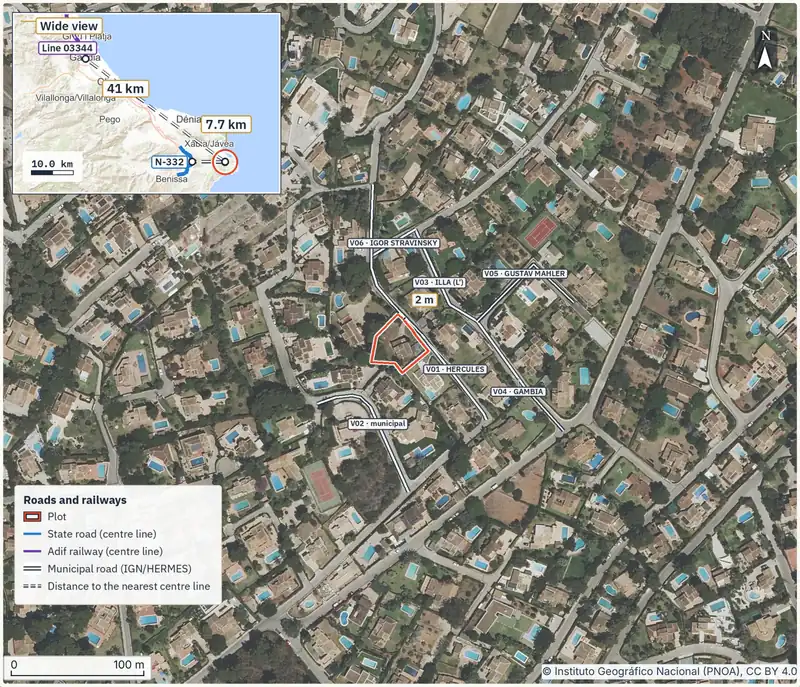

A rural fence is governed by your region's planning law and, if the land fronts a road or a river or dry riverbed ("rambla"), by road or water law too. This guide compares Andalusia, the Valencia region and Galicia, with consolidated laws read on 12 November 2026; elsewhere, check that region's land law.
Licence, declaration or prior notice
A licence ("licencia") is granted before you start. With a "declaración responsable" you state that you meet the rules and, once it is filed with all the documents, you may begin that day (Law 39/2015, art. 69; in the Valencia region, TRLOTUP, art. 241.3). Galicia's prior notice is different: you file it at least fifteen working days ahead, with a technical description, any sector consents or proof you have applied for them, and proof the fees are paid. If the town hall has not asked for more documents by then, a complete notice is your authority to start (Law 2/2016, art. 146).
| Region | What you file at the town hall | Detail | Law and article |
|---|---|---|---|
| Andalusia | A planning licence for permanent fences, walls and enclosures on rustic land | Except the acts in art. 292, such as small works without a project, which go by declaration (art. 293.1.a) | LISTA Regulation, art. 291.j; LISTA, arts. 137 and 138 |
| Valencia region | A declaration for fencing a plot, whatever the building method | A licence in the cases of art. 232; a masonry wall or a fence under the plan's design rules: with a certificate from an approved body or professional association (art. 233.2.d) | TRLOTUP, arts. 232 and 233 |
| Galicia | Prior notice, at least 15 working days before you start: fencing land is not on the list of acts needing a licence | A licence for retaining walls (art. 142.2.d). On specially protected rustic land, first a sector consent or report (art. 36.2) | Law 2/2016, arts. 35, 36, 142 and 146 |
Consolidated texts on the BOE (Spain's official gazette) read on 12.11.2026 (LISTA 7.4.2026, TRLOTUP 10.8.2026, Law 2/2016 31.12.2025); LISTA Regulation as published in BOJA no. 232 of 2.12.2022. Other regions were not reviewed. Sources: Law 7/2021 (LISTA), BOE; Decree 550/2022, LISTA Regulation, BOJA; Legislative Decree 1/2021 (TRLOTUP), BOE; Law 2/2016 on land in Galicia, BOE. Accessed 12 November 2026.
In Andalusia, ask in writing whether your fence falls within that exception.
Height, materials and distance from the lane
The three laws do not set a general height for every fence; check the town's planning rules or ask for a planning certificate.
Galicia gives two rules. Among the building conditions on rustic land, masonry fences ("cierres de fábrica") may not exceed 1.5 metres and must suit their surroundings (art. 39.c). And permanent fences, walls or hedges in areas not consolidated by building must stand at least 4 metres from the centre line of the public way they face, except boundary stones and post-and-wire fences on rustic land (art. 92.1).
Beside a State road
Law 37/2015 sets four strips on each side of a State road. Three are measured from the outer edge of the earthworks (on flat ground, the far edge of the ditch, art. 29.2); the building line from the carriageway.
Motorways and dual carriageways: public domain 8 m, easement strip ("servidumbre") 25 m, affected strip ("afección") 100 m and building line 50 m from the carriageway. Ordinary roads: 3, 8 and 50 m, building line 25 m (arts. 29, 31, 32 and 33); at junctions and slip roads, 50 m (art. 33.2). These are general figures: on bypasses the line is 50 m whatever the road (art. 33.4), it shifts with very wide earthworks or overlapping lines (art. 33.6) and the Ministry may shorten it on specific stretches (art. 33.3). Ask the roads authority for the line on your stretch before building a wall. For a house, see building near a road.
Any work or installation in the affected strip needs prior consent (art. 32.2); in the easement strip, only uses compatible with road safety and with consent (art. 31.2), except farming and livestock work (RD 899/2025, art. 94.2). The town hall's licence is conditional on that consent (Law 37/2015, art. 28.5).
Which fence fits in which strip
The 2025 General Roads Regulation (art. 124.1.f) calls "fully see-through" a fence of metal mesh or similar on posts driven into the ground, or on a plain concrete or unreinforced masonry footing that does not rise above natural ground level or affect road drainage. Those may only be allowed outside the public domain. Any other fence, a wall for example, only outside the zone where building is restricted.
Rebuilding an existing fence is assessed as if it were new.
Roads owned by the region, the provincial council or the town hall follow their own laws and distances: ask whoever owns the road.
Beside a river or rambla
The Public Water Domain Regulation (RDPH) puts two strips along public watercourses: a 5 m easement for public use and a 100 m control zone ("zona de policía") (art. 6.2). The easement exists, among other things, for public passage on foot (art. 7.1.b) and as a rule no building is allowed in it (art. 7.3).
In the control zone the regulation covers "construction of every kind" (art. 9.1), with a declaration or prior consent from the river basin authority (art. 78). The declaration list names electric livestock fences (art. 78 bis.1.g), not other fencing. As a general rule, "any kind of construction" needs a permit, with six months to decide, and no answer counts as a refusal (art. 78 ter). No separate permit is needed if a town or sector plan reviewed by the basin authority already includes its requirements, though projects under that plan are still notified to it (art. 78 ter.1). Ask the basin authority ("confederación hidrográfica") in writing which route applies.
In the preferential flood flow zone on rural land, new "fences and enclosures that are not permeable", such as watertight walls, are not allowed (art. 9 bis.1.e). More in the guide on building near a river or rambla.
Drove roads, lanes and rights of way
If a drove road ("vía pecuaria") crosses or borders the land, ask for the approved edge before you drive in posts (drove roads and public paths). A neighbour with a right of way keeps it after you fence. In a protected area, see protected areas and Natura 2000.
Fines: what each law says
Valencia region. Those who build fences and enclosures without a licence are fined 1 % to 5 % of their value, and the fine may not be less than €300 (TRLOTUP, art. 285.3, in the section on minor offences).
Andalusia. Acting without a required licence, whether or not it can be legalised, is a serious offence (LISTA, art. 161.3.a): a fine of €3,000 to €29,999, unless the value of the works, the land affected or the damage is higher, in which case it can reach 75 % of those values (art. 162.1.b).
Galicia. Work without a licence or prior notice, if it can be legalised, is a minor offence (art. 158.4.a): €300 to €6,000 and at least 2 % of the value of the work (art. 161.1.a). Breaching the building conditions for rustic land is serious (art. 158.3.b): €6,001 to €60,000 and at least 20 % (art. 161.1.c). If you restore the land yourself before the decision, the fine is cut by 90 % (art. 161.4).
State roads. Unauthorised work in the easement or affected strip that can be legalised: minor, €300 to €3,000; work that cannot be legalised or may affect road safety, not put right: serious, €3,001 to €15,000 (Law 37/2015, arts. 41.3.b, 41.4.a and 43.1).
A €6,000 mesh fence put up without a permit in the Valencia region
1 % is €60 and 5 % is €300; as the fine cannot be below €300, the art. 285.3 penalty would be €300. If it also stands without consent in the affected strip of a State motorway and can be legalised, the roads authority can fine separately (€300 to €3,000).
What this guide does not cover
Limits of this guide. It compares only three regions and State roads; it does not cover game fencing or town bylaws. If a fence already exists, how long the authorities have to act against it is explained in the guide on planning enforcement deadlines.
What to do, in order
- Measure the distance to the road from the edge of the ditch, on a map viewer or with a surveyor (cost: their fee). Time: an hour on the map viewer.
- If you are within 100 m (motorway) or 50 m (ordinary road), apply for consent to the State roads directorate through the Transport Ministry's e-office ("sede electrónica"), with a dimensioned plan. Time: the articles cited set no deadline; do not start without a decision.
- If a watercourse lies within 100 m, ask the river basin authority in writing which route applies. Time: if a permit is needed, six months to decide (RDPH, art. 78 ter.2.b).
- Ask the town hall for the planning sheet (height, materials) and the fee. Time: no deadline is set.
- File the town hall permit with the consents attached. Time: with a complete "declaración responsable", you start on filing; in Galicia, 15 working days after a complete prior notice, if the town hall has not asked for more documents (art. 146.2); with a licence, once granted.
- You know whether the land is in a road's affected strip and who owns the road.
- You know the distance to the nearest watercourse and whether you are in its control zone.
- You have checked that the fence does not cut across a drove road, a public lane or a right of way.
- The town hall permit and the sector consents are filed or granted.
You can order the plot report by its cadastral reference and take the roads and watercourses, already identified, to the town hall.
Common questions
Do I need a licence to put up mesh fencing on my rustic land?
It depends on the region: a licence in Andalusia for permanent fences (art. 291.j, except the acts in art. 292), a declaration in the Valencia region except under art. 232, prior notice in Galicia (art. 142.3), filed at least 15 working days before you start (art. 146).
How close to a road can I fence?
On a State road, a see-through fence outside the public domain (3 m on ordinary roads, 8 m on motorways, from the earthworks); a solid one beyond the building line for that stretch (art. 33). In the easement and affected strips, always with the roads authority's consent.
Can I fence right down to the river?
The 5 m easement is for public passage on foot (RDPH, art. 7); within the 100 m control zone, a declaration or a permit from the river basin authority (art. 78), unless a plan it has already reviewed includes its requirements for such works (art. 78 ter.1).
How much is the fine for fencing without a permit?
In the Valencia region, 1 % to 5 % of the fence's value, at least €300 (art. 285.3). Andalusia and Galicia apply their general scales, with the conditions in the section on fines.
How high can the fence be?
In Galicia, masonry fences on rustic land may not exceed 1.5 m (art. 39.c). In the other two regions the law gives no general figure: the town's planning rules set it.
Keep reading
Check this on your own plot
Pin the plot on the map and confirm the cadastral reference: the report gathers the public data and official maps for it, each with its source and date. It does not replace the land registry extract, the notary or a tax adviser. €29 VAT included.