Pillar: Hazards and constraints
What if the plot has archaeological remains or sits in a protected setting?
On this page
In Andalusia, works to a protected BIC property or its setting generally require prior heritage authorisation. Certain simple works without a project use notification under article 33.3; the town hall may have delegated powers under article 40. Check the precise protection and work first. Where regional authorisation is required, the authority has three months from complete documentation; silence means refusal.
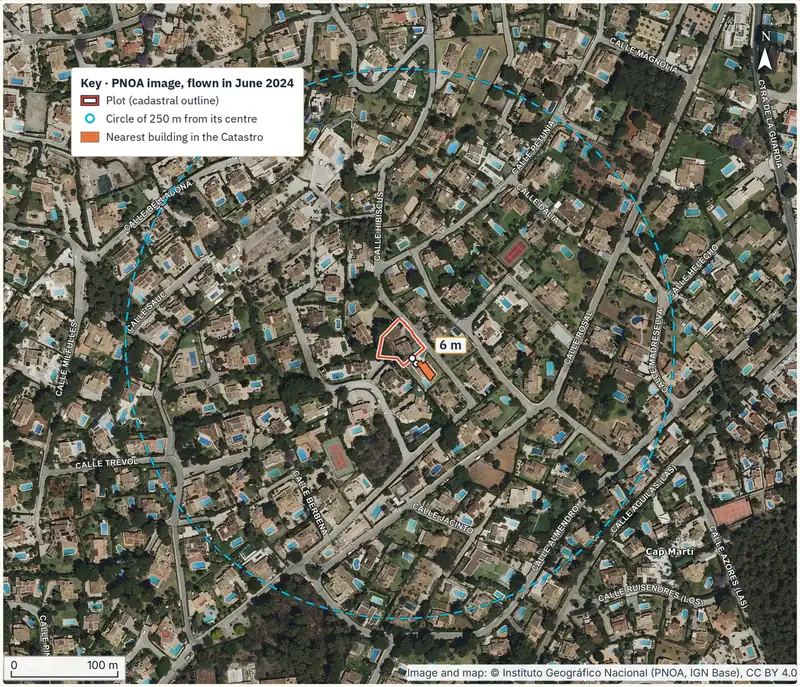

Read the protection decision and its boundaries, then check the municipal planning catalogue before paying a deposit. BIC status, general listing and local planning protection do not all require a separate regional authorisation.
What Spain's heritage law protects
Spain's heritage law, Law 16/1985, gives assets declared Bienes de Interés Cultural (BIC, the top listing grade) "singular protection" (art. 9.1). Buildings and land are listed as monuments, gardens, historic ensembles, historic sites or archaeological zones (art. 14.2). An archaeological zone is a place holding remains that can be studied with archaeological methods, "whether on the surface, underground" or under territorial waters (art. 15.5).
The protected setting around a listed asset
The decision that lists a building as BIC also marks out its setting, the "entorno" (art. 11.2). Around a monument, works in that setting need the same express approval as works on the monument itself (art. 19.1).
In Andalusia, the setting covers any building or space whose alteration could harm the asset or the view of it, whether next door or further away (Law 14/2007, art. 28.1). Monuments listed before Law 16/1985 and castles protected by the 1949 decree that have no setting of their own get a fixed one: fifty metres on urban land and two hundred on developable and non-developable land (fourth additional provision).
Where to check whether the plot is affected
In Andalusia, check three places:
- The General Catalogue of Andalusian Historic Heritage ("Catálogo General del Patrimonio Histórico Andaluz"). It holds the BIC and the assets with general listing (art. 7.1), including BIC listed under the national law (third additional provision).
- The Digital Guide to Andalusian Cultural Heritage, run by the Andalusian Historic Heritage Institute (IAPH). It shows the heritage records of each municipality and their protection.
- The town's planning catalogue ("catálogo urbanístico"). Town plans must list heritage elements in it (art. 29.1), including those in the Inventory of Recognised Assets (art. 13.3). Ask the town hall, as explained in the planning certificate guide.
For listed assets anywhere in Spain, the Ministry of Culture runs a search of buildings and sites in the national BIC register.
A real case: Algarrobo in the IAPH records
Morro de Mezquitilla, above the mouth of the Algarrobo river, is a listed archaeological zone, and its record describes the site as covered by crops and terraces. A farmed plot can lie inside a protected zone with nothing on the ground to show it. Three more sites in the municipality (Cuesta de las Palmas, La Plancha 1-2 and La Mayora) have no protection listed in their records.
A record with no protection listed does not mean the building is free of rules: the town's planning catalogue can still protect it.
Works on a listed asset or in its setting: approval and deadlines
In Andalusia, subject to the notification exception in article 33.3 and delegated municipal powers in article 40, works on a BIC building or in its setting, including moving earth, need approval from the regional ministry responsible for heritage before any other licence (Law 14/2007, art. 33.3). The application goes in with a conservation project drawn up by your architect (art. 33.6).
One exception: once a protection plan is approved, the ministry can delegate to the town hall works on buildings that are not monuments, historic gardens or archaeological zones, nor in their setting, and in settings regulated by the plan (art. 40.1 and 40.2).
| Plot situation | What the law requires | Deadline | Article |
|---|---|---|---|
| BIC building or its setting (general rule; exceptions: arts. 33.3 and 40) | Heritage approval before the licence, earthworks included | Three months from the complete file; no answer means refusal. Lapses if works do not start within two years, extendable once | 33.3 and 33.4 |
| Minor works needing no project in a historic ensemble, historic site or archaeological zone (except monuments and historic gardens) or in their setting | Prior notice to the ministry | Thirty days to set corrective measures | 33.3, second paragraph |
| Asset with general listing | Notice before applying for the licence | Thirty days | 33.5 |
| Archaeological easement zone | Notify the works at least fifteen days ahead; a BIC still needs its approval | Fifteen days to order trial trenches or surveys | 49.1 |
| BIC listing procedure opened | Land-division, building and demolition licences suspended, including those already granted | Until the ministry gives approval | 36.1 |
| Remains found during works | Report at once; leave the remains in place | Up to two months without compensation; extension with compensation for actual loss | 50.1 and 50.2 |
Andalusia, Law 14/2007 in the BOE consolidated text (update of 7.4.2026). These are the ministry's deadlines; licence deadlines are set by the planning law. Source: Law 14/2007 on Andalusian Historic Heritage (BOE, consolidated text). Accessed 13 November 2026.
Without that approval the licence cannot be granted (Law 16/1985, art. 23.1). Works carried out without it are illegal, and the town hall or the heritage authority can order rebuilding or demolition at the cost of whoever is responsible (art. 23.2).
Archaeological zones and easement zones
Subject to the Andalusian exceptions in articles 33.3 and 40 explained above, works or earthworks in a BIC archaeological zone or historic site generally need approval, and the authority can first order surveys and excavations (Law 16/1985, art. 22.1). Until the town approves the area's protection plan, every licence needs a favourable decision from the heritage authority, and land may not be divided or merged (art. 20.3).
The archaeological easement zone ("zona de servidumbre arqueológica") is an Andalusian designation for areas where remains are presumed to exist (Law 14/2007, art. 48.1). On its own it needs notice, not approval: tell the regional heritage department at least fifteen days ahead, and within that time it can order trial trenches (art. 49.1). If a BIC, a BIC setting or a listed asset also applies, the notice does not replace what that regime requires (art. 33).
Who pays for the archaeology
In Andalusia, where remains are known or presumed to lie underground, the ministry or the town plan can require the developer (whoever promotes the works) to carry out the archaeological work before the works are approved (art. 59.1). That work reaches the limit of the building rights the developer holds; if the ministry extends it for scientific reasons, it pays the extra cost (arts. 59.2 and 59.3).
Archaeological monitoring of earthworks starts with a prior signed statement ("declaración responsable") from the archaeologist in charge (art. 52.3). There is no official statistic on what this work costs, so get a quote from an archaeologist before you buy.
If remains turn up during the works
The national law requires finds to be reported within thirty days at most, and at once for chance finds (Law 16/1985, art. 44.1). In Andalusia the report is always immediate, to the regional ministry or the town hall, which passes it on within twenty-four hours (Law 14/2007, art. 50.1). If you live abroad, agree in writing that your builder reports for you.
Reporting alone does not establish the reward. For cases within Law 16/1985 article 44.3, finder and landowner share half the legally appraised value equally. Failure to meet paragraph 1 reporting duties or paragraph 2 custody duties until delivery to the administration, apart from delivery to a public museum, removes entitlement on paragraph 4’s terms. Paragraph 5 excludes finds forming integral parts of the architectural structure of a property in the BIC Register.
In Andalusia, keep remains at the find location and do not remove them without the regional ministry’s prior authorisation and supervision (Ley 14/2007 article 50.1). Facilitate their availability and follow instructions for deposit or delivery; the reward rules do not instruct you to transport objects yourself.
Fines: national and Andalusian law
The national law fines works in archaeological zones without approval, among other offences, up to €150,253.03 (art. 76.1.d and 76.3.B). Where the damage can be valued, the fine runs from one to four times that value (art. 76.2).
In Andalusia, works without approval on a BIC building, or failing without good reason to meet the duties after a find, is a serious offence: €100,001 to €250,000 (Law 14/2007, arts. 109.h, 109.o and 114.1.b). It is a minor offence, up to €100,000, to work without approval in a historic ensemble or a setting with no individual listing, unless the damage is irreparable, or to report a find late without good reason (arts. 109.t, 110.i, 110.k and 114.1.c). Destroying a listed site with irreparable loss of information is very serious: €250,001 to €1,000,000 (arts. 108.1.d and 114.1.a). The fine is never below twice the profit made (art. 114.5).
Effect on the licence and on value
While a BIC listing is being processed, land-division, building and demolition licences in the area are suspended, and so are the effects of licences already granted (Law 16/1985, art. 16.1). The suspension lasts until the procedure is decided or lapses (art. 16.2).
In Andalusia, the results of the archaeological work shape whether and how the building rights can be used (art. 59.4). The authority can also order excavations on any private land where it presumes remains, with compensation under the compulsory purchase law (Law 16/1985, art. 43). What can be built on each land class is covered in what you can build.
Andalusia's new heritage law of 2026
Law 4/2026 on Andalusian Cultural Heritage comes into force on 7.4.2027 and repeals Law 14/2007. In archaeological easement zones, notice is replaced by a request for a report, with two months to answer and silence counting as approval (art. 89.1). Fines move to bands of up to €10,000 (minor), €10,001 to €150,000 (serious) and €150,001 to €1,000,000 (very serious) (art. 159.1). If your works start after that date, check the new law.
What this guide does not settle. It covers the national law and Andalusian law. Every other region has its own heritage law, with different deadlines and fines. The IAPH record does not replace the listing decision or the town's planning catalogue: the exact boundary of a zone or setting is in the decision published in the BOJA or the BOE.
What to do, in order
- Search the municipality in the IAPH Digital Guide. The online search gives an instant result; note the code and protection of every nearby record.
- Ask the town hall whether the plot is in the planning catalogue or in an area with archaeological conditions. No deadline is set for this enquiry; make it before signing the deposit contract ("arras").
- Establish the procedure with the town hall and heritage authority. BIC properties and settings generally require regional authorisation (three months from complete documentation, negative silence); article 33.3 simple works use notification, and article 40 allows delegated municipal decisions. General listing uses article 33.5. Do not apply the simple-works exception to a Monument or Historic Garden itself.
- In an archaeological easement zone, notify the works to the ministry. At least fifteen days ahead; the ministry has fifteen days to order trial trenches.
- If archaeological monitoring of earthworks is required, file the signed statement before starting. The law sets no deadline for a reply.
- If remains turn up, stop and report immediately to the ministry or town hall; do not move them without prior authorisation and supervision. Do not restart merely because two months have elapsed.
- You have searched the plot in the IAPH Digital Guide and the town's catalogue.
- You know whether it is a BIC, in a setting or in an archaeological easement zone.
- You hold heritage approval if a project already exists, or know it will be needed.
- The seller has stated in writing whether they know of remains or open listing procedures.
With the plot report, ordered by cadastral reference, you will know the plot's surroundings and land class before you contact the town hall and the regional culture office.
Common questions
Can I build on a plot with an archaeological site?
It depends on the protection. In a BIC archaeological zone, heritage approval is the general rule, subject to the Andalusian exceptions in articles 33.3 and 40, and the authority can first order surveys or excavations (Law 16/1985, art. 22.1). In Andalusia the archaeological work can be required of the developer (Law 14/2007, art. 59.1).
What is the protected setting of a listed asset?
The buildings and spaces whose alteration could harm the asset or the view of it, next door or further away (Law 14/2007, art. 28.1). The listing decision marks it out; old monuments and castles with no setting of their own get 50 metres on urban land and 200 elsewhere.
How long does heritage approval take in Andalusia?
Three months from the complete file. With no answer it counts as refused; it lapses if works do not start within two years, extendable once (Law 14/2007, art. 33.4).
What happens if I find archaeological remains on my building site?
Report them at once to the regional ministry or the town hall and move nothing. Works can be halted for up to two months with no compensation; if the halt is extended, the ministry makes good the actual loss (Law 14/2007, art. 50).
Do I get paid for a chance find?
Reporting is insufficient by itself. For a find within Law 16/1985 article 44.3, with paragraphs 1–2 duties fulfilled and no paragraph 5 exclusion for structural parts of a BIC-registered property, finder and owner share half the legal valuation equally. Keep remains in place and follow the ministry’s instructions; do not transport them yourself.
Keep reading
Check this on your own plot
Pin the plot on the map and confirm the cadastral reference: the report gathers the public data and official maps for it, each with its source and date. It does not replace the land registry extract, the notary or a tax adviser. €29 VAT included.