How much IBI will you pay on rural land in Spain?
On this page
IBI is Spain’s annual local property tax. Under the common regime, apply the municipal rate to the base liquidable, then deduct applicable relief. A hypothetical €10,000 base at an assumed 0.60% gives a €60 gross annual charge, with no surcharge. If the land includes a dwelling, check local surcharges separately. The Basque Country and Navarra have their own tax systems, so these figures do not apply there.
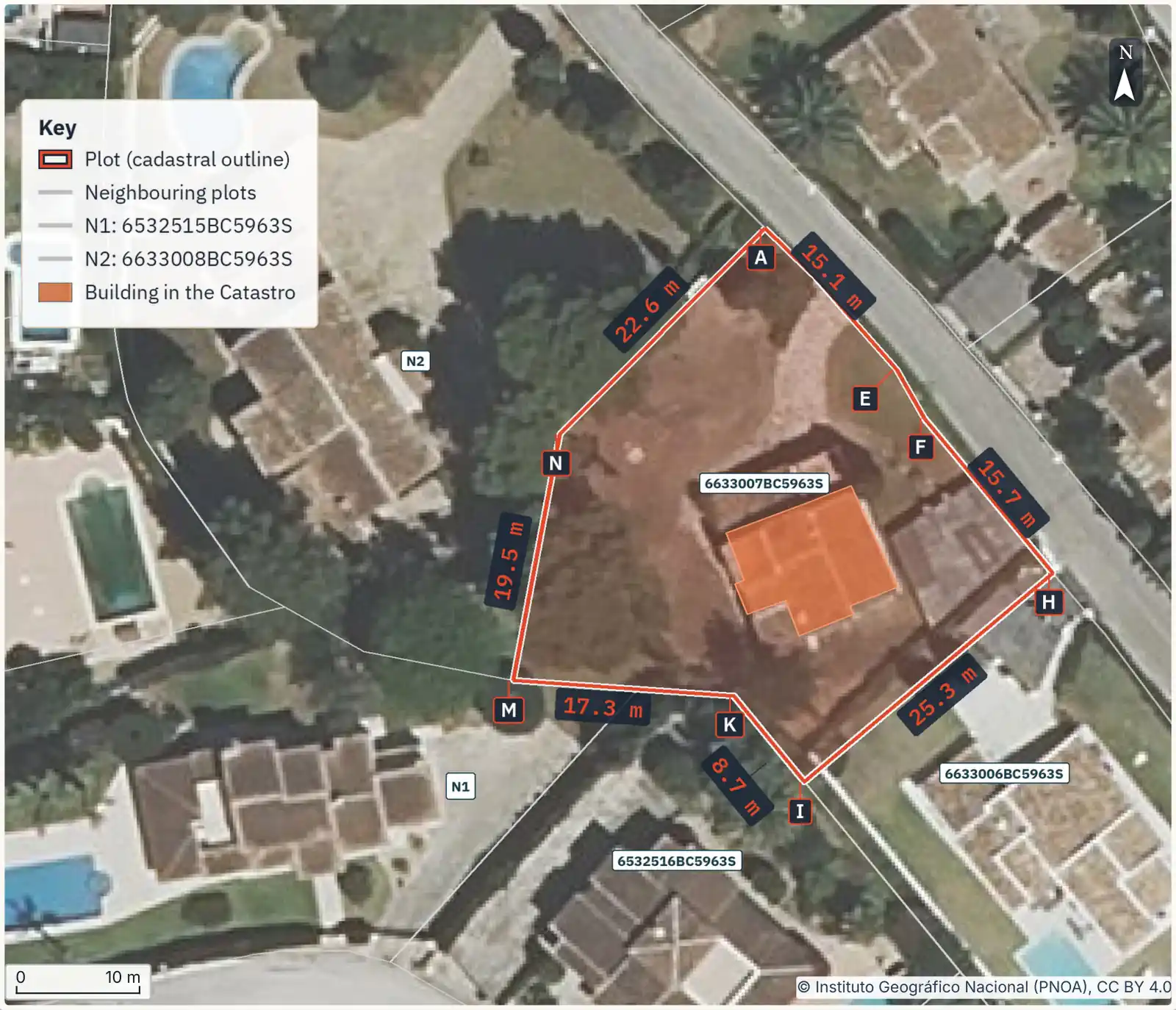

Under Spain’s common IBI regime, the annual charge depends on the assessment base and municipal rate, rather than the purchase price. This guide does not substitute common-regime figures for the separate foral systems of the Basque territories and Navarra.
Learn the fields on the Spanish bill
IBI means Impuesto sobre Bienes Inmuebles, the local property tax. Article 65 of the consolidated local finance law, TRLRHL, makes the valor catastral, or cadastral value, the base imponible. Article 66 defines the base liquidable after the reduction governed by the following provisions, where applicable.
Under article 71, applying the tax rate to the base liquidable produces the cuota íntegra, the gross charge. Deducting applicable statutory bonificaciones produces the cuota líquida, the net charge. Keep those original Spanish labels beside the figures when asking your adviser to explain a bill.
A seller’s statement that “the land tax is about sixty euros” leaves several questions open. Request the full document, identifying the year and property, with its payment status. Where the purchase includes several cadastral properties, ask which bill relates to each one.
Work through a bill rather than the asking price
Consider a hypothetical property with a €12,000 base imponible, a €10,000 base liquidable and an assumed municipal rate of 0.60%. Its gross charge is €10,000 × 0.006 = €60. Assuming no relief and no surcharge, its net charge is also €60.
Multiplying €12,000 by the same rate gives €72, using the wrong base for this particular example. The illustration does not mean every property qualifies for a reduction or that 0.60% applies in your municipality. Replace all the figures with the actual bill and ordinance for the year.
The valor de referencia used in some acquisition-tax contexts is another figure. It is not the purchase price or automatically the base for this calculation. See the cadastral reference value guide when reviewing acquisition taxes, keeping the annual IBI calculation separate.
National provisions and the rate actually adopted
As read in November 2026, TRLRHL article 72.1 gives rustic property a minimum and default rate of 0.30% and an ordinary maximum of 0.90%. Those figures are not a universal floor and ceiling for every situation: paragraphs 3 and 5 provide increases and reduced rates.
For rustic property, paragraph 3 allows percentage-point increases in specified circumstances: 0.06 for a provincial or autonomous-community capital; 0.05 for surface public transport; 0.06 where the municipality provides more services than required by article 26 of Ley 7/1985; and 0.15 where rustic land exceeds 80% of the municipality’s area. Where several circumstances apply, one, some or all increases may be used. Check the ordinance rather than adding them automatically.
Paragraph 5 allows reduced rates for up to six years in municipalities where new rustic and urban cadastral values take effect following a general collective valuation. The rustic rate cannot fall below 0.075% in that arrangement. Paragraph 7 also addresses land transferred between municipal territories: the original municipality’s rate continues unless a different one is adopted. Your calculation needs the rate applicable to the actual property and year.
Match each question to a document
| Question | Useful evidence | Check |
|---|---|---|
| What was charged? | Annual bill or assessment | Reference, bases, rate, relief and charge |
| Which rate applies? | Fiscal ordinance and relevant amendments | Year, rustic category and effective date |
| Where does the value come from? | Owner’s cadastral information or certificate | Correct property, land value and building value |
| Are previous amounts unpaid? | Collecting authority’s debt information | Property and years covered, beyond the latest bill |
| Why are house and land shown separately? | Cadastral description and valuation history | References and applicable transitional rules |
| Is there a surcharge on the dwelling? | Fiscal ordinance and surcharge assessment | Residential use, declared vacancy or holiday letting, and tax year |
For one year’s calculation, property identification, assessment data and ordinance must match. Certificate availability and delivery periods depend on the issuing body. Sources: TRLRHL, articles 65–75; TRLCI, articles 51–52. Accessed 13 November 2026.
Cadastral values are protected information
An individual cadastral value is protected information under article 51 of the cadastral law, TRLCI. Article 52 permits a holder to access information about their property. Before ownership transfers, ask the seller for the documents or have your adviser use a legally available access route. A publicly visible cadastral reference does not disclose every protected tax field.
Retain the ordinance or official publication used, with its date. For comparisons between municipalities, use the same year and examine bases as well as rates. A lower percentage can still produce a higher bill when the assessment base is larger.
A rural house is not classified by the listing
The cadastral law uses its own definitions for properties and land categories. Its first transitional provision also addresses buildings on rustic land that are not indispensable to agricultural, livestock or forestry operations: they retain urban status until the valuation procedure identified in that provision.
This makes blanket answers unhelpful. Do not assume that everything in a rural holding attracts one rustic bill, or that every house must have a separate urban bill. Ask for the current descriptions, cadastral references and valuation history relevant to the documents presented.
If the seller provides two bills, establish whether they cover different properties or different years before adding them up. The guide to cadastral and planning categories explains a further distinction: a tax classification does not confer permission to build or enlarge a home.
Surcharges when the house is a dwelling
Article 72 TRLRHL also lets town halls add surcharges to the net charge of residential properties. They are not another rustic rate: they do not apply to land without a dwelling, and they exist only where the local ordinance adopts them. The €60 example excludes them.
For the 2026 tax year, the wording introduced by Ley 12/2023 applies. It allows up to 50% for a permanently empty home: vacant for more than two years without a recognised reason and owned by someone with four or more residential properties. The surcharge can reach 100% after three years. If the owner also has two or more empty residential properties in the same municipality, the ordinance can add up to 50 percentage points, so the surcharge can reach 150% of the net charge. A second home counts as a justified reason for up to four years of continuous vacancy.
Article 8 of Royal Decree-law 29/2026 changed these rules. In areas declared stressed housing markets, it allows the empty-home surcharge without the four-property condition and adds a surcharge on holiday lets identified under regional rules of up to 50%, 100% or 150%, depending on how many the owner holds. It takes effect for tax periods starting on or after 8 October 2026. As the IBI period is the calendar year, the new rules do not automatically govern the 2026 bill. The surcharge accrues on 31 December and is assessed annually, so ask for that assessment as well as the ordinary bill.
Buying during the tax year
Articles 61 and 63 link taxpayer status to the right giving rise to the tax, following the statutory order of precedence. Where relevant rights such as usufruct exist, ownership alone may not settle who is the taxpayer. Article 75 places accrual on the first day of the calendar year.
The economic allocation between buyer and seller needs to be checked in the contract and under the applicable law. Ask your conveyancer to distinguish liability to the collecting authority from any agreed completion adjustment. Do not assume the authority automatically splits the bill on the date of purchase.
Also request a debt check. Article 64 makes the property security for payment of the tax charge through subsidiary liability on the terms of the general tax law. Evidence that the latest bill was paid does not establish the position for every previous year.
Arrange payment from abroad
The annual accrual date is not a nationwide collection date. Ask the town hall or collecting body for the current calendar and direct-debit arrangements, and confirm which bill a new instruction will first cover.
Relief shown on a seller’s bill also requires investigation. Establish its legal basis and whether its conditions continue for you. Do not carry a seller-specific reduction into a long-term ownership budget without that check.
The separate guide to annual property taxes and costs covers the wider budget. Keeping the rustic IBI calculation separate makes it easier to see whether a quoted amount includes additional properties or unrelated local charges.
Same assessment base, different assumed rates
Two illustrative bills each have a €10,000 base liquidable. At 0.30% the gross charge would be €30; at 0.60% it would be €60. Before deciding that one holding costs twice as much, the buyer checks the year, whether all properties are included and whether relief alters the comparison.
A purchase-file sequence
- Collect the bills. Ask the seller for the current year and the earlier records your adviser needs. Agree a delivery date; there is no national statutory period for preparing this private advice file.
- Verify the bases. Use the owner’s cadastral information, including buildings. Online access depends on the service; check the service conditions and period for any certificate or correction needed.
- Find the ordinance. Use the town hall, electronic office or official gazette for the relevant year. Reading an available publication online differs from obtaining an individual certificate.
- Check debt and collection dates. Ask the collecting authority about the property and years covered. Obtain its service period and review the answer before treating the matter as resolved.
- Document the completion adjustment. Have your adviser and notary review taxpayer status, payments and any agreed allocation before signing. The delivery time depends on outstanding evidence.
A calculation is not a clearance certificate Correct arithmetic estimates a charge under stated assumptions. It does not establish that the seller has paid outstanding amounts or declared every building. Those checks require their own evidence.
- Tax year and reference for every property.
- Base imponible and base liquidable identified separately.
- Applicable municipal rate and official source.
- Relief verified for the relevant taxpayer.
- Surcharges on empty or holiday-let homes checked in the ordinance.
- Debt position, collection calendar and sale adjustment reviewed.
You can order the plot report to organise the territorial purchase review, then complete the tax file with the seller’s bills and the relevant certificates.
Common questions
Is rustic IBI charged on the purchase price?
No. In the common regime, the gross charge applies the rate to the base liquidable, while the taxable base starts from the cadastral value.
Is 0.90% an absolute maximum?
No. It is the ordinary article 72.1 maximum before paragraph 3 increases. Paragraph 5 permits conditional reduced rates; the ordinance and other applicable provisions must be checked.
Will a house on rural land always have a separate urban bill?
That cannot be established without checking its description, references and valuation, including the cadastral law’s transitional rules.
Does a paid latest bill prove there are no arrears?
It does not check every earlier year. Ask the collecting authority for debt information relating to the property being purchased.
Keep reading
Check this on your own plot
Pin the plot on the map and confirm the cadastral reference: the report gathers the public data and official maps for it, each with its source and date. It does not replace the land registry extract, the notary or a tax adviser. €29 VAT included.