Pillar: Documents and contract
Is a “rústica” cadastral plot rustic land for planning purposes?
On this page
Not necessarily. “Rústica” or “urbana” in the Catastro, Spain's property survey and tax register, is a tax class set by the Catastro Act (TRLCI, article 7) that decides how the IBI property tax is charged. Whether you may build is decided by the town plan. Development land with a detailed plan is already urban for the Catastro; without one it stays rustic unless another case in article 7.2 applies.
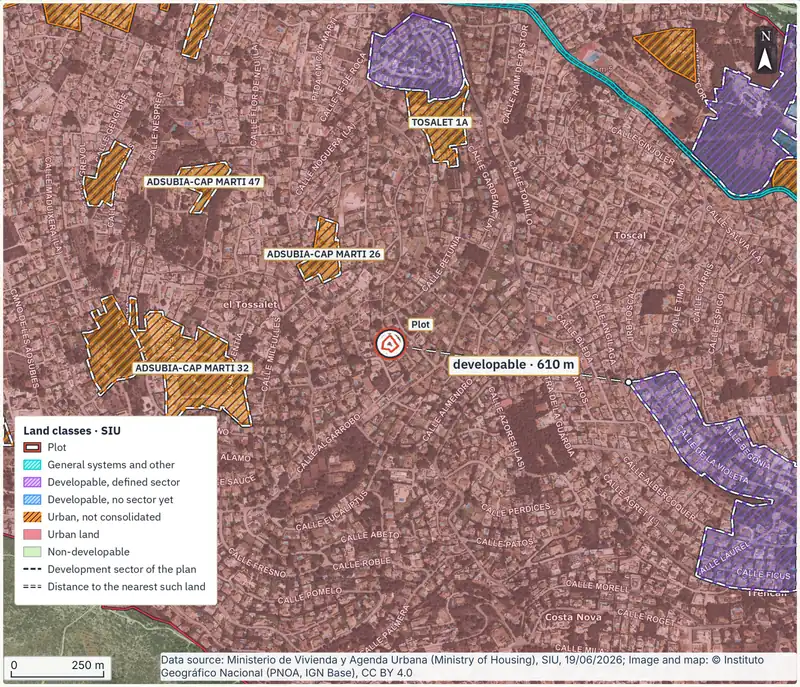
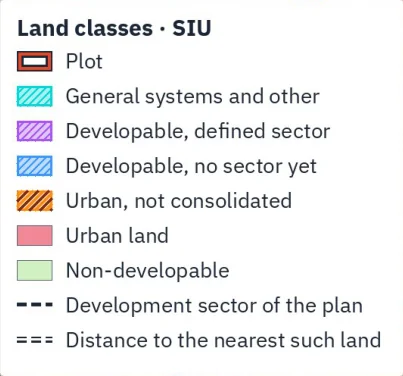

An IBI bill that says “rústica” does not prove the plan protects the land, and one that says “urbana” gives you no right to build. They are two readings of the same plot made under different laws, and a foreign buyer should check both before signing anything.
What each planning class allows is covered in the guide to rustic, urban and developable land; here we deal only with how the Catastro differs.
To calculate the charge, compare the bases and rate with the rustic IBI example.
What the cadastral class is
The Catastro is an administrative register run by the Ministry of Finance that describes rustic, urban and special-category property (TRLCI, art. 1.1). Whether a property is urban or rustic depends on the nature of its land (art. 7.1). The local property tax then follows that class: for IBI purposes, rustic and urban property is whatever the Catastro rules define as such (TRLRHL, art. 61.3).
Cadastral data are presumed correct unless proved otherwise, but the legal findings of the Land Registry (“Registro de la Propiedad”) prevail (TRLCI, art. 3.3). Neither is a building permit or a planning report.
In the Basque Country and Navarre the Catastro Act applies subject to their own regional (“foral”) systems (art. 1.2): each territory keeps its own register, as the guide to the Basque foral cadastres explains.
When the Catastro treats land as urban
Article 7.2 of the TRLCI lists six cases. Any one of them makes the land urban:
| Case | What the Act requires | Same as the plan? |
|---|---|---|
| a) Urban land in the plan | Classified or defined by the plan as urban, urbanised or equivalent | Yes, by definition |
| b) Development land with a detailed plan | “Urbanizable” land inside a defined sector or area, with detailed planning approved | No: the plan calls it “urbanizable” |
| c) Part of a settlement’s fabric | Effectively integrated into the services and facilities of a settlement | Not always |
| d) Isolated settlements | Occupied by villages or settlements apart from the main one, however scattered | Not always |
| e) Land with services | With the urban services the planning law requires or, failing that, road access, water, drainage and electricity | Not always |
| f) Consolidated by buildings | In the way and with the features the planning law sets | Not always |
| Rustic | Land in none of the above and not part of special-category property | May be rustic or “urbanizable” in the plan |
TRLCI, art. 7.2 and 7.3, BOE consolidated text (last update published 24.12.2022). Land forming part of special-category property (dams, toll motorways, power plants, art. 8) is neither urban nor rustic. Source: TRLCI (BOE, consolidated text). Accessed 12 November 2026.
Where the two readings part company
Development land without a detailed plan. Without detailed planning, and unless another case in article 7.2 applies, the plot stays rustic in the Catastro, but its land is valued from modules based on location (TRLCI, DT 2ª.2), and once a plan creates that kind of sector the Catastro may revalue the rustic plots affected through the simplified procedure (art. 30.2.h).
Development land with a detailed plan. It is already urban for the Catastro (art. 7.2.b) and pays urban IBI, even if the land readjustment (“reparcelación”) and infrastructure works are still to come. What the buyer may have to pay towards them is explained in the guide to buying development land.
A house on rustic land. The Catastro counts as a building anything permanently fixed to the ground, even if it could be moved or taken apart (art. 7.4.a). A house on a rustic plot makes a rustic property with a building, valued under DT 1ª.1. In municipalities where no general collective revaluation has taken place since 1 January 2006, buildings on rustic land that are not essential to a farming, livestock or forestry holding keep urban status (DT 1ª.1). Neither outcome makes the house legal: if it is old, read the guide to declaring an old building.
The wrong crop. The rustic record says scrubland and there is an olive grove, or the other way round. Crop changes must be declared (TRLCI, art. 16.2.b), and the Ministry of Agriculture passes on to the Catastro the changes it learns of through EU farm subsidy (CAP) applications (art. 14.1.e).
What a rustic record shows
Anyone can search the Catastro’s website (“Sede Electrónica del Catastro”) for a plot’s reference, area, use and crop; the owner and the value are protected data (Catastro FAQs). On 12 November 2026 we queried the Catastro’s official lookup service for polygon 1, parcel 1 in Orgaz (Toledo):
Orgaz (Toledo), polygon 1, parcel 1 (Villaverde area)
Class “RU” (rustic), reference 45125A001000010000WQ, use “Agrario” (agricultural), 2,156 m² of land in a single sub-parcel of pasture (“pastos”). The answer says nothing about the planning class: for that you need the Orgaz plan or the SIU.
The “RU” or “UR” code is the cadastral class; the crop type feeds into the value (TRLCI, art. 12.3). Neither field tells you what the plan allows. To find a plot by polygon and parcel number, follow the guide to finding rustic land in the Catastro.
What it means if you want to build
Nothing. The town plan and your region’s planning law decide the land class and what it allows; the town hall applies them when it grants or refuses a building licence. Check the planning class on your region’s viewer or the Ministry’s SIU viewer, and ask the town hall for a written planning report or certificate before you pay a deposit. What each class allows you to build is in the guide what you can build on a plot.
What it means for tax
IBI. The cadastral class decides which rate band applies. What follows is the common regime: in the Basque Country and Navarre local taxes follow their own foral rules (TRLRHL, art. 1.2). Article 72.1 sets the general limits and the town hall sets the exact rate in its tax bylaw. There are two ways outside those limits: the increases in article 72.3 and, in municipalities where new values from a general collective revaluation come into force, reduced rates for up to six years, not below 0.1% for urban or 0.075% for rustic property (art. 72.5).
The tax due is the assessed base (“base liquidable”) times the rate (TRLRHL, art. 71.1), and that base is the cadastral value less the statutory reduction, where it applies (arts. 65 and 66).
One plot, before and after it becomes urban
A plot has an assessed base of €4,000 as rustic land. At the minimum rustic rate (0.3%) the owner pays €12 a year. Once its sector’s detailed plan is approved it becomes urban; assume a new base of €80,000. At the minimum urban rate (0.4%) the bill is €320. The example assumes the municipality does not apply reduced rates under article 72.5; your municipality’s rates may be higher or, in that case, lower.
Plusvalía (municipal land value tax). Gains on land that is rustic for IBI purposes are not taxed, but gains on land that should count as urban for IBI are, whether or not the Catastro lists it as urban (TRLRHL, art. 104.2). How that tax is worked out and when it is paid is in the guide to municipal plusvalía on rustic land.
How to correct the record
Form 900D does not change the class A change of class is not one of the events an owner declares (TRLCI, art. 16.2). When the plan changes, the Catastro itself makes the change through a collective revaluation, taking effect on the 1 January set by articles 29.5 and 30.3. Values notified in a general or partial revaluation can be challenged by an appeal for reconsideration (“recurso de reposición”) or a claim to the economic-administrative tribunal within one month from the day after notification (art. 29.7). If you think the class is wrong, tell the Catastro and attach the planning report (correction of discrepancies, art. 18.1).
The owner does declare buildings, demolitions, changes of use or crop, plot splits and the purchase (TRLCI, art. 16.2). The form is 900D (Orden HAC/1293/2018, art. 1), with the papers each case needs: for a crop change, a document proving the change and its date and, if it affects only part of the plot, a plan drawn on the cadastral map (art. 4.7).
If the mistake is the Catastro’s and not a missing declaration, the Catastro may open a correction of discrepancies of its own motion, with 15 days for comments and six months to decide (TRLCI, art. 18.1). The area and shape can also be corrected before the notary when the deed is signed (art. 18.2).
What to do, step by step
- Read the cadastral record. Catastro website, free search by reference or by polygon and parcel. Note the class, use, crops and buildings. No fee (TRLCI, art. 62.2); a few minutes.
- Read the planning class. The Ministry’s SIU viewer or your region’s planning viewer, online. Takes a few minutes.
- Ask the town hall for a planning report, giving the cadastral reference and a plan of the plot. Fee and response time are those of your town hall and region; ask when you apply. A Spanish-speaking lawyer or “gestor” can file it for you under a power of attorney.
- Ask the seller for the last IBI bill and compare its class with the record. One day.
- Get the certified cadastral description and map (“certificación catastral descriptiva y gráfica”) if the deed needs it: free on the Catastro website (TRLCI, art. 62.2) and €17.97 at a Catastro office (fees in force in November 2026). Online it is issued at once.
- After buying, declare what is missing (house, crop, use) on form 900D within two months from the day after the event; for the purchase itself there is no need if the notary or the Land Registry has already passed it on to the Catastro (Catastro FAQs).
- You know the cadastral class (RU or UR) and the plan’s class and category, and why they differ.
- The town hall has told you in writing what the plan allows on that plot.
- The buildings on the land appear in the Catastro, or you know you will have to declare them.
- You know last year’s IBI and the rate in that town hall’s bylaw.
- If the sector is “urbanizable”, you know whether its detailed plan is approved.
If the tax bill and the plan seem to disagree, you can order the plot report by its cadastral reference and take both readings to the town hall.
Common questions
My IBI bill says urban. Can I build a house?
Not on that basis. The Catastro’s urban class may come from the plan, but also from the services on the land or from an isolated settlement (TRLCI, art. 7.2). What you may build is set by the plan, and the town hall should confirm it in writing.
Why do I pay urban IBI if the plan says “urbanizable”?
Because the Catastro treats as urban any development land inside a sector whose detailed plan is approved (TRLCI, art. 7.2.b). If the sector has no detailed plan yet, the plot stays rustic unless another case in article 7.2 applies (for example, it already has urban services).
I own a house on rustic land. Is it taxed as rustic or urban?
The property is rustic with a building, and the land it occupies and the house are valued under DT 1ª of the TRLCI. In municipalities with no general collective revaluation since 1 January 2006, a building not essential to farming keeps urban status. Being in the Catastro does not make the house legal.
Can I ask for my plot to be changed from urban to rustic?
Form 900D cannot do that: a change of class is not one of the events you declare (TRLCI, art. 16.2). The Catastro makes it in a collective revaluation (arts. 29 and 30), and if you think there is a mistake you can tell it, so that it opens a correction of discrepancies of its own motion (art. 18.1). Buildings, demolitions and crop changes are declared on form 900D.
How long do I have to declare a change to the Catastro?
Two months from the day after the event: completion of the works, the authorisation of a change of use or the date of the deed (RD 417/2006, art. 28.2).
Keep reading
Check this on your own plot
Pin the plot on the map and confirm the cadastral reference: the report gathers the public data and official maps for it, each with its source and date. It does not replace the land registry extract, the notary or a tax adviser. €29 VAT included.