Pillar: Planning and buildings
What does Balearic law allow on rustic land?
On this page
In the Balearic Islands, a new house on ordinary rustic land ("suelo rústico común") needs a plot of at least 14,000 m², or the larger figure the town plan sets (Law 6/1997, article 25.2). In protected natural areas (ANEI and AANP) and in the territorial protection strips, the regional planning guidelines ban it, and in areas of agricultural interest (AIA) they allow it only as part of a farm holding. Island and town plans can be stricter.
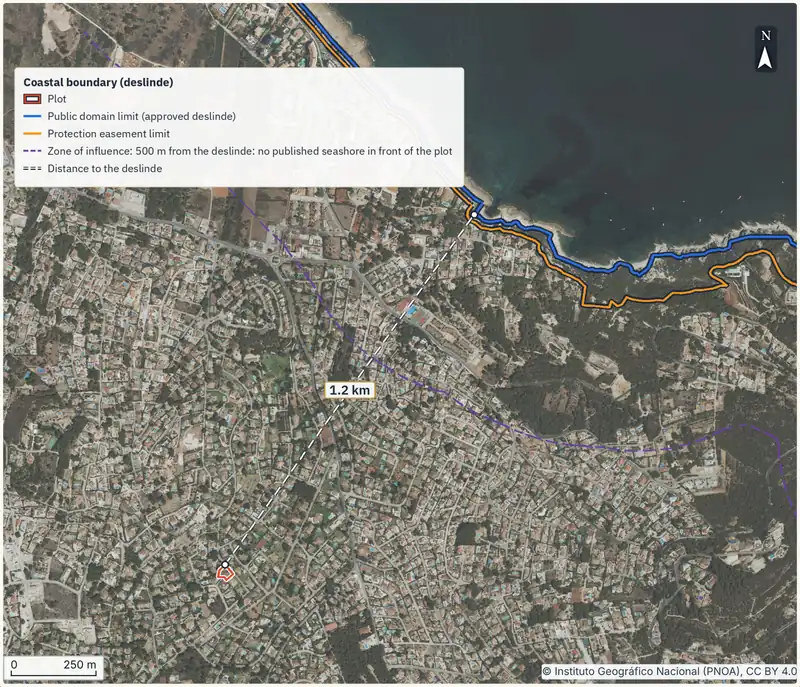

Balearic rules come in four layers. Law 6/1997 on rustic land sets the minimums, Law 6/1999 on the Territorial Planning Guidelines ("Directrices de Ordenación Territorial", DOT) sets the land categories and a matrix of permitted uses, each island's territorial plan fills in the exceptions, and the town's general plan gives the final figure. What applies across Spain is in what you can do on rustic land.
The DOT land categories
Rustic land ("suelo rústico") is either protected or ordinary ("común"). Protected land is land that, for its exceptional values, its territorial role or the defence of wildlife, plants and ecological balance, has "un régimen especial de protección", a special protection regime (Law 6/1997, article 6.1). Common land is "el resto", everything else classed as rustic (article 7).
The DOT names the areas in each group (articles 19 and 20), and its annex I says which uses each one allows. The matrix is a minimum level of protection: island and town plans can add to it, never lower it.
| Area | Group | What it is | New house in the matrix |
|---|---|---|---|
| AANP | Protected | Natural area of special interest with a high protection level | 3: prohibited |
| ANEI | Protected | Natural area of special interest (Law 1/1991) | 3: prohibited |
| ARIP | Protected | Rural area of landscape interest (Law 1/1991) | 2-3: prohibited, save the island plan's exceptions |
| APR | Protected | Area at risk of flooding, wildfire, erosion or landslides | 2-3: prohibited, save the island plan's exceptions |
| APT | Protected | Coastal and road protection strips | 3: prohibited |
| AIA | Ordinary | Area of agricultural interest | 2: conditional, and only a house attached to a working farm (specific rule 4) |
| AT | Ordinary | Transition belt next to urban land | 2: conditional |
| SRG | Ordinary | General-regime rustic land | 2: conditional |
Values from the 'Vivienda unifamiliar aislada' (detached single-family house) column of the annex I matrix. 'Conditional' means: as the island's territorial plan sets out. In high-value farming zones, including AIAs, a house can only be authorised if attached to a working farm (specific rule 4). Source: Law 6/1999, articles 19 and 20 and annex I, consolidated text. Accessed 12 November 2026.
For 2-3 areas, the DOT adds that a house counts as a conditional use until the island's territorial plan sets out its exceptions. The answer therefore depends on the island and on how up to date its plan is.
Minimum plot: 14,000 m² as a floor
Article 25.2 of Law 6/1997 allows a single house per plot, with the area the town's general plan sets, which on ordinary rustic land "deberá ser superior o igual a 14.000 metros cuadrados" (must be 14,000 m² or more). The town plan can raise it (article 25.4).
On protected rustic land, the town plan sets the area, which must match or exceed the ordinary-land figure (article 25.3). If a plot straddles zones with different minimums, a proportional rule applies (article 25.5). In an APR, the minimum plot for a new house is that of the underlying rustic category or, if that is not known, the most restrictive neighbouring one (DOT, annex I, specific rule 1).
What each island adds Each island has its own territorial plan (Mallorca, Menorca, Ibiza; Formentera has its Subsidiary Planning Rules), and each town its general plan. They can raise the minimum plot or ban more uses, never lower what this guide sets out. Your plot's figure comes from the planning certificate in step 2.
How much you can build on each island
Law 6/1997 caps what any town plan may allow (article 28). It is one of the few rules the Act itself sets island by island.
Floor area cannot exceed 3% of the plot in Mallorca and Menorca, or 4% in Ibiza and Formentera. The share of the plot covered by the building and other built elements must stay below 4% in Mallorca and Menorca and below 5% in Ibiza and Formentera. On every island a building has at most two storeys and eight metres from ground floor to the top of the roof, and no more than 1,500 m³.
Two plots of 14,000 m²
In Mallorca, the floor-area cap is 14,000 × 3% = 420 m², and coverage must stay below 14,000 × 4% = 560 m². In Ibiza, the same plot would allow at most 560 m² of floor area and coverage below 700 m². These are legal ceilings: the town plan, the island plan or the land category can bring the figure down, even to zero. In an AIA, the house is also allowed only if attached to a working farm.
The pool: one per property
Since Decree-law 10/2022, the Balearic planning Act says that the use of rustic land for a single-family house "no puede dar lugar a la construcción de más de una piscina por finca", that is, cannot lead to more than one pool per property (Law 12/2017, article 68 bis). New pools may have a water surface of no more than 35 m² and a volume of no more than 60 m³. The same article requires building projects on rustic land to collect rainwater from roofs, except those tied to farm holdings.
Risks: flooding, wildfire and the coast
In flood-risk prevention areas (APR), no new detached houses may be placed until the water authority has mapped the flood zones and the preferential flow zones (Law 6/1997, eighth additional provision, paragraph 1). Once mapped, they remain banned in the preferential flow zone, and elsewhere in the flood zone they are only allowed if they meet article 14 bis of the Public Water Domain Regulation. Until the mapping is done, if only part of the plot lies in the APR, the house can be authorised on the part outside it, in line with the plans (paragraph 2).
In wildfire APRs, a house must have safe access for people and vehicles, a water tank for a first emergency and vegetation work within a 30-metre radius (DOT, annex I). The coastal territorial protection area is a 500-metre strip in Mallorca, Menorca and Ibiza and a 100-metre strip in Formentera, measured from the inner edge of the shore (DOT, article 19.1.e.1). Spain's national coastal easements are covered in the Coastal Law.
Caravans and mobile homes
Outside zones the general plan expressly allows for them, rustic-land planning bans caravans and other mobile units that can be lived in (Law 6/1997, sixth additional provision). A prefabricated house is no shortcut: see prefab houses on rustic land.
Who enforces and the time limits for action
On protected rustic land in AANP, ANEI, ARIP and coastal APT areas, planning enforcement belongs to each island's council ("consell insular"), including inspection and restoring legality (Law 12/2017, article 166.3). On other rustic land, the island council steps into the town hall's powers under the rules of article 166.4.
For illegal works, restoration proceedings can only start while works are under way or within eight years of their full completion (article 196.1); whoever claims a completion date has to prove it (article 196.3). There is no time limit for illegal acts or uses on land that was classed as protected rustic land when they were carried out, or for those affecting the assets and spaces in article 196.2.b. An unlicensed use or change of use is ongoing: the period runs from when it stops (article 196.4). If the works had a licence that is later annulled, the period runs from the annulment (article 196.5). The deadline passing does not make the works lawful. The detail is in illegal houses on rustic land and planning prescription periods.
A real reading in Ibiza
The regional government publishes the Ibiza island-plan layers and the Law 1/1991 areas on IDEIB, the Balearic Islands' spatial data infrastructure. This is how they answer at a point next to the village of Sant Joan de Labritja.
With 'ANEI', the DOT matrix lists a new house as '3. Prohibido', and enforcement lies with the Consell d'Eivissa. The viewer does not replace the town hall's certificate: the line between two categories can run through the plot.
What to do, in order
- Check the category in the IDEIB viewer (ideib.caib.es): free, a few minutes. Note the area (ANEI, ARIP, SRG…) and the plan it comes from.
- Ask the town hall for a planning certificate ("cédula" or "informe urbanístico") stating the category, the minimum plot, the floor-area limit and whether the plot is in an APR. The fee is set by the town's tax bylaw. Time: Law 12/2017 sets no deadline for this certificate; ask at the municipal registry when you file. More in planning certificate.
- Order the nota simple (Land Registry extract) to see the owner, charges and any planning case noted on the property. Price and timing in nota simple.
- If there is already a house or pool, ask the seller for the licence and the completion certificate, and check each structure's date and that it matches what was licensed. The 35 m² and 60 m³ limit in article 68 bis applies to new pools; an older pool is judged by its licence and the rules in force when it was built. If papers are missing, have a surveyor date the works before the deed. Time: no rule sets a deadline; get the surveyor's quote and timescale in writing.
- If you are buying to build, have an architect check the general-plan and island-plan figures, then pay the deposit ("arras"). Time: no rule sets a deadline; agree the study's timescale and fee with the architect in writing.
What this guide does not settle. It does not give the minimum plot of each island plan or each town plan, which can be larger than 14,000 m². Nor does it cover existing houses, extensions or activities declared of general interest by the island council (Law 6/1997, article 26), which have their own rules.
- You have the rustic-land area (ANEI, ARIP, APR, APT, AIA, AT or SRG) and the plan that sets it, in writing.
- If you want a new house: the area is not AANP, ANEI or APT, the plot reaches the general plan's minimum and, in an AIA, the house is attached to a working farm.
- You have worked out the floor area with 3% (Mallorca, Menorca) or 4% (Ibiza, Formentera) and the town plan's own limit.
- The plot is not in a flood APR, or the house fits outside it.
- The nota simple shows no planning case noted on the property.
Once you have chosen a property, you can order the report by its cadastral reference and take the report and its maps to the town hall.
Common questions
What is the minimum plot for building a house on rustic land in Mallorca?
Law 6/1997 requires at least 14,000 m² on ordinary rustic land, with only one house per plot (article 25.2), and lets the town plan set more (article 25.4). On protected rustic land the town plan sets an equal or larger area (article 25.3). The exact figure is in the town's general plan and the Territorial Plan of Mallorca.
Can I build a house in an ANEI area?
The matrix of Law 6/1999 lists a detached house as '3. Prohibido' in ANEI areas, as in AANP and APT areas. It is a floor that plans cannot lower. Existing houses and works on them follow other rules set by the plan.
How big can the pool be?
One per property linked to a single-family house, with a water surface of up to 35 m² and a volume of up to 60 m³ for new pools (Law 12/2017, article 68 bis).
How many square metres can I build on a rustic plot in Ibiza?
At most 4% of the plot as floor area, with coverage below 5% (Law 6/1997, article 28); in Mallorca and Menorca, 3% and below 4%. On every island, two storeys, eight metres and 1,500 m³ per building. The town plan can set less.
Is there a time limit on action against an illegal house in the Balearics?
For completed works, the authority can start restoration proceedings while works are under way and within eight years of full completion; whoever claims the date has to prove it (Law 12/2017, article 196.1 and 196.3). There is no limit if the land was protected rustic land when the works were done, or in the cases of article 196.2.b; unlicensed uses and annulled licences have their own count (article 196.4 and 196.5). Once the period has passed, the house is still not lawful.
Keep reading
Check this on your own plot
Pin the plot on the map and confirm the cadastral reference: the report gathers the public data and official maps for it, each with its source and date. It does not replace the land registry extract, the notary or a tax adviser. €29 VAT included.